
Security Dogma is reader-supported. When you buy through links on this page, we may earn a commission at no extra cost to you. As an Amazon Associate I earn from qualifying purchases. Learn more
Quick answer
Both are security jobs at sea, but they’re very different jobs:
- Maritime security means armed anti-piracy work on merchant ships. It pays a day rate (published ranges run from about $450 to $1,500 a day, more for team leaders), but only for days you’re deployed, usually as a contractor. Almost every listing wants combat arms or special operations military experience.
- Cruise ship security means unarmed access control, screening, patrols and incident response on a passenger ship. It pays a monthly salary (about $1,600 a month for a guard to about $3,900 for a security officer in published listings) with your cabin, meals and usually flights covered. One to four years of military, police or private security experience can get you in.
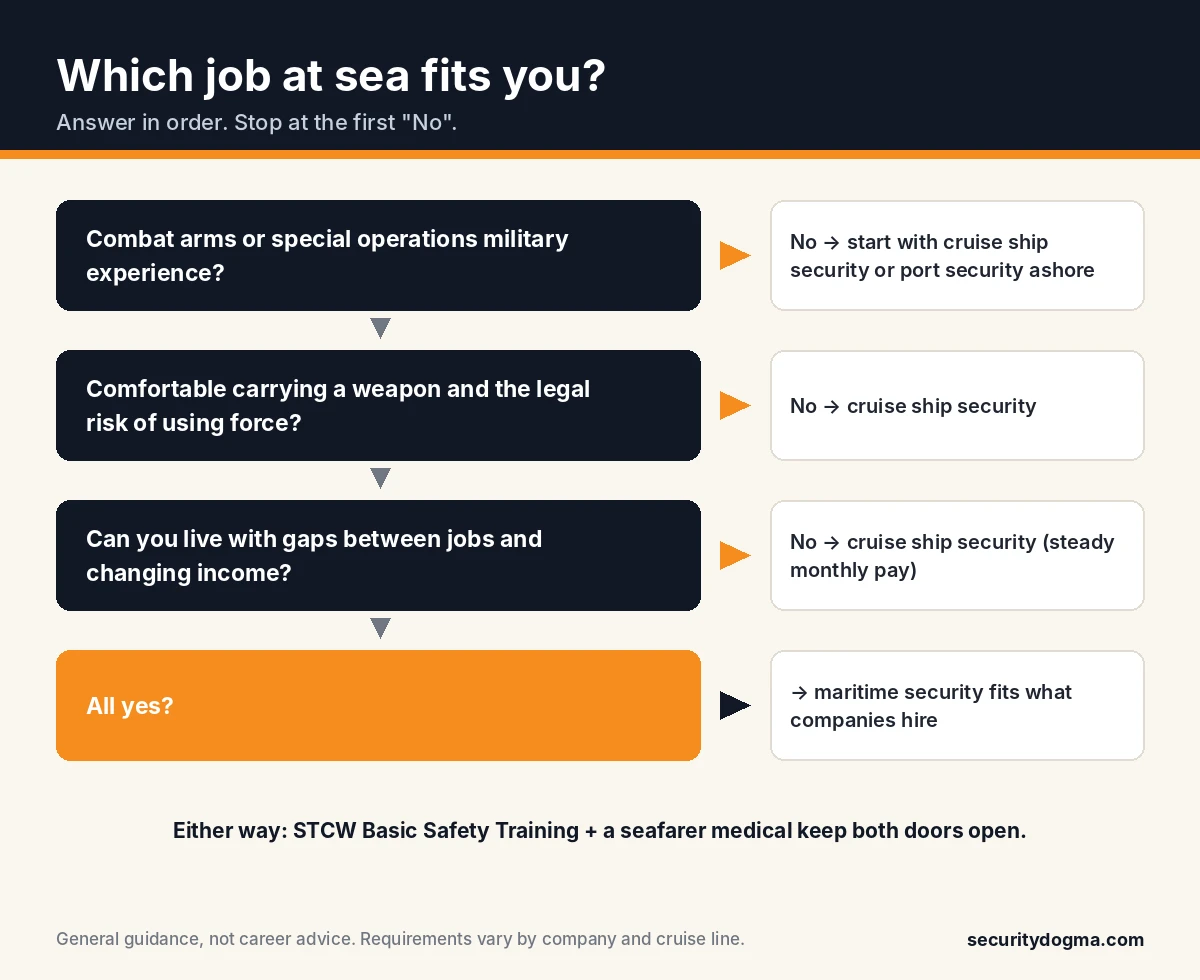
Short version: if you’re a combat veteran who wants high pay for short, intense deployments and can live with irregular work, look at maritime. If you’re a civilian guard, hotel or police officer who wants a steady contract, travel and the chance to save, start with cruise.
Free printable: Security Jobs at Sea: Self-Check and Document Checklist (PDF)
Prefer to watch? This video goes round by round through the job, the pay, the schedule, who gets hired and the risks, in about eight minutes.
This video is hosted by YouTube (Google). Loading it shares your IP address with Google and may set cookies. See our Privacy Policy.
This video was made with AI tools and is based on published job listings and industry sources from our career guides. Scenes are illustrations, not real events. The figures come from published listings, not from the author’s own work at sea.
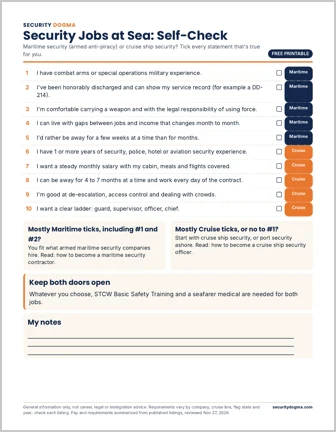
Security Jobs at Sea: Self-Check & Document Checklist
A 10-question check to see which job fits you, plus the documents and certificates each one asks for. Two pages, no email needed.
⬇ Download the checklist (PDF)The two jobs in one minute
Maritime security contractor (PCASP). You’re part of a small armed team, usually at least four guards with one experienced leader, put on a merchant ship by a private maritime security company for its passage through high-risk waters, such as the Gulf of Aden, the Indian Ocean or the Gulf of Guinea. You advise the ship’s Master, harden the ship, stand long lookout watches and, if pirates approach, follow the agreed rules for the use of force. The Master keeps overriding authority. When the ship is through the high-risk area, you get off. Full guide: Maritime security jobs.
Cruise ship security guard or officer. You’re a member of the ship’s own security department, under a Chief Security Officer who reports to the Staff Captain. You run the gangway, screen people and bags, patrol guest and crew areas, handle drunk guests, fights, thefts and missing children, write the reports and support the crew in emergencies, every day of a contract that lasts months. Full guide: Cruise ship security.
The first job protects a ship from the outside. The second keeps order among thousands of people inside one.
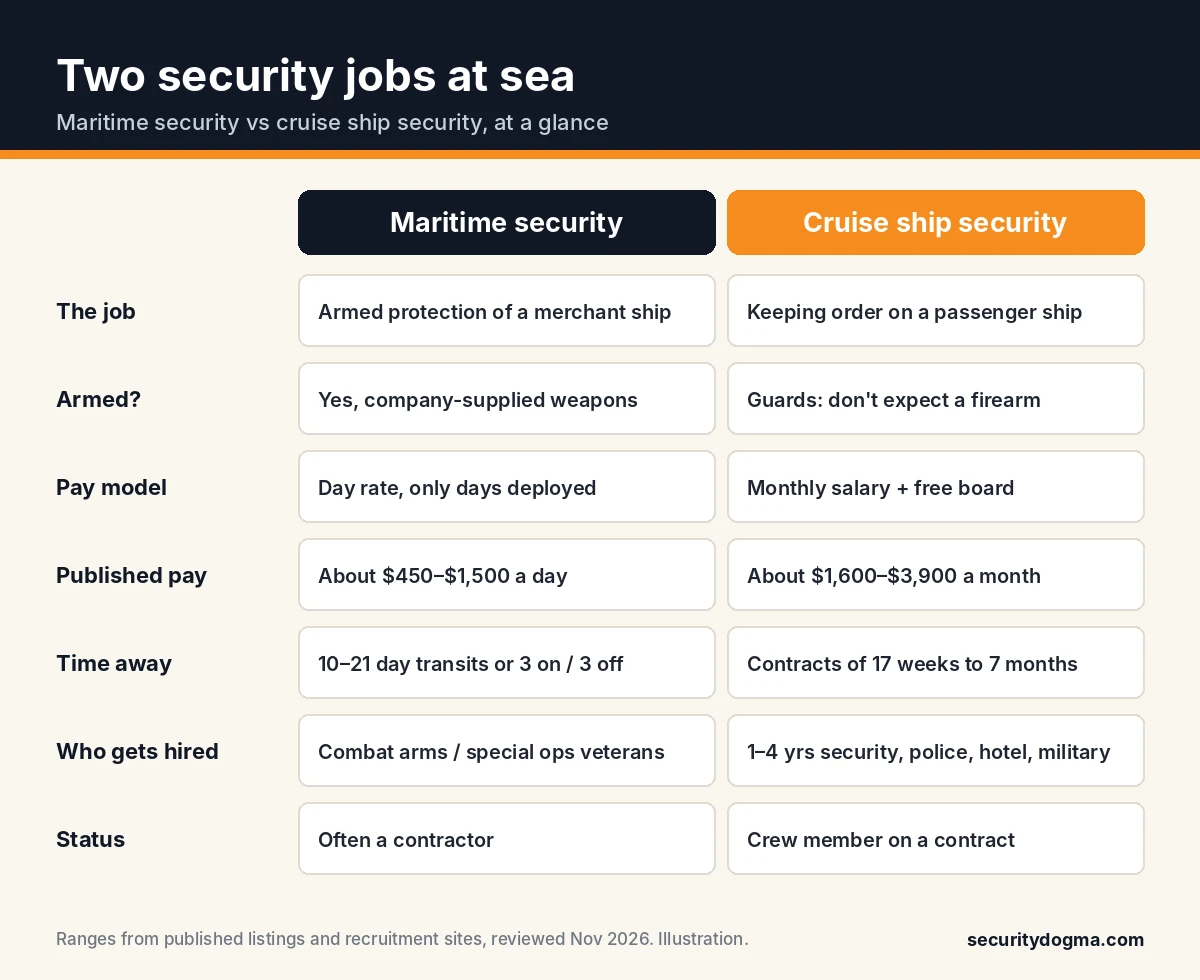
Side by side
| Maritime security (armed anti-piracy) | Cruise ship security | |
|---|---|---|
| Who you work for | A private maritime security company (PMSC), hired by the ship owner | The cruise line, or a ship manager or crewing agency on its behalf |
| Employment status | Often a contractor; check each contract | Crew member on a fixed-term contract |
| Armed? | Yes. Company-supplied weapons under the flag state’s authorization | Guards should not expect to carry a firearm; weapons arrangements vary by line and aren’t public |
| How you’re paid | Day rate, for days deployed | Monthly salary |
| Published pay | About $450–$800 a day for standard transits; $800–$1,500 in the Gulf of Guinea; team leaders up to about $2,000 | About $1,600 a month (guard) to $3,800–$3,900 a month (security officer) |
| What’s covered | Varies; some listings cover flights, lodging and meals, many don’t say | Cabin, meals and usually flights |
| Length of work | Transits of about 10–21 days, or fixed rotations like 3 weeks on, 3 off | Contracts of about 17 weeks to 7 months |
| Hours | Long watches; listings show 12-hour shifts, 7 days a week | No weekends; maritime rules cap work at 14 hours in 24 and 72 in 7 days |
| Time off | Between transits or rotations, usually unpaid | A few months between contracts, usually unpaid |
| Typical background | Combat arms or special operations military; amphibious or maritime experience preferred | 1–4 years military, police, private, aviation or hotel security |
| Core certificates | STCW Basic Safety Training, seafarer medical, trauma first aid, weapons competence | STCW Basic Safety Training, seafarer medical, STCW security training (usually Designated Security Duties) |
| Living conditions | Working merchant ship, small team, basic quarters | Shared crew cabin, crew mess, a ship of thousands |
| Main risk | Piracy, use-of-force decisions, legal exposure | Violent or drunk guests, fatigue, incidents among thousands of people |
| Job stability | Rises and falls with piracy and what ship owners will pay | Steadier; cruise lines hire every season |
| Career ladder | Team member → team leader → ship or company security officer, consulting | Guard → supervisor → security officer → deputy chief → Chief Security Officer |
| Best for | Combat veterans who want high pay for short, intense stints | Civilian and hotel security, police and veterans who want steady contracts, travel and savings |
Sources for every row are listed at the end. Pay figures are from published listings and recruitment sites, dated in the sources; treat them as a guide.
Which pays more?
On paper, maritime wins by a mile: one deployed day can pay what a cruise guard earns in a week or more. But you’re comparing two different pay models:
- Maritime is paid per deployed day. No deployment, no pay. You also usually cover more of your own costs: certificates, medicals, insurance and sometimes travel to the joining port. Contractor roles often come with no paid leave, pension or health cover.
- Cruise is paid per month, with board included. The ship gives you a cabin, meals and usually your flights, so you spend almost nothing while you’re on a contract. That’s why crew on modest pay can save most of it.
So the real question is how many days you’ll actually work, and what you keep after costs.
Illustrative scenario: not a report of a real event. The figures below are hypothetical assumptions built from the published ranges above. They aren’t observed earnings or promises, and they’re before tax:
| Scenario | How it’s worked out | Gross for the year | What it doesn’t show |
|---|---|---|---|
| Cruise security guard | 8 months on contract × $1,600 | $12,800 | Rent, food and usually flights are covered while on board |
| Cruise security officer | 8 months × $3,850 | $30,800 | Same; officer roles need leadership and shipboard experience |
| New maritime contractor, occasional transits | 60 days × $500 | $30,000 | You pay more of your own costs; gaps between jobs are unpaid |
| Maritime contractor on a 3-on, 3-off rotation | about 180 days × $500 | about $90,000 | Depends on staying on the rotation; benefits often not included |
The honest answer: an experienced maritime contractor with steady work earns far more than most cruise security staff. A new contractor waiting for work can earn less than a cruise officer, with more risk and less security. For the full breakdowns, see maritime security contractor salary and cruise ship security pay and life onboard.
Which one can you actually get?
This is where most people’s decision gets made for them.
| Your background | Maritime security (armed) | Cruise ship security |
|---|---|---|
| New to security | No | Not yet: get 1–2 years of security experience first |
| Civilian security guard (1+ years) | Very unlikely for armed anti-piracy work. Port security ashore is a realistic way in | Yes: access control, screening and de-escalation are exactly what listings ask for |
| Hotel, casino or aviation security | Very unlikely | Yes: listings name hotel and aviation security |
| Police officer | Some U.S. port security contract roles accept law enforcement with armed protective experience | Yes |
| Ex-military, combat arms or special operations | Yes: this is who the industry hires. U.S. listings ask for a DD-214 with an honorable discharge | Yes, especially for officer roles |
| Ex-navy, non-combat roles | Depends on the role and the company; some listings want combat arms specifically | Yes: shipboard life is a plus |
Other gates to check before you apply:
- Passport and nationality. Some listings are open to certain passport holders only. One current MSC cruise guard listing accepts European passport holders only; U.S. anti-piracy listings ask for a U.S. passport, a TWIC card and a DD-214.
- Visas. Non-U.S. cruise crew on ships calling at U.S. ports need a C-1/D crew visa; some European itineraries need a Schengen visa.
- Fitness. Maritime listings include a fitness test (running, lifting 50 pounds regularly, occasionally over 100). Cruise listings require you to be fit to stand and walk for long periods and to take part in drills.
- English. Clear spoken and written English is required for both.
Step-by-step routes: how to become a maritime security contractor and how to become a cruise ship security officer.
Schedule, time off and family life
Maritime: a ship transit lasts about 10 to 21 days. Some contracts run fixed rotations instead; current listings show three weeks on and three weeks off, with 12-hour shifts seven days a week. The upside: you’re home for weeks at a time. The downside: you often don’t know when the next job comes, and the phone can ring at short notice.
Cruise: contracts run from about 17 weeks to 7 months, with no going home in the middle except for emergencies. You work every day of the contract, and port days are the busiest. Then you usually get a few months at home.
Which suits a family better? It depends on what your family needs. Maritime gives you shorter absences but less predictable income and timing. Cruise gives you long absences but a known start and end date and a steady salary. If you have young children, ask yourself which you’d rather explain at home: three weeks away at a time with uncertain work, or six months away with certain pay.
Risk, weapons and the law
Maritime security is the higher-risk job. You’re the armed layer protecting a ship in waters where pirates operate. Piracy overall is at historic lows: the International Maritime Bureau recorded 51 incidents worldwide in the first nine months of 2026, the lowest nine-month total since 1992. But all eight hijackings in that period were by Somali pirates, and the number of crew directly affected rose. The risk moves with the region and the year.
The legal risk is just as real. Armed guards are one layer of protection, not the plan. The rules for the use of force must be acceptable to the flag state and the shipping company, the Master keeps overriding authority, and a bad decision with a weapon can end a career or worse. Weapons belong to the company, not to you, and are often collected from and returned to floating armouries outside territorial waters.
Cruise ship security risk is different, not zero. You deal with drunk and violent guests, fights, thefts, missing persons and serious crimes that must be reported to the FBI on ships covered by U.S. law, on a ship where backup is whatever team is on board. The bigger long-term risk for most people is fatigue: long days, rotating shifts and months without a break.
Employee or contractor?
This matters more than most people expect.
- Maritime: many contractors are self-employed on a day rate. That usually means no paid leave, pension or health insurance, so you budget for your own cover. The industry’s trade body, BIMCO, has warned that insolvent security companies have left guards unpaid. Working for firms certified to ISO 28007, the standard for companies that provide armed guards on ships, is the usual safeguard.
- Cruise: you’re a crew member on a contract with the cruise line or a ship manager. The ship covers board and medical care on board while you work. Under the Maritime Labour Convention, recruitment agencies should not charge seafarers for finding them a job. A cruise “job offer” that asks you to pay a fee is a scam red flag.
How either job is taxed depends on your citizenship and residence, not the ship’s flag. U.S. citizens are taxed on worldwide income. Talk to a tax adviser before your first contract.
Certificates: what overlaps and what doesn’t
Two things open the door to almost any job at sea, and both jobs ask for them:
- STCW Basic Safety Training. The international seafarer safety course: personal survival, firefighting, first aid, and personal safety and social responsibilities.
- A seafarer medical certificate, such as the UK ENG1 or your country’s equivalent.
After that, the paths split:
| Certificate or training | Maritime | Cruise |
|---|---|---|
| STCW Basic Safety Training | Required | Required |
| Seafarer medical | Required | Required |
| STCW Designated Security Duties | Useful | Usually required for security crew |
| Ship Security Officer (SSO) | A step toward team leader and security management | A step toward officer and chief roles |
| Trauma first aid (for example FREC 3) | Expected | Useful |
| Weapons competence | Required, to the company’s standard | Not usually |
| Crowd and crisis management, X-ray screening | Rarely | Some lines ask for them |
If you’re undecided, STCW Basic Safety Training and a seafarer medical are the two investments that keep both doors open. More on the officer-level course: Ship Security Officer (SSO) course.
Can you switch from one to the other?
- Cruise to maritime: shipboard experience, STCW certificates and a clean record all help. But for armed anti-piracy work, the military background is the gate, and cruise experience doesn’t replace it. Cruise security is a realistic route toward port security, ship security officer roles and maritime security management ashore.
- Maritime to cruise: experienced contractors and team leaders often have the leadership and maritime background cruise lines want in security officers and chiefs. Expect lower pay, but steadier work.
- Where each one leads: cruise security climbs a clear ladder to Chief Security Officer, and the experience transfers to port, hotel, resort and corporate security. Maritime security leads to team leader, ship and company security officer roles and maritime security consulting.
Other security jobs at sea
Not every job on or near the water is one of these two:
| Job | What it is | Learn more |
|---|---|---|
| Port security officer | Land-based security at ports and harbors; open to civilians, with pay closer to land security | Maritime security jobs |
| Offshore platform security | Rotation-based security on oil and gas platforms | Maritime security contractor salary |
| Yacht security officer | A security role on some privately owned superyachts, often close-protection backgrounds | Yacht security and executive protection on yachts |
| Ship Security Officer | The officer responsible for a ship’s security plan under the ISPS Code | SSO course |
The author’s take
Yair Arad never worked as a maritime security contractor or on a cruise ship. His career went to other security fields: guard and armed officer posts, nightclub and event security, loss prevention, executive protection, private investigation and security management. But he did serve at sea. In the Israeli Navy, his service included patrols near the shore, intelligence-gathering operations and operations with other military units.
What that time taught him applies to both jobs in this guide. Watches can be boring and cold. You learn to live in small quarters with your team. And he got seasick. “The important thing was to learn how to still operate while sick.”
Asked whether he’d hire someone with cruise ship security on their CV, he said yes: people with that background bring teamwork, discipline and the other “power skills” that matter in any security team.
His advice for choosing between them: don’t overthink which job is “harder.” Every security role, on land or at sea, rests on the same foundation: being observant, detailed and disciplined. The further you go, the more skills you add for each new role, but the base never changes. Pick the job your background actually qualifies you for, and build from there.
Your 5-question decision checklist
- Do you have combat arms or special operations military experience? If not, armed maritime work is very unlikely; start with cruise or port security.
- Do you need steady, predictable income? Cruise is steadier. Maritime depends on deployments.
- Can you be away for months at a time? If not, maritime’s shorter stints may suit you better, if you qualify.
- Are you comfortable carrying and possibly using a weapon, and with the legal exposure that comes with it? That’s the core of maritime work. Cruise guards shouldn’t expect to carry a firearm.
- Do you have STCW Basic Safety Training and a seafarer medical? Either way, those two keep both doors open.
The free printable has a 10-question version of this check, plus the document list for each job: download the Self-Check and Document Checklist (PDF).
Personal gear that suits both jobs
How these picks were chosen: from store listing data and the practical needs of life at sea. They have not been hands-on tested for this article. Paid links.
TOPBAG travel document organizer
RFID-blocking
Passport, seafarer medical, STCW certificates, visas and training records in one case, ready for airports, ports and the gangway.
Watch out for: Keep scans of every document in your email too.
See current price →MZOO sleep mask
Contoured, light-blocking
Rotating shifts mean sleeping in daylight, between watches or while a cabin mate is up.
Watch out for: Pack a spare.
See current price →Mack’s Ultra Soft foam earplugs, 50 pair
33 dB
Engines, doors and alarms run around the clock on any ship.
Watch out for: Never wear them on duty or when you could miss an alarm.
See current price →Personal gear only: on a cruise ship, uniforms and security equipment are issued by the line; on a maritime team, firearms, body armor and duty equipment are issued and controlled by the security company under the flag state’s authorization.
Frequently asked questions
Which pays more, maritime security or cruise ship security?
Maritime security pays much more per day: published ranges run from about $450 to $1,500 a day, with team leaders up to about $2,000. Cruise security pays about $1,600 a month for a guard to about $3,900 for a security officer, but with cabin, meals and usually flights included. Over a year, it depends on how many days a maritime contractor actually works.
Is cruise ship security easier to get into than maritime security?
Yes, for most people. Cruise lines hire people with about one to four years of military, police, private, aviation or hotel security experience. Armed maritime security almost always requires combat arms or special operations military experience.
Do you need military experience for cruise ship security?
No. Military experience helps, but cruise listings also accept police, private security, aviation and hotel security backgrounds.
Can a civilian security guard become a maritime security contractor?
For armed anti-piracy work, it’s very unlikely; companies hire former military. Port security jobs ashore are open to civilians and are a realistic way into the maritime world.
Are cruise ship security guards armed?
Guards should not expect to carry a firearm. Cruise security teams are trained in defensive tactics and incident response, and weapons arrangements vary by cruise line and flag state and aren’t made public.
Which job is more dangerous?
Maritime security carries more risk: you’re the armed protection on a ship in waters where pirates operate, and use-of-force decisions carry legal risk. Cruise security deals mainly with incidents among passengers and crew, with fatigue as a big long-term risk.
Which is better if you have a family?
Maritime means shorter absences, such as three weeks on and three off, but less predictable work. Cruise means long contracts of up to about seven months, but a fixed start and end date and steady pay.
Are maritime security contractors employees?
Often not. Many work as contractors on a day rate, without paid leave, pension or health insurance. Read the contract and work for established companies, ideally certified to ISO 28007.
What certificates do you need for both jobs?
STCW Basic Safety Training and a seafarer medical are needed for both. Cruise security usually adds STCW Designated Security Duties; maritime work adds trauma first aid and weapons competence.
Can you move from cruise ship security to maritime security?
Shipboard experience and STCW certificates help, but armed maritime companies still look for a military background. Cruise security leads more naturally to port security, ship security officer and maritime security management roles.
Do cruise lines hire women for security jobs?
Yes. Current cruise security listings advertise for female and male candidates, for example a November 2026 MSC Cruises security guard listing.
What other security jobs are there at sea?
Port security, offshore platform security, yacht security officer roles and Ship Security Officer roles, each with different requirements and pay.
Sources
- Baird Maritime: IMB records 51 piracy incidents in nine months (IMB report, January–September 2026), October 16, 2026
- Silent Professionals: Maritime Security, Indian Ocean listing ($450–$550 a day, 3 weeks on, 3 off)
- Silent Professionals: maritime security (anti-piracy) listing
- Silent Professionals: maritime security officer, U.S. ports listing
- All Cruise Jobs: Maritime Security Guard (female/male), MSC Cruises (updated November 9, 2026)
- Day-rate ranges (CPO Leads, 2026), BIMCO guidance on armed guards and GUARDCON, IMO guidance on ISO 28007, cruise pay and contract listings (Crewell 2024, Faststream 2025, Virgin Voyages 2026), cruise line requirements (Carnival, Royal Caribbean, Azamara), MLC hours of work and rest, and ILO guidance on recruitment fees: sourced and linked in our maritime salary, maritime how-to, cruise pay and cruise how-to guides.
- Author interview: Yair Arad, November 27, 2026 (Israeli Navy service; hiring and managing security teams).
Reviewed November 27, 2026. Pay and requirements vary by company, cruise line, flag state and year; check each listing.
Keep reading: Maritime security jobs: the complete guide · Cruise ship security: the complete guide · Maritime security contractor salary · Cruise ship security pay and life onboard · How to become a maritime security contractor · How to become a cruise ship security officer · Security careers: every path compared
Product names, brands and company names are trademarks of their respective owners. Security Dogma is independent and is not affiliated with, sponsored or endorsed by any company or brand mentioned. Job listings are described as found and are not endorsements.
Legal disclaimer: This page is for general information and education only. It is not legal advice, and reading it does not create an attorney-client relationship. Security Dogma is not a law firm. Laws, licensing rules and court decisions vary by state and change often, and what is written here may not match your situation or be current when you read it. Before you act on anything here, check the official rules from your state licensing agency, follow your employer’s and client site’s policies, and talk to a licensed attorney in your state for legal questions. See our Terms and Conditions and how facts are checked in our Editorial Policy.
Firearms and weapons disclaimer: This page discusses firearms or other weapons for general information only. It is not legal advice, not firearms training, and not a recommendation to buy, carry or use any weapon. Laws on owning, carrying, transporting and using firearms, stun guns, pepper spray, batons and knives vary by state, county and city. They change often, can be different for security work, and breaking them can lead to criminal charges. Before you carry or use any weapon, confirm the current law where you are, get any required permit or license, train with a certified instructor, and follow your employer’s, client’s and property owner’s rules. You alone are responsible for how you buy, carry, store and use any weapon. Security Dogma and its authors accept no liability for any injury, loss, damage or legal consequence that results from acting on this information. A product link does not mean the item is legal where you live, so check local restrictions before you buy.
How we research careers and check facts: see our Editorial Policy.