
Security Dogma is reader-supported. When you buy through links on this page, we may earn a commission at no extra cost to you. As an Amazon Associate I earn from qualifying purchases. Learn more
Quick answer: most security guards wear a uniform their employer chooses and usually supplies: a shirt or polo, dark trousers, boots or duty shoes and company identification. The style changes with the post, from a blazer in a corporate lobby to a tactical polo on patrol. In the United States, federal law treats a required uniform as the employer’s business expense, and some states, including California, Washington and New York, go further. Outside the U.S., your country’s labor rules apply.
What does a security guard uniform include?
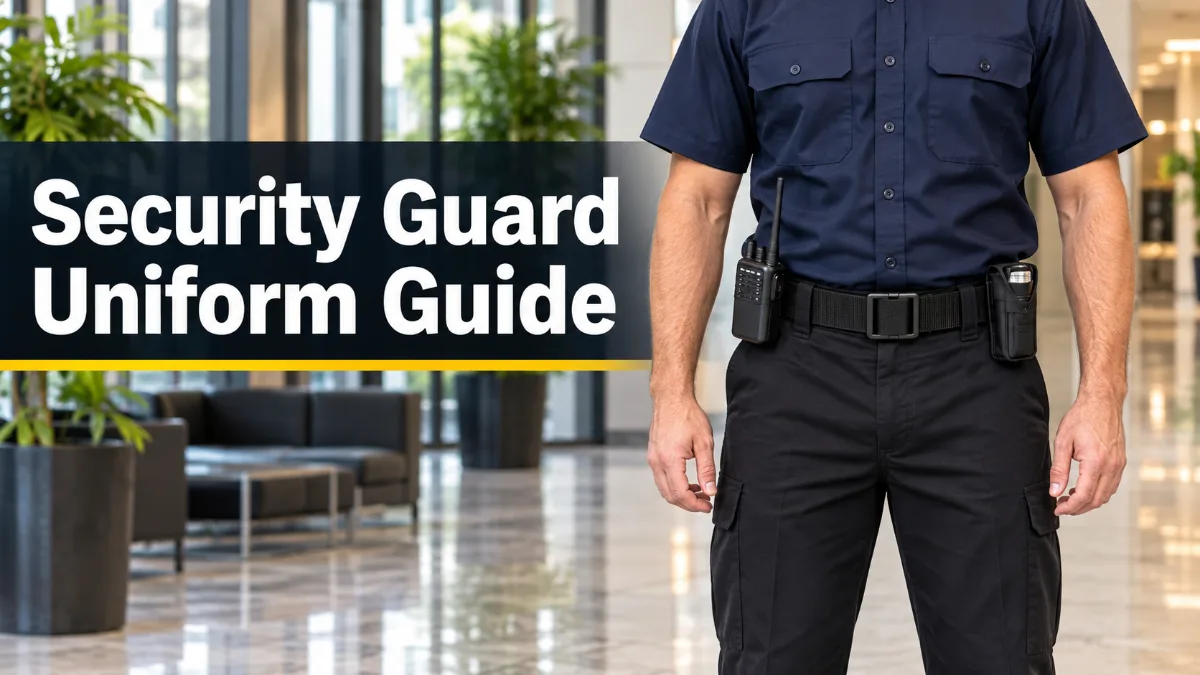
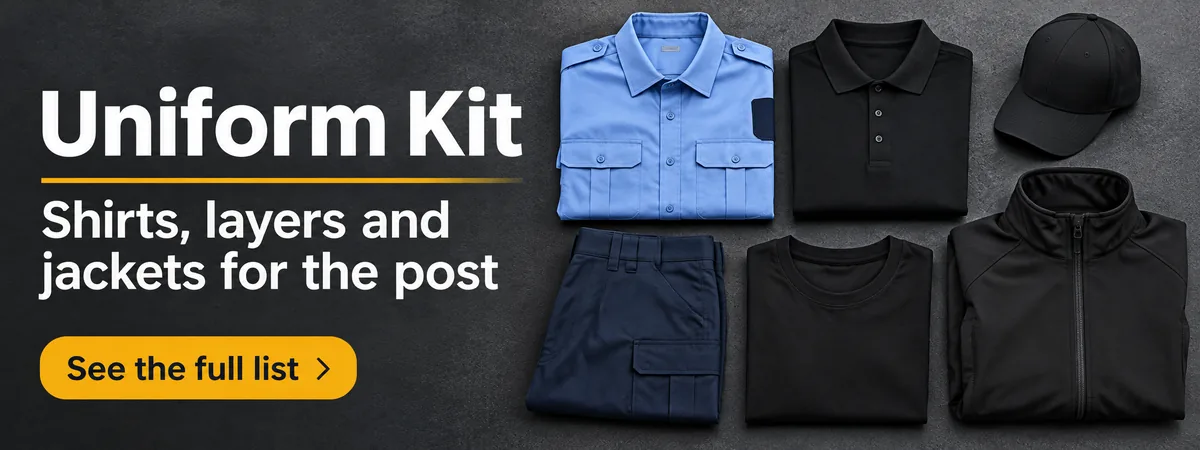
A typical security guard uniform includes a shirt or polo, trousers, a belt, footwear, an outer jacket for weather, and the company’s identification, such as a patch, badge or ID card. Some posts add a hat, a tie or a high-visibility vest.
Several of those pieces have their own guides on this site, so this page only points to them:
- Badges, patches, ID and look-alike rules: do security guards wear badges? explains what state regulators allow and the uniform mistakes that get guards in trouble.
- Footwear: best boots for security guards.
- Jackets and layers: cold and wet weather gear.
- Duty belt, light, radio and the rest: security guard equipment list.
What do security guards wear on different posts?
What a guard wears depends mostly on the post and on how the client wants the guard to come across. Some clients want an approachable presence that blends with the business, others want a guard who is obvious from across a parking lot. Your company and the client decide; the table shows the common patterns.
| Post | Typical look | Why |
|---|---|---|
| Corporate lobby, front desk, high-end retail | Blazer or suit, dress shirt, tie, dark trousers | Blends with the business; reads as staff who can help |
| Standard contract post (office, mall, residential) | Uniform shirt with patch, dark trousers, duty shoes or boots | Clearly identifiable without looking aggressive |
| Patrol, warehouse, industrial, construction | Tactical polo or ripstop shirt, cargo trousers, boots; hi-vis vest outdoors | Durable, easy to move in, visible near vehicles |
| Events and concerts | Company shirt marked SECURITY or EVENT STAFF, durable pants | Crowds need to spot staff quickly |
| Nightclubs and bars | Usually all black, often a shirt with the venue logo and SECURITY | Matches the venue; identifiable under low light |
| Executive protection | Suit and tie at formal events; casual to business casual elsewhere | Fit the client’s setting and avoid drawing attention |
| Loss prevention | Plainclothes | Observing shoplifting requires not being noticed |
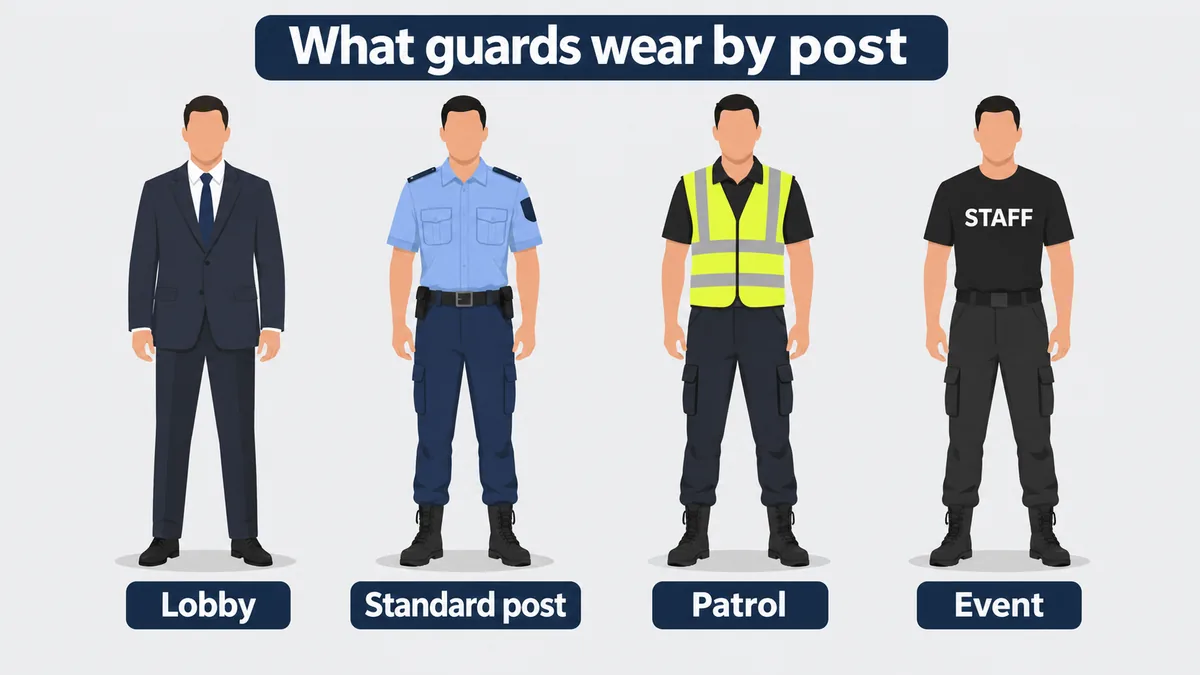
That table matches what I wore. On guard posts the company gave me the uniform. At events it was durable pants and a company shirt marked SECURITY or EVENT STAFF. In the nightclubs where I worked it was usually all black, with a shirt carrying the club’s logo and SECURITY. One club tried white button-down shirts with a black vest and a bow tie. It didn’t last, because we felt we looked like waiters.
In executive protection I wore suits and ties for red-carpet events and high-end places like jewelry stores. At residences and other assignments it was casual to business casual, adapted to the place.
The career guides go deeper on specific posts: hotel security, hospital security, casino security, loss prevention, bouncer work and bodyguard work. Cruise ship uniforms and onboard laundry are in the cruise ship security packing list.
Who pays for a security guard uniform?
This section covers U.S. rules. Under federal law, a uniform the employer requires is the employer’s business expense, and an employer can only pass the cost to you if your pay stays at or above minimum wage and overtime after the deduction. Several states set stricter rules. The table summarizes the federal rule and three states as of the date checked; your state may differ, and your state labor agency has the final word. Outside the U.S., check your country’s labor ministry or employment regulator, because rules on uniform costs and pay deductions differ from country to country.
| Jurisdiction | Rule on required uniforms | Source (checked Nov. 11, 2026) |
|---|---|---|
| Federal (FLSA) | Cost and maintenance of a required uniform is a business expense of the employer. If the employee pays, the cost may not reduce wages below the federal minimum wage or cut into required overtime pay. Deductions can be spread across paydays within those limits. | U.S. Department of Labor, Wage and Hour Division, Fact Sheet #16 (revised July 2009) |
| California | Uniforms required as a condition of employment must be provided and maintained by the employer. “Uniform” includes apparel and accessories of distinctive design or color. | IWC Wage Order 4-2001, section 9(A); the order lists guards among covered occupations |
| Washington | The employer must pay for required apparel only if it is a uniform: clothing that identifies a specific employer, carries the employer’s logo, is formal wear or has a historical or ethnic theme. A dress code in common colors (white, tan or blue tops; tan, black, blue or gray bottoms) is not a uniform. L&I says business suits and traditional business attire do not count as formal wear. | RCW 49.12.450; Washington L&I uniforms guidance and Administrative Policy ES.C.8.1 (Jan. 2, 2002) |
| New York | If you buy a required uniform, the employer must repay you by the next payday. If the employer doesn’t launder or maintain it, it must add weekly uniform maintenance pay on top of minimum wage, at rates set by hours worked and region. Clothing that is part of an ordinary wardrobe is not a required uniform. | 12 NYCRR 142-2.5(c) and 142-2.22 (Miscellaneous Industries and Occupations wage order); current weekly rates in NYSDOL’s Part 142 summary (rev. 12/25) |
Two details trip people up. Each state defines “uniform” its own way: a generic white shirt and black trousers may not count in Washington or New York, while a shirt with the company’s logo generally does. And in California, Wage Order 4 is an occupational order, which applies only when the employer’s business isn’t covered by an industry order. A guard hired directly by a hotel or a manufacturer, for example, falls under that industry’s order, so check which order covers your employer.
What happens to your uniform when you leave the job?
You are normally expected to return employer-issued uniform items when you leave. In the U.S., the rules on charging you for missing pieces depend on the state:
- Federal: charges for lost or damaged employer property follow the same limit as uniform costs. They may not push your pay for the workweek below minimum wage or into your overtime, even if the loss was your fault (DOL Fact Sheet #16).
- California: the employer may take a reasonable deposit, with a receipt, as security for returning uniforms. With your prior written authorization, it may deduct the cost of an item you don’t return from your last paycheck. It may not deduct for normal wear and tear (Wage Order 4, section 9(C)). Deductions for loss of equipment are only allowed if the loss came from a dishonest or willful act or gross negligence (section 8).
- Washington: employers may not deduct from wages or require a deposit for a uniform (Washington L&I). Under L&I’s policy, normal wear and tear and loss due to workplace conditions are the employer’s responsibility (ES.C.8.1).
The practical version: when you’re issued uniform pieces, get a list of what you received and keep a copy. When you leave, return everything clean, ideally to a supervisor who signs for it. Both records help if your final paycheck comes up short.
Should you buy your own uniform pieces or wait for issued ones?
Wait for the issued uniform, then buy only what your company allows and doesn’t supply. In most of my guard and nightclub work the employer provided the uniform or the shirts. When I managed a security company, posts were casual dress, or I provided the shirts. The exception was executive protection: EP clothing came out of my own pocket, because the “uniform” was a suit and whatever the assignment called for.
The pieces guards most often buy for themselves are the ones that touch comfort rather than identity: a base layer under the shirt, boots, a better belt and a jacket where the company allows a personal one. I wore Dickies work pants, Under Armour under the uniform, Oakley Assault boots and jackets from The North Face, Columbia and Timberland. My notes on the pants and boots are on the field-tested gear page. Before you buy, confirm the piece is allowed on your post and whether the company has to pay for it; if it does, keep the receipt.
How should a security uniform fit for long shifts?
A uniform for long shifts should let you sit, climb stairs and crouch without pulling, and should still look neat at the end of the night. Fit matters more than brand.
- Trousers: sit and squat in them before you take the tags off. If the waistband digs in when you sit, it will be worse under a loaded duty belt after eight hours.
- Shirts: raise your arms. A shirt that untucks every time you reach for a door handle looks sloppy by midnight.
- Under a duty belt: a smooth, close-fitting base layer and a shirt that tucks flat cut down on chafing where the belt sits.
- Heat: lighter fabric and a moisture-wicking base layer help on hot posts. Fabric claims like “moisture-wicking” come from the manufacturer, so read the fabric content on the label.
- Layers: if the company issues an outer jacket, layer under it rather than over it so the identification stays visible. The cold-weather guide covers layering in detail.
Women’s cuts: many uniform makers sell women’s versions of their uniform trousers and shirts, sized in women’s sizes rather than men’s waist and inseam. If your company issues only men’s sizes, ask whether it will supply or reimburse a women’s cut in the same color and fabric, so the uniform still matches the rest of the team. This section is based on manufacturer listings and research, not on my own observations.
How many uniforms do you need, and how do you keep them inspection-ready?
One or two full uniforms and three to four shirts is enough for most guards; that’s what I worked with. Shirts get dirty first, so having more of them than trousers lets you rotate without doing laundry every day.
What lasted for me were suits, if taken care of, and durable work pants. A simple routine keeps a uniform looking right for inspection:
- Follow the care label, especially for anything with patches or reflective trim.
- Hang shirts as soon as they come out of the dryer, or iron them the night before a shift.
- Check each shirt before you put it on: buttons, collar, loose patch stitching, faded color.
- Keep one clean shirt in your car or bag for spills and rain.
- Replace faded or frayed pieces before a supervisor or client points them out; ask the company first if it supplies replacements.
- Have suits dry cleaned on a schedule and hang them properly between details.
Marking and identification rules are a separate subject, covered on the badges page.
What uniform gear is worth buying yourself?
The pieces worth buying yourself are the ones your company allows but doesn’t issue, usually a base layer, a personal jacket and replacement shirts or trousers that match the company spec. The first two picks below are from brands I wore; I haven’t tested these exact models. The rest are research-based picks of products working guards commonly wear, chosen from manufacturer listings, not tested by me. Check your dress code before you order.
Some links in this section are affiliate links. If you buy through them, Security Dogma may earn a commission at no extra cost to you. As an Amazon Associate I earn from qualifying purchases. Learn more.
Under Armour Men’s HeatGear Tactical Shirt
Compression fit · short sleeve · black, white or tan
Under Armour is what I wore under the uniform. This is UA’s tactical-line HeatGear tee: close-fitting, so it sits flat under a uniform shirt and a duty belt, in colors that disappear under most shirts.
Watch out for: compression fit is tight by design. Check the size chart before you order.
See current price →Paid link · opens Amazon.com
Columbia Men’s Ascender Softshell Jacket
Softshell · water- and wind-resistant (manufacturer claim) · black or navy
I wore jackets from The North Face, Columbia and Timberland. The Ascender is a plain softshell for cool, damp nights on posts where a personal jacket is allowed.
Watch out for: many companies issue their own jacket with SECURITY lettering. This is not a winter coat; for real cold, see the cold-weather guide.
See current price →Paid link · opens Amazon.com
Propper Men’s Short Sleeve Tactical Shirt
65/35 poly-cotton ripstop · optional badge tab
A classic two-pocket uniform shirt for posts where you supply your own. Propper lists it as fade-, shrink- and wrinkle-resistant, with pen pockets and a gusseted underarm for reaching.
Watch out for: the color range includes police shades. Match your company’s spec and your state’s rules.
See current price →Paid link · opens Amazon.com
5.11 Tactical Performance Short Sleeve Polo
100% polyester · radio mic clips · sleeve pen pocket
A polo for patrol, warehouse and event posts. Mic clips at the placket and shoulders keep a radio mic where you can reach it.
Watch out for: a polo reads less formal. Lobby and front-desk posts may still require a button-up.
See current price →Paid link · opens Amazon.com
Propper Women’s Uniform Slick Pant
Women’s sizing · belt loops sized for a nylon duty belt
A women’s-cut uniform trouser with a clean, no-cargo look for posts that want a professional appearance.
Watch out for: the fabric blend differs by color. Check the listing for the color you order, and try one pair before buying a set.
See current price →Paid link · opens Amazon.com
Flexfit Low-Profile Garment-Washed Cap
Fitted · cotton · black, navy or khaki
A plain, low-profile cap for outdoor posts where headwear is allowed and the company doesn’t issue an embroidered one.
Watch out for: hand wash only. Wear a plain cap only if your dress code allows it.
See current price →Paid link · opens Amazon.com
Frequently asked questions
Can security guards wear shorts in summer?
Only if the company’s dress code allows it, and policies differ from post to post. Ask your supervisor before you show up in them, and expect client-facing posts to be stricter than outdoor ones.
Can I alter or hem an issued uniform?
Ask first. Issued pieces usually belong to the company and may have to be returned, so get approval before hemming trousers or taking in a shirt. Many companies would rather exchange a size than have you alter it.
What should I wear to a security guard job interview?
Clean business casual is a safe choice: a collared shirt, dark trousers and polished shoes. Don’t wear a uniform or anything with another company’s markings.
Sources
- U.S. Department of Labor, Wage and Hour Division, Fact Sheet #16: Deductions From Wages for Uniforms and Other Facilities Under the FLSA (revised July 2009).
- California Industrial Welfare Commission, Order No. 4-2001, sections 2, 8 and 9 (effective Jan. 1, 2002, as amended).
- Supreme Court of California, Mendiola v. CPS Security Solutions, Inc. (2015) 60 Cal.4th 833, which applies Wage Order 4 to security guards.
- California Division of Labor Standards Enforcement, Which IWC Order? Classifications (March 2013).
- Revised Code of Washington, RCW 49.12.450 (1998 c 334; 2016 c 202).
- Washington State Department of Labor & Industries, Uniforms, and Administrative Policy ES.C.8.1 (Jan. 2, 2002).
- New York Codes, Rules and Regulations, 12 NYCRR 142-2.5(c) and 142-2.22; New York State Department of Labor, Minimum Wage Order for Miscellaneous Industries and Occupations (Part 142).
Legal sources checked November 11, 2026. Product details: the Amazon listings linked in the cards, checked from a U.S. delivery address on November 11, 2026.
Next steps
- → Do security guards wear badges? Rules and risks
- → Best boots for security guards
- → Cold and wet weather gear for security guards
- → Security guard equipment list: 20 essentials
- → Night shift survival guide
Legal disclaimer: This page is for general information and education only. It is not legal advice, and reading it does not create an attorney-client relationship. Security Dogma is not a law firm. Laws, licensing rules and court decisions vary by state and change often, and what is written here may not match your situation or be current when you read it. Before you act on anything here, check the official rules from your state licensing agency, follow your employer’s and client site’s policies, and talk to a licensed attorney in your state for legal questions. See our Terms and Conditions and how facts are checked in our Editorial Policy.