

Security Dogma is reader-supported. When you buy through links on this page, we may earn a commission at no extra cost to you. As an Amazon Associate I earn from qualifying purchases. Learn more
A guard card isn’t enough to work armed in California. You also need a firearms permit from the Bureau of Security and Investigative Services (BSIS). People often call it an “armed guard card” or an “exposed firearm permit.” This guide covers who qualifies, the steps in the right order, what it really costs, how long it takes, what the permit does and doesn’t let you carry (including shotguns and rifles), and how to keep it.
I held a California guard card and an armed permit in the early 2000s and qualified at my local range. The rules have changed a lot since then, so everything below comes from current BSIS rules and California law, checked November 28, 2026.
This guide is general information about California’s rules, not legal advice. Firearms laws, fees and processing times change, so confirm with BSIS before you apply, and ask a California attorney about your own situation.
Quick answer
- What it is: a BSIS firearms permit added to your guard card (or to a PI, PPO or alarm license). It lets you carry an exposed firearm on duty, only in the handgun calibers printed on the permit.
- Who qualifies: age 21 or older, a U.S. citizen or permanent legal resident, not barred from owning guns under state or federal law, and holding a guard registration or one of the qualifying licenses.
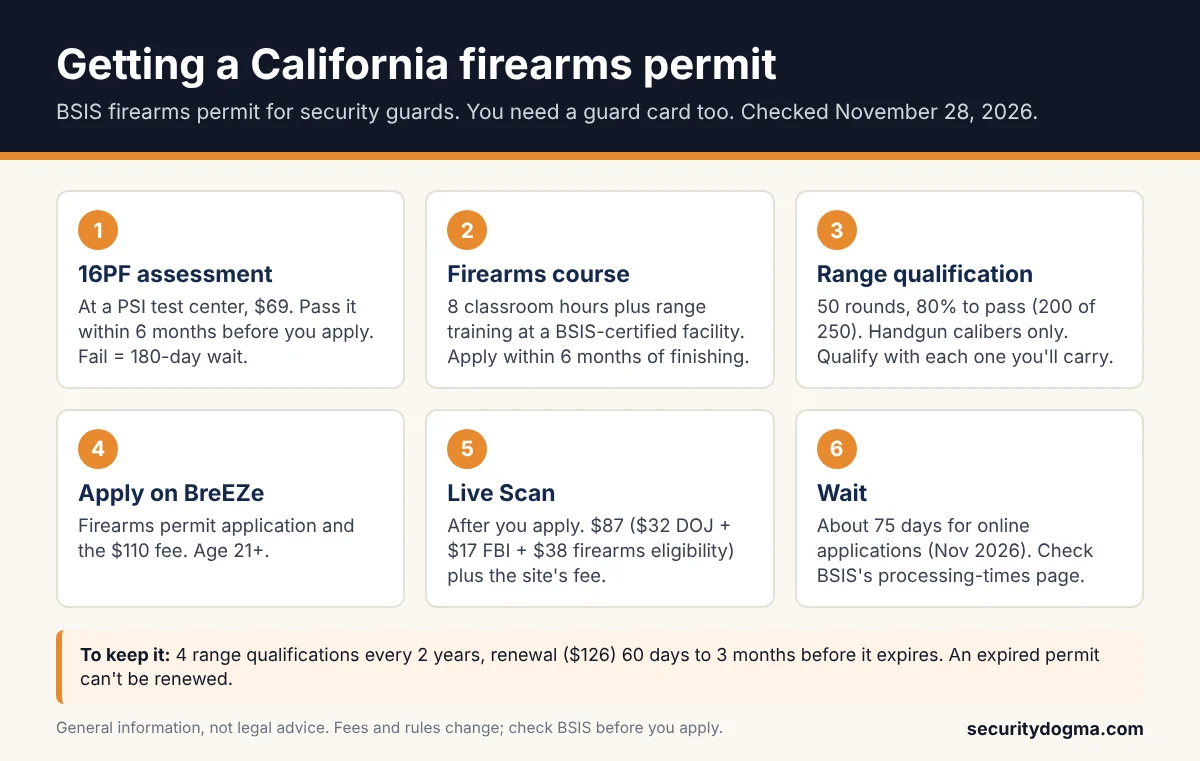
- The steps: pass the 16PF assessment ($69) → take the firearms course and pass the range qualification → apply on BreEZe ($110) within 6 months of finishing the training → get Live Scan fingerprints ($87 plus the site’s fee) → wait.
- How long: BSIS’s fact sheet says to allow 6–8 weeks before asking about your application. Its live processing-times page showed about 75 days for online first-time applications in November 2026.
- Shotguns and rifles: not covered. BSIS says guards aren’t authorized to carry long guns on duty.
- To keep it: the permit lasts 2 years and needs 4 range qualifications and a $126 renewal. An expired permit can’t be renewed.
- Free printable: Firearms Permit Requalification Planner (PDF)
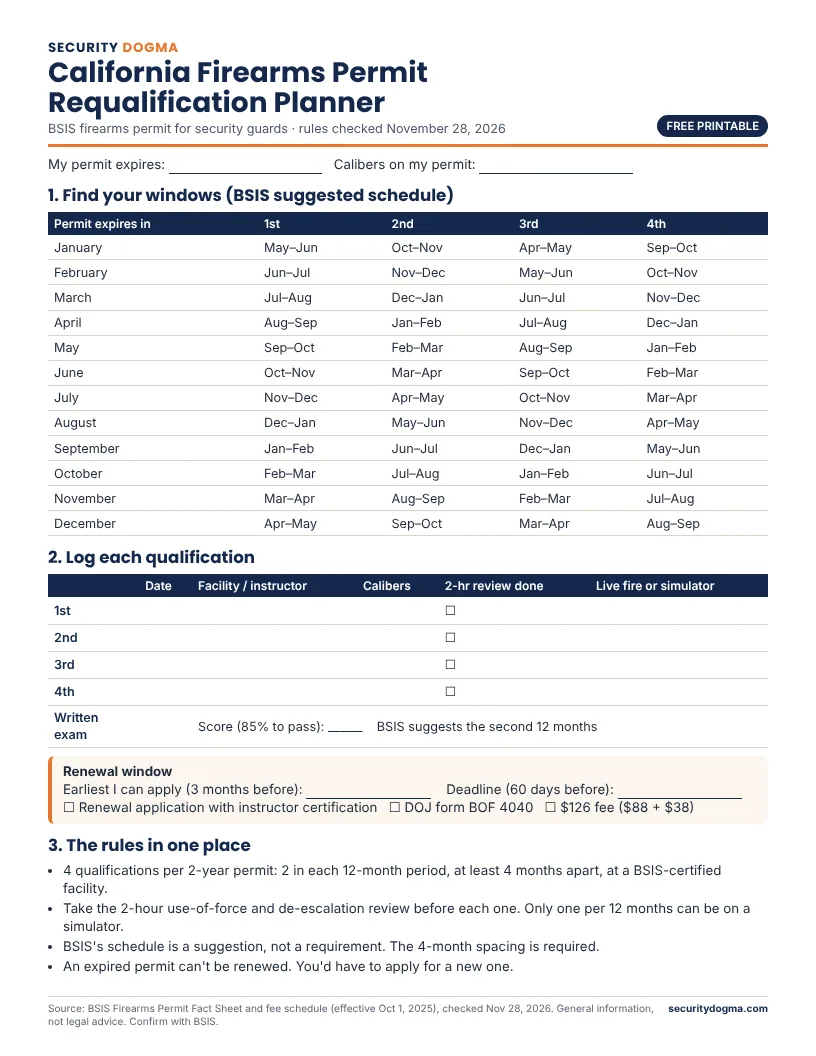
Firearms Permit Requalification Planner
Find your 4 range windows from your expiration month, log each qualification, and never miss a renewal. One page, no email needed.
⬇ Download the planner (PDF)Prefer to watch? This video covers the same ground in about eight minutes.
This video is hosted by YouTube (Google). Loading it shares your IP address with Google and may set cookies. See our Privacy Policy.
This video was made with AI tools and summarizes this guide. Scenes are illustrations, not real events.
Guard card vs. firearms permit: two different things
Your guard card (Security Guard Registration) is what lets you work as a guard. The firearms permit is a separate BSIS permit linked to it. You need both to work armed, and the law requires the permit to be associated with a valid, current guard registration (Business and Professions Code 7583.3(c)).
There’s no separate “armed guard license” in California. When job ads ask for an “armed guard card” or “exposed firearm permit,” they mean this permit.
If you don’t have your guard card yet, start there: How to Get a Guard Card in California.
Who can get a California firearms permit
According to BSIS, you must:
- be at least 21,
- be a U.S. citizen or have permanent legal immigration status,
- not be prohibited from owning or possessing a firearm under state or federal law, and
- hold a security guard registration, an alarm agent registration, or a PI, private patrol operator (PPO) or alarm company operator license (or be a qualified manager of one).
Who you can work armed for: as a security guard, you can carry a firearm (or a baton) on duty only if you’re employed by a licensed private patrol operator or by the state or a local government (Business and Professions Code 7583.3(e), added by AB 229 in 2021).
In-house security can’t be armed: proprietary private security officers (PPSOs), who work in-house for one employer, are unarmed by law. Since January 1, 2023, they can’t carry a firearm or any other deadly weapon, including a baton, stun gun or pepper spray, according to BSIS.
If you have a record: the question is whether state or federal law bars you from owning a gun, and then BSIS’s background review. In general, a felony conviction means a lifetime firearms ban in California, and some misdemeanors (for example assault, battery, brandishing, criminal threats and stalking) carry a 10-year ban, according to the California DOJ’s list of prohibiting categories, which DOJ says may not include every prohibition. Our guide to security guard jobs with a criminal record explains how reviews work. For your own case, ask a California attorney before you pay for training.
The steps, in order
Step 1: Pass the firearms assessment (security guards)
Before you can apply, BSIS requires security guard registrants to pass a personality assessment. It checks whether you can show appropriate judgment, restraint and self-control when carrying a firearm (Business and Professions Code 7583.47).
- What it is: the Sixteen Personality Factor Questionnaire (16PF), a written personality test. It isn’t a session with a psychologist.
- Where: at a PSI test center. PSI runs it under contract with BSIS.
- Cost: $69, paid to PSI.
- Timing: you must pass it within the 6 months before you submit your permit application. Since January 1, 2022, it has to come before the application.
- If you don’t pass: you get a “Did Not Demonstrate” result and must wait 180 days to retake it. BSIS says the wait starts the day after you test. BSIS receives only “Demonstrate” or “Did Not Demonstrate,” not your scores.
Step 2: Take the firearms course
You train at a BSIS-certified firearms training facility with a BSIS-certified instructor. Under California’s training regulation (16 CCR 635), the classroom part covers:
- use of force (including de-escalation): 3.5 hours
- moral and legal aspects: 1.5 hours
- firearms nomenclature and maintenance: 2 hours
- registration and permit rules: 1 hour
That adds up to 8 classroom hours, plus a written exam. Range training follows: 1 hour of weapon handling and fundamentals, 1 hour of range preparation, then as much range training as you need to qualify.
Timing matters. Since January 1, 2025, a BSIS-certified firearms instructor must certify that you passed the written exam and the firearms course within the 6 months before you submit your application (Business and Professions Code 7583.23(b)). Your 16PF pass has its own 6-month window. Plan the assessment, course and application close together, or you may have to repeat training.
For how firearms training fits with the rest of your guard training, see California guard card training.
Step 3: Pass the range qualification
- 50 rounds of live ammunition at a single silhouette target, fired in stages from 15 yards down to 3 yards. There’s a revolver course and a semi-automatic handgun course.
- Passing score: 80%, which is 200 of 250 points.
- Your initial qualification must be live fire, not on a simulator.
- You qualify with each caliber you want to carry. BSIS’s approved calibers are all handgun calibers: .357, .38, .45, 9mm, 10mm, .40 and .380. Your permit lists only the calibers you qualified with.
Step 4: Apply on BreEZe and pay $110
Fill out the Firearms Permit Initial Application and submit it with the $110 fee (fees in effect since October 1, 2025). BSIS recommends applying online through BreEZe and paying by card. It says this skips the cashiering step and can cut up to two weeks off processing. Paper applications go by mail to BSIS in West Sacramento.
Step 5: Get fingerprinted (Live Scan)
BSIS asks you to submit your application first, then complete Live Scan. Use the Live Scan form for a firearms permit that matches your registration or license. The wrong form delays processing. Keep your copy with the ATI number and the operator’s signature.
For a firearms permit, BSIS lists the fingerprint fees as $87: $32 DOJ, $17 FBI and a $38 firearms eligibility fee. The Live Scan site adds its own fee, which varies by location.
Step 6: Wait
BSIS’s fact sheet asks you to wait 6–8 weeks from your cashiering date before contacting it about status, and DOJ or FBI delays can add more time. Its live Application Processing Times page is more current: on November 9, 2026, it showed about 75 days for online first-time firearms permit applications, and paper applications were further behind. Check that page before you count on a start date.
Once BSIS approves your permit, you can carry a printout of the approved permit from BSIS’s website plus a photo ID until the card arrives (Business and Professions Code 7583.3(b)). Until then, don’t carry a firearm on duty.
What it really costs
| Item | Cost | Paid to |
|---|---|---|
| Firearms assessment (16PF) | $69 | PSI |
| Firearms course and range qualification | Set by the training facility | Training facility |
| Ammunition and range fees | Varies | Training facility or range |
| Firearms permit application | $110 | BSIS |
| Live Scan fingerprints | $87 ($32 DOJ + $17 FBI + $38 firearms eligibility) plus the site’s fee | Live Scan site |
| Later: renewal every 2 years | $126 ($88 renewal + $38 DOJ firearms eligibility fee) | BSIS |
| Later: 4 range requalifications per renewal cycle | Set by the training facility | Training facility |
| Adding a caliber (replacement card) | $25 | BSIS |
Training, ammunition and Live Scan site fees are set by the businesses that charge them, so ask for a full quote before you book. And remember the guard card itself: $60 to apply and $44 to renew, plus its own training. See How to Get a Guard Card in California.
What the permit lets you carry, and where
Exposed, on duty, and only your calibers
BSIS says the permit lets you carry an exposed firearm only while you’re doing the work of the license types listed on it, and only in the calibers printed on your permit. You can’t carry a caliber on duty that BSIS hasn’t issued a permit for.
Getting to and from work
California’s ban on carrying a loaded firearm in public (Penal Code 25850) has an exception for uniformed security guards who are regularly employed and paid as guards and hold the required firearms and arrest-training certification (Penal Code 26030). It covers them:
- while protecting their employer’s property,
- while on duty, and
- while traveling between home and work, or to and from range training their employer requires.
That exception covers the loaded-carry law only. It doesn’t authorize concealed carry. Outside those situations, follow your employer’s policy and California’s general firearms laws.
It’s not a concealed carry license (CCW)
The BSIS permit is for exposed carry at work. Carrying a concealed handgun requires a separate CCW license from your county sheriff or city police chief (Penal Code 26150 and 26155), with its own age (21+), residency, training and background requirements. Since January 1, 2026, California also issues CCW licenses to nonresidents. Having a CCW doesn’t give you a BSIS permit, and a BSIS permit doesn’t give you a CCW.
Can armed guards carry a shotgun or rifle?
No, not under a BSIS permit. The permit is issued by handgun caliber, and California’s range qualification (16 CCR 635) covers only revolvers and semi-automatic handguns. BSIS’s Firearms Training Manual says that existing law doesn’t authorize security guards, alarm agents or other BSIS licensees to carry long guns, such as rifles and shotguns, on duty. It warns that doing so could violate Penal Code 25850, California’s loaded-carry law.
A few things follow from that:
- There’s no shotgun or rifle add-on. BSIS has no long-gun course or qualification. A school advertising a “BSIS shotgun permit” is offering something BSIS doesn’t issue.
- Carrying it unloaded isn’t a workaround. California generally bans openly carrying an unloaded long gun in public in cities (Penal Code 26400), and the exceptions in Penal Code 26405 don’t include security guards.
- Assault weapons are a separate problem. California’s assault-weapon exemptions for possession cover government agencies and sworn peace officers acting for their agency (Penal Code 30625 and 30630). We found no exemption for private security.
This is BSIS’s reading of the law, and we found no court decision on it. If an employer asks you to carry a long gun, get the request in writing and check with BSIS or a California attorney first.
Where rifles and shotguns are used in security work
The security jobs in California that do use long guns work under federal rules, not a BSIS permit. Two examples:
- Nuclear power plant security officers. Federal Nuclear Regulatory Commission (NRC) rules (10 CFR Part 73, Appendix B) require armed security officers at nuclear plants to qualify with a handgun, a shotgun and a semi-automatic rifle, and to requalify at least once a year. Armed officers must be at least 21, have a high school diploma or equivalent, and not be barred from owning firearms. You get there by applying to the plant operator and passing the NRC-required background checks and training. California’s only operating plant is Diablo Canyon.
- Department of Energy protective forces. Security Police Officers at DOE sites, such as Lawrence Livermore National Laboratory, are authorized under federal law (the Atomic Energy Act and 10 CFR Part 1046) to carry firearms and make arrests. A 2025 Livermore posting asked for age 21+, a DOE Q clearance (U.S. citizens only), medical, psychological and drug screening, physical tests, and qualification with “site-approved weapons.”
Other routes, such as police work, follow their own agency rules. Federal Protective Service contract guards follow state licensing and weapons laws, which in California means the BSIS handgun rules. Armored-car guards and executive protection officers also work under the BSIS rules, and we found nothing that authorizes long guns for them.
Buying a duty handgun in 2026 and 2027
Before you buy, check what your employer allows and make sure you’ll qualify with that caliber so it’s on your permit. Two California rules also shape what a store can sell you:
- The handgun roster. Dealers can generally sell only models on the California DOJ’s Roster of Certified Handguns. Parts of the roster’s requirements are being challenged in federal court, so check the current DOJ roster and confirm with your dealer before you buy.
- The 2026 dealer-sale rule (AB 1127, Penal Code 27595 and 16885). Since July 1, 2026, licensed dealers can’t sell a “machinegun-convertible pistol.” That’s a semi-automatic pistol with a cruciform (cross-shaped) trigger bar that can be readily converted into a machine gun, by hand or with common household tools, by installing a converter in place of the slide’s backplate. News coverage describes this as the Glock design. The exemptions include law enforcement and corrections agencies, the military, certain on-duty peace officers, private-party transfers through a dealer, pistols delivered to a dealer before January 1, 2026, and repairs. Private security isn’t among them. The rule limits dealer sales; it doesn’t make owning a pistol you already have illegal. The law is being challenged in court and was in force as of November 2026.
If you ever fire your weapon on duty
California has several reporting rules, and they overlap:
- Tell your employer within 24 hours of any on-duty incident in which you discharged a firearm (Business and Professions Code 7583.3(d)).
- Report to BSIS within 7 days. You and your employer must send BSIS a written report on any on-duty firearm discharge within seven days, and a copy must go to the local police or sheriff’s department within seven days (Business and Professions Code 7583.4).
- The employer’s report. Your licensed employer must also report any on-duty firearm discharge or physical altercation with a member of the public to BSIS within seven business days (Business and Professions Code 7583.2).
From January 1, 2027, BSIS citation fines can reach $10,000 per violation, up from $2,500 (SB 1203). Know your employer’s procedure before your first armed shift. Our incident report examples show what a clear report looks like.
Keeping your permit: renewal and requalification
- Validity: 2 years from issue. BSIS mails a reminder about 90 days before it expires, but the reminder isn’t the application.
- 4 range qualifications per cycle: 2 in each 12-month period, at least 4 months apart, at a BSIS-certified facility with a BSIS-certified instructor. Only one per 12 months can be on a firearms simulator.
- Before each qualification: a 2-hour classroom review on use of force and de-escalation.
- Written exam: pass with 85% or higher during the term. BSIS recommends taking it in the second 12 months.
- Apply on time: submit the renewal application (with the instructor’s certification pages), the DOJ Biennial Firearms Permit Qualification Application (BOF 4040) and the $126 fee at least 60 days before expiration, but no more than 3 months early.
- Miss it and you start over: a firearms permit can’t be renewed after it expires. You’d have to apply for a new one.
My advice: the four requalifications are the minimum, not the goal. Train on your own time, and keep up with the rules yourself, because they change.
BSIS’s suggested qualification schedule
BSIS publishes a suggested schedule based on your expiration month. It’s optional, but following it keeps you within the 4-month spacing rule.
| Permit expires in | 1st | 2nd | 3rd | 4th |
|---|---|---|---|---|
| January | May–Jun | Oct–Nov | Apr–May | Sep–Oct |
| February | Jun–Jul | Nov–Dec | May–Jun | Oct–Nov |
| March | Jul–Aug | Dec–Jan | Jun–Jul | Nov–Dec |
| April | Aug–Sep | Jan–Feb | Jul–Aug | Dec–Jan |
| May | Sep–Oct | Feb–Mar | Aug–Sep | Jan–Feb |
| June | Oct–Nov | Mar–Apr | Sep–Oct | Feb–Mar |
| July | Nov–Dec | Apr–May | Oct–Nov | Mar–Apr |
| August | Dec–Jan | May–Jun | Nov–Dec | Apr–May |
| September | Jan–Feb | Jun–Jul | Dec–Jan | May–Jun |
| October | Feb–Mar | Jul–Aug | Jan–Feb | Jun–Jul |
| November | Mar–Apr | Aug–Sep | Feb–Mar | Jul–Aug |
| December | Apr–May | Sep–Oct | Mar–Apr | Aug–Sep |
Keep your dates in one place: download the Firearms Permit Requalification Planner (PDF). It has this table plus a log for each qualification.
Adding a caliber
To add a handgun caliber, you need a current permit, at least 8 hours of classroom instruction, a written exam (85% or higher), range training and the Add Caliber form. It costs $25 if you want a new card. After that, you requalify with every caliber at each renewal qualification.
Gear for the range
Some links in this section are affiliate links. If you buy through them, Security Dogma may earn a commission at no extra cost to you. As an Amazon Associate I earn from qualifying purchases. Read our affiliate disclosure. These are research picks: I haven’t tested these exact products.
Howard Leight Impact Sport Electronic Earmuffs
Built-in microphones amplify range commands to a safe 82 dB and shut off amplification above it · NRR 22 · low-profile earcups · folding design (per the listing)
Electronic earmuffs let you hear range commands and instructors while protecting your hearing from gunfire, which matters during your firearms course and every requalification.
Watch out for: an NRR of 22 is moderate; some shooters add foam earplugs under the muffs at indoor ranges.
See current price →Paid link · opens Amazon.com
Peltor Sport SecureFit Safety Eyewear, 3-Pack
Clear, amber and gray lenses · anti-fog, scratch-resistant · meets ANSI Z87.1 · low-profile temples for wearing with hearing protection (per the listing)
Keeping a California firearms permit means four range qualifications every two years, plus the range time you put in on your own. Eye protection is part of every one.
Watch out for: these aren’t prescription glasses. Ask your range or instructor about their eye and ear protection rules before qualification day.
See current price →Paid link · opens Amazon.com
Bianchi 7200 Duty Belt
5-part laminate with an internal polymer stiffener · ballistic weave exterior · 2.25″ (58 mm) wide · hook-and-loop closure (per the listing)
A stiff duty belt keeps a holstered firearm, magazines and a radio from sagging over a long shift.
Watch out for: pair it with an inner belt and belt keepers, and check your employer’s uniform rules first.
See current price →Paid link · opens Amazon.com
Frequently asked questions
Is an armed guard card the same as a guard card?
No. The guard card (Security Guard Registration) lets you work as a guard. To work armed, you also need a separate BSIS firearms permit, often called an armed guard card or exposed firearm permit.
How old do you have to be to be an armed guard in California?
At least 21. You can get a guard card at 18, but the firearms permit requires 21.
What is the BSIS psych test?
It’s the Sixteen Personality Factor Questionnaire (16PF), a written personality test taken at a PSI test center for $69. Security guards must pass it within the 6 months before applying. If you don’t pass, you wait 180 days to retake it.
How long does it take to get a firearms permit?
BSIS’s fact sheet says to allow 6–8 weeks before asking about status, but its processing-times page showed about 75 days for online first-time applications in November 2026. Applying online through BreEZe can shorten processing by up to two weeks, according to BSIS.
Can a California security guard carry a shotgun or AR-15?
No. A BSIS firearms permit covers only the handgun calibers you qualified with, and BSIS says existing law doesn’t authorize guards to carry long guns on duty. Security jobs that use rifles or shotguns, such as nuclear plant security, work under federal rules.
Can I carry my gun to and from work?
California law lets uniformed security guards who hold the required firearms and arrest-training certification carry a loaded firearm while on duty and while traveling between home and work or employer-required range training (Penal Code 26030). It doesn’t authorize concealed carry.
Does a BSIS firearms permit let me carry concealed?
No. The permit covers exposed carry while working. Concealed carry requires a CCW license from your county sheriff or city police chief.
Can I still buy a Glock as an armed guard?
Since July 1, 2026, licensed dealers in California can’t sell machinegun-convertible pistols, which news coverage describes as the Glock design. There’s no exemption for private security. Guns you already own are unaffected, and private-party transfers through a dealer are still allowed.
What happens if my firearms permit expires?
It can’t be renewed. You have to apply for a new permit. Submit your renewal at least 60 days before expiration, but no more than 3 months early.
Related guides
- How to Get a Guard Card in California
- California guard card training
- California guard card renewal
- Armed vs. unarmed security guards
- What can security guards carry?
Sources
- BSIS, Firearms Permit Fact Sheet
- BSIS, Firearms Permit Assessment Requirement for Security Guards
- BSIS, New Fees effective October 1, 2025 (PDF)
- BSIS, Criminal History Background Check (Live Scan) Requirement
- BSIS, Application Processing Times
- BSIS, SB 1454 notice: firearms training timing (PDF)
- BSIS, Firearms Training Manual (PDF)
- BSIS, Proprietary Private Security Officer FAQ
- BSIS, Submitting Incident Reports
- Business and Professions Code 7583.3
- Business and Professions Code 7583.4
- Business and Professions Code 7583.2
- Business and Professions Code 7583.23
- California Code of Regulations, title 16, section 635
- Penal Code 26030
- Penal Code 26150 (CCW licenses)
- Penal Code 26405
- Penal Code 27595 (AB 1127)
- Penal Code 16885
- Penal Code 30625
- California DOJ, Firearms Prohibiting Categories (PDF)
- California DOJ, Roster of Certified Handguns
- 10 CFR Part 73, Appendix B (NRC security training and qualification)
- 10 CFR 1046.3 (DOE protective force definitions)
Checked November 28, 2026. California firearms law changes often and several rules are in litigation; confirm with BSIS and the DOJ before you apply or buy.
Firearms and weapons disclaimer: This page discusses firearms or other weapons for general information only. It is not legal advice, not firearms training, and not a recommendation to buy, carry or use any weapon. Laws on owning, carrying, transporting and using firearms, stun guns, pepper spray, batons and knives vary by state, county and city. They change often, can be different for security work, and breaking them can lead to criminal charges. Before you carry or use any weapon, confirm the current law where you are, get any required permit or license, train with a certified instructor, and follow your employer’s, client’s and property owner’s rules. You alone are responsible for how you buy, carry, store and use any weapon. Security Dogma and its authors accept no liability for any injury, loss, damage or legal consequence that results from acting on this information. A product link does not mean the item is legal where you live, so check local restrictions before you buy.
Legal disclaimer: This page is for general information and education only. It is not legal advice, and reading it does not create an attorney-client relationship. Security Dogma is not a law firm. Laws, licensing rules and court decisions vary by state and change often, and what is written here may not match your situation or be current when you read it. Before you act on anything here, check the official rules from your state licensing agency, follow your employer’s and client site’s policies, and talk to a licensed attorney in your state for legal questions. See our Terms and Conditions and how facts are checked in our Editorial Policy.