

Security Dogma is reader-supported. When you buy through links on this page, we may earn a commission at no extra cost to you. As an Amazon Associate I earn from qualifying purchases. Learn more
Quick answer
An armored car guard (also called an armed transport guard, messenger or driver guard) moves cash and valuables between banks, stores and ATMs as part of a two-person crew. To get hired at a company like Brink’s or Loomis you typically need to:
- Be at least 21 with a valid driver’s license and a clean driving record.
- Hold a security guard license and a firearms permit for your state, or be able to get them. Employers often help pay for them.
- Pass a background check, a drug screen and a physical test, including lifting about 50 pounds.
- Meet Department of Transportation (DOT) requirements, which usually means a DOT medical certificate.
Pay: recent postings offer about $21 to $26 an hour, more than the typical security guard. Risk: it is one of the more dangerous security jobs, because the crew is the target. Record: because the job is armed, a felony conviction or a domestic violence misdemeanor usually rules you out under federal law.
How this guide was made: I have worked armed and unarmed security, executive protection and private investigations, but I have not worked armored car routes. Everything here comes from current employer job postings, state licensing rules and federal law, which are linked in the Sources section. Rules and pay change, so check your state and the employer before you apply.
What does an armored car guard do?
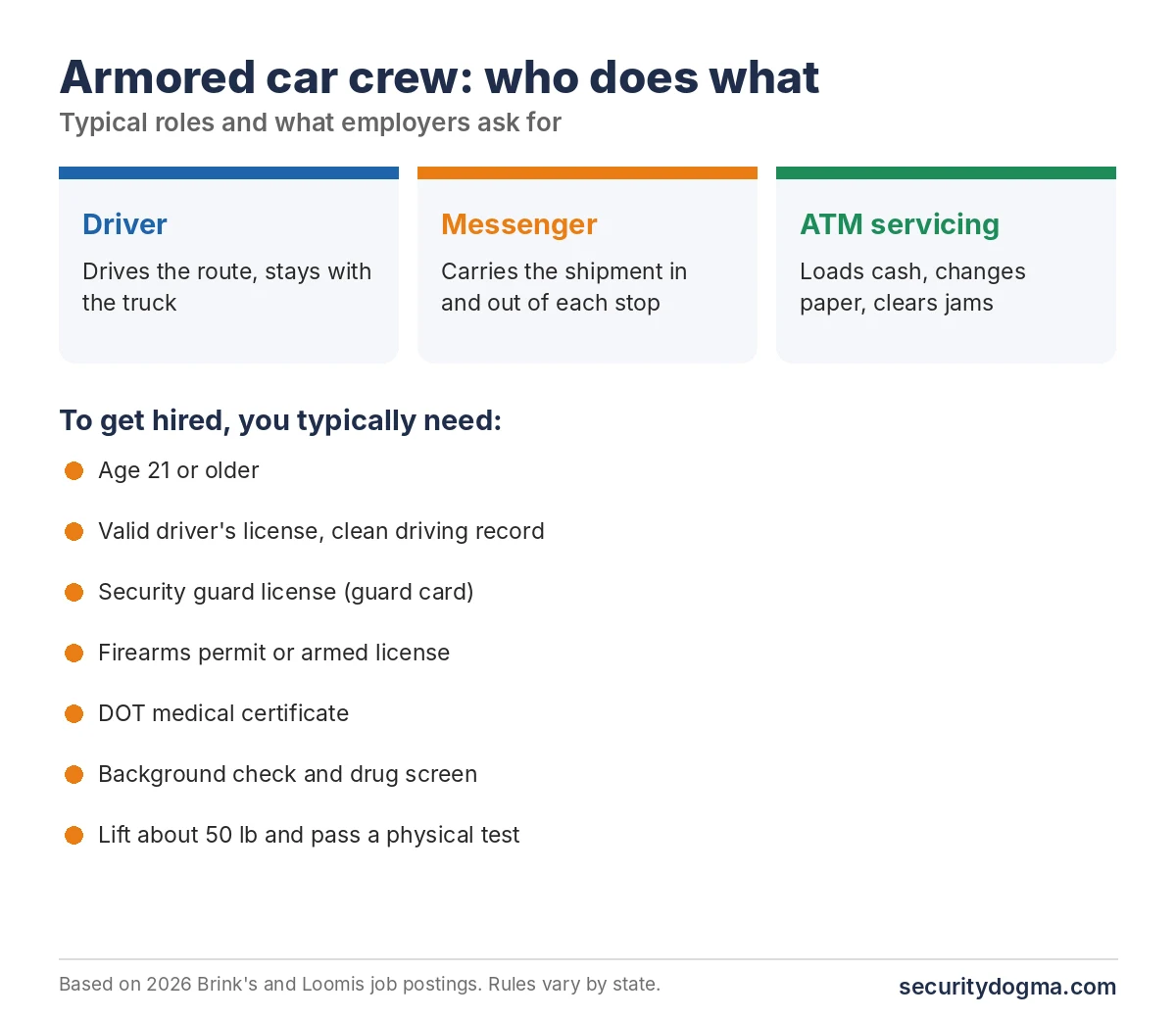
Armored car crews pick up and deliver cash, coins, checks and other valuables for banks, retailers, casinos and other businesses. Most crews have two or more people with different jobs:
- Driver: drives the armored truck on a set route and stays with the vehicle. In job postings this is often called a driver guard.
- Messenger: leaves the truck, walks into the customer’s location, collects or delivers the shipment and signs for it. This is the most exposed part of the job, because the shipment is outside the armored vehicle.
- ATM servicing: many crews also load and unload cash in ATMs, change receipt paper and clear jams.
A current Brink’s posting lists duties such as delivering and picking up valuables, keeping radio contact with the crew and dispatch, staying alert to protect the crew against attack, reconciling deposits through the day, and servicing ATMs. A Loomis posting adds loading and unloading “multiple bags and boxes of coins” and servicing smart safes.
Requirements to become an armored car guard
Requirements vary by company and state, but the two biggest employers ask for much the same thing. Here is what two real 2026 postings required:
| Requirement | Brink’s (Armed Transport Guard, Missouri, Nov 2026) | Loomis (Armed Driver Guard, Chicago, Mar 2026) |
|---|---|---|
| Minimum age | 21 | 21 |
| Driving | Valid driver’s license; meet DOT requirements | At least a 3-year driving record; DOT medical examiner’s certificate |
| Licenses | Guard card and firearms permit, or able to get them | Firearms permit may be required; Loomis pays for licensing and firearms qualification |
| Physical | Lift at least 50 lb | Physical test that includes 50 lb lifts, carries and step climbs |
| Experience | 6 months in courier, customer service, security, military or protective work | Not listed beyond the driving record |
| Screening | Background check and drug screen | Not detailed in the posting |
| Schedule | Weekends, holidays or extended hours | About 40 to 50 hours a week, 5 days in 6, some weekends |
You do not need a college degree. A high school diploma or GED is listed as preferred, and previous armored messenger experience helps but is not required for entry-level postings.
Do you need a license to be an armored car guard?
Yes. In practice you need two things: your state’s security guard license (often called a guard card) and a firearms permit or armed license, because nearly all armored car work is armed. Some states also have a separate armored car license. The rules depend on where you work:
| State | What the rules say |
|---|---|
| New York | A separate armored car guard license from the Department of State. It requires 47 hours of firearms training recognized by the state, 8 hours of firearms in-service training every year, fingerprints, and fees of $50 to apply and $88.50 for fingerprinting. |
| Florida | State law counts “armored car personnel” as security officers, so you need the security officer license (Class D). Anyone who carries a firearm also needs a Class G license, which takes 28 hours of training and at least 4 hours of firearms requalification each year. |
| California | State law requires each armored vehicle guard to register with the Bureau of Security and Investigative Services (BSIS), with fingerprints and a fee. To carry a loaded firearm, guards of armored contract carriers must complete a firearms course that meets state standards plus training in the powers of arrest. BSIS sets the firearms qualifications for armored carrier employees. |
| Texas | Armored car companies are regulated under the state’s private security law. Armed security officers need a commission, which requires at least 45 hours of Level III training, including a course of fire. |
| Other states | Most states license armed guards through a state board or the state police. Start with our security guard license guide for all 50 states, and ask the employer which licenses they will sponsor. |
Crossing state lines: a federal law, the Armored Car Industry Reciprocity Act, lets a crew member licensed in the state where they mainly work carry their weapon and work in other states while on duty for the armored car company. The home-state license must meet federal minimums, including firearms training and a background check, and generally lasts no more than two years.
Do you need a CDL? The Loomis route posting asks for a DOT medical certificate but not a commercial driver’s license. Brink’s posts separate CDL driver jobs for larger vehicles, so check each posting.
Can you become an armored car guard with a criminal record?
It depends on the offense, but the armed part of the job is the biggest hurdle. Under federal law, it is illegal to possess a firearm if you have been convicted of a crime punishable by more than one year in prison (in practice, most felonies) or of a misdemeanor crime of domestic violence. Since armored car guards carry firearms, either of those convictions usually rules you out.
- Expunged or pardoned convictions: federal law says a conviction that has been expunged, set aside or pardoned, or for which civil rights were restored, does not count, unless the pardon or expungement says you still cannot have firearms. These rules are technical, so get legal advice for your case.
- Other offenses: each state decides who can hold a guard card, and employers run their own background checks and drug screens. Some older or minor offenses are not automatic bars, but you must disclose them.
- Never hide a conviction. Lying on a license application is often treated as a reason for denial on its own.
See our full guide to security guard licensing with a criminal record for each state’s rules.
⚖️ Legal note: this is general information, not legal advice. Firearms eligibility depends on the exact conviction and the laws of your state. If you have a record, talk to a lawyer before you apply.
How much do armored car guards make?
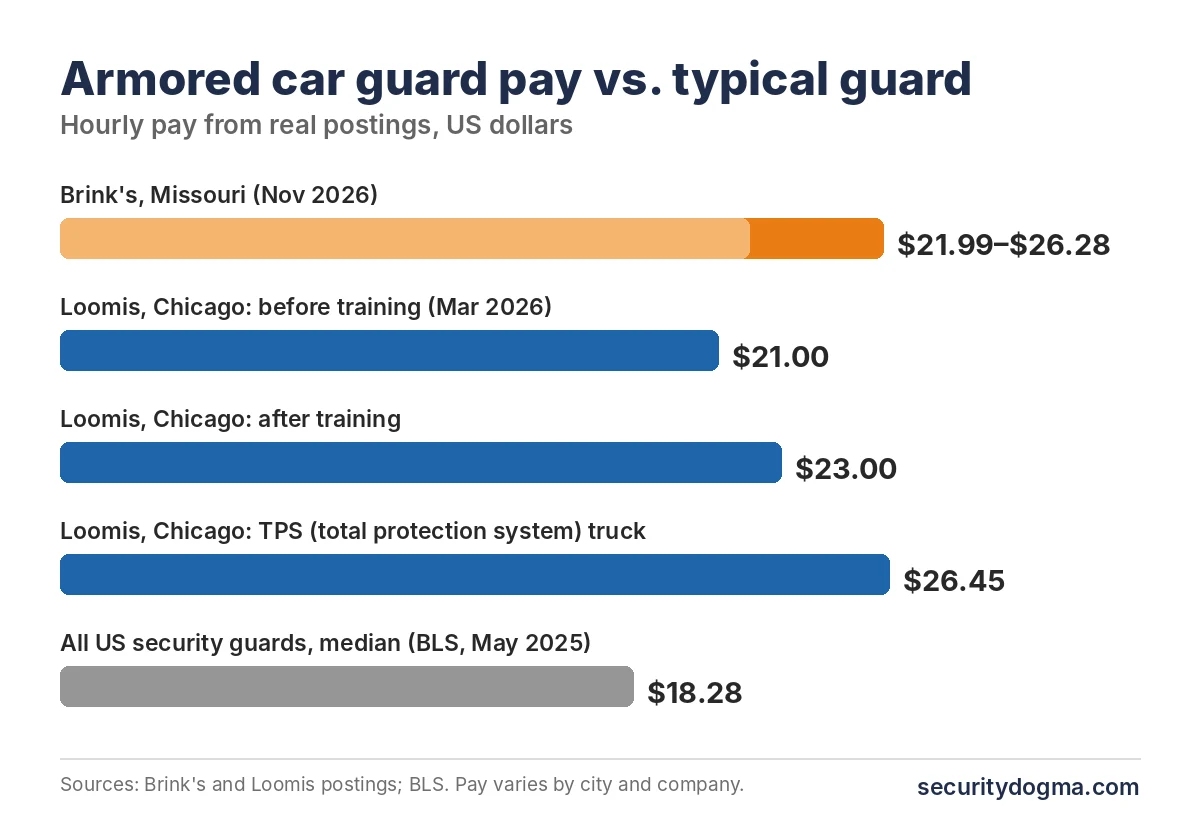
Real postings from the two largest employers give a clear picture:
| Source | Pay | Date |
|---|---|---|
| Brink’s Armed Transport Guard, Kansas City area, Missouri | $21.99–$26.28 an hour | Posted Nov 4, 2026 |
| Loomis Armed Driver Guard, Chicago | $21 an hour before Loomis training, $23 after, $26.45 on a TPS (total protection system) truck | Posted Mar 2026 |
| All US security guards (BLS median) | $38,020 a year (about $18.28 an hour, worked out over 2,080 hours) | May 2025 |
Worked out from those figures, the armored car rates are roughly 15% to 45% higher than the median hourly pay for all security guards.
Why does armored car work pay more?
The postings themselves explain most of it. Compared with an ordinary unarmed post, an armored car job asks for more:
- An armed license and regular firearms qualification.
- Driving responsibility, a clean record and a DOT medical certificate.
- Physical work: lifting coin bags and boxes and climbing in and out of the truck all day.
- Responsibility for cash: you sign for shipments and reconcile deposits, so accuracy matters.
- Real risk: the crew carries the money, and that makes them a target.
Is being an armored car guard dangerous?
Yes, more than most security jobs. An armored truck is built to be hard to break into, so robbers usually target the people, especially when a messenger is carrying a shipment between the truck and a building. An armored vehicle industry expert told CBS News that the guards are the weak point, and claimed that in the US “nearly all thefts are an inside job.” That is one expert’s view, not a measured statistic.
The FBI’s bank crime report for 2023 recorded 43 robbery cases against armored carriers under the federal Hobbs Act. The same section of the report counted 2 deaths, 5 injuries and 2 hostages. The FBI notes that not every case is reported to it, and local spikes happen: FBI data showed armored car robberies in the Chicago area more than tripled from 2022 to 2023.
What that means for you: you will follow strict procedures, stay alert on every stop, and train with your firearm regularly. Companies set the rules for when and how force can be used, and state law limits what any guard can do. See what security guards can legally do.
What the job is really like
- Long days: Loomis describes 40 to 50 hours a week, at least 5 days out of 6, with some weekends. Brink’s asks for weekends, holidays and extended hours.
- Mostly in the truck: Loomis says 90 to 95% of the work is in an air-conditioned vehicle, with frequent stops.
- Heavy lifting: coin is heavy. Expect to carry bags and boxes many times a day.
- Routine with sudden stakes: most stops are uneventful, but you have to treat every one as if it might not be.
- Paperwork: counting, signing for and reconciling every shipment.
Is armored car work a good step in a security career?
It can be, if you go in knowing the trade-offs.
| Pros | Cons |
|---|---|
| Pays more than most entry-level guard jobs | Higher risk of robbery than a lobby or patrol post |
| Employers often pay for your guard card, firearms permit and training | Physically demanding, long days, weekends |
| Builds an armed license and a record of handling valuables, which other armed and protective jobs value | A conviction, a bad driving record or a failed physical can end it |
| Clear entry requirements: no degree needed | Routine work that can feel repetitive |
If you want to move toward armed posts, executive protection or investigations later, armored work gives you armed experience and a track record of trust. Compare the options in our armed vs unarmed security guide and the complete guide to security career paths.
How to become an armored car guard, step by step
- 1. Check that you qualify: 21 or older, a valid license with a clean driving record, and no conviction that bars you from owning a firearm.
- 2. Check your state’s rules: find out which guard license and armed permit you need, and whether your state has a separate armored car license.
- 3. Apply to armored carriers: Brink’s, Loomis and GardaWorld are the big names, plus regional companies. Many hire people who can get the licenses after they are hired.
- 4. Pass the screening: background check, drug screen, DOT medical exam and the physical test.
- 5. Complete training and firearms qualification: the company and your state set the hours. Keep requalifying on time to keep your license.
- 6. Learn the procedures: radio protocol, route security and shipment paperwork. Doing this well is what keeps you safe and employed.
Gear for the job and for firearms qualification
These are research picks, not products I’ve tested: chosen from manufacturer listings and long-term buyer ratings. Employers issue uniforms and often firearms and other gear, so check what they provide and what their policy allows before you buy. Prices change, so check the listing. Some links are affiliate links: if you buy through them, Security Dogma may earn a commission at no extra cost to you. As an Amazon Associate I earn from qualifying purchases.
Howard Leight Impact Sport Electronic Earmuffs
Built-in microphones amplify range commands to a safe 82 dB and shut off amplification above it · NRR 22 · low-profile earcups · folding design (per the listing)
Electronic earmuffs let you hear range commands and instructors while protecting your hearing from gunfire, which matters during firearms training and yearly requalification.
Watch out for: an NRR of 22 is moderate; some shooters add foam earplugs under the muffs at indoor ranges.
See current price →Paid link · opens Amazon.com
Pyramex Intruder Safety Glasses
Clear anti-fog lens · rimless frame · foam padding · UV protection claimed (per the listing)
Light, clear safety glasses for qualification days, indoors or out.
Watch out for: the listing doesn’t clearly state an ANSI Z87.1 rating, so if your range or employer requires one, confirm it on the packaging.
See current price →Paid link · opens Amazon.com
Mechanix Wear FastFit Covert Gloves
0.6 mm synthetic leather palm with touchscreen capability · elastic slip-on cuff · mesh back for ventilation · reinforced fingertips (per the listing)
Thin, ventilated gloves that protect your hands from rough coin bags, box edges and truck doors all day, without the bulk of a winter glove.
Watch out for: no cut resistance and little warmth. Check your employer’s policy, since some don’t allow gloves while handling certain items or the firearm.
See current price →Paid link · opens Amazon.com
Bates Ultra-Lites 8″ Composite Toe Boot
Non-metallic composite toe rated to ASTM F2413 · slip-resistant rubber outsole · side zipper · leather and nylon upper · electrical hazard protection (per the listing)
A light safety-toe duty boot: the toe cap helps if a box of coins lands on your foot, and the side zipper makes it quick to get in and out of.
Watch out for: check that the color and style match your company’s uniform rules, and that composite toes are allowed.
See current price →Paid link · opens Amazon.com
Real Avid Gun Boss Pro Universal Cleaning Kit
One 3-section 32″ brass rod with adapters for common pistol, rifle and shotgun calibers · multi-function handle · organized case (per the listing)
A complete cleaning kit in one case, for guards who are responsible for maintaining their own duty firearm between qualifications.
Watch out for: many companies issue and maintain firearms themselves; follow their policy on who may clean or disassemble a duty weapon.
See current price →Paid link · opens Amazon.com
Frequently asked questions
How do I become an armored car guard?
Be at least 21 with a valid driver’s license and clean driving record, get (or be able to get) your state’s guard license and firearms permit, and pass a background check, drug screen, DOT medical exam and physical test. Then apply to armored carriers such as Brink’s, Loomis or GardaWorld, which often help pay for licensing.
How much do armored car guards make?
Recent postings pay about $21 to $26 an hour. A November 2026 Brink’s posting in Missouri offered $21.99 to $26.28, and a March 2026 Loomis posting in Chicago offered $21 before training, $23 after and $26.45 on a TPS (total protection system) truck.
Do armored car guards carry guns?
Almost always. Armored car jobs require a firearms permit or armed license, regular firearms qualification and, in many states, extra firearms training.
Is being an armored car guard dangerous?
It is riskier than most security jobs because the crew carries the money. The FBI recorded 43 Hobbs Act robbery cases against armored carriers in 2023, with deaths and injuries among employees and guards.
Can you be an armored car guard with a felony?
Usually not. Federal law bars anyone convicted of a crime punishable by more than a year in prison, or of a domestic violence misdemeanor, from possessing a firearm, and armored car guards are armed. Expunged or pardoned convictions may not count, but get legal advice.
Do you need a CDL to drive an armored truck?
Not always. A Loomis route posting asked for a DOT medical certificate and a clean driving record but not a CDL. Brink’s posts separate CDL driver jobs for larger vehicles.
Why do armored car guards get paid more than regular guards?
The job asks for more: an armed license, driving responsibility and a DOT medical certificate, heavy lifting, accountability for cash, and real robbery risk.
Is armored car work a good career move?
It can be. It pays more than most entry-level guard jobs and builds armed experience, but it is physically demanding and riskier than a typical post.
Sources
- Brink’s, Armed Transport Guard – LLV posting, Missouri (posted Nov 4, 2026)
- Loomis, Armed Driver Guard posting, Chicago (Mar 2026)
- New York Department of State, Get an Armored Car Guard License
- Florida Statutes, Chapter 493 (2025)
- California Business and Professions Code § 7581 and Penal Code § 26030
- Texas DPS, Private Security training and Texas Occupations Code Chapter 1702
- 15 U.S.C. § 5902, Armored Car Industry Reciprocity
- 18 U.S.C. § 922(g) and 18 U.S.C. § 921(a)(20)
- FBI, Bank Crime Statistics 2023
- ABC7 Chicago, armored car robberies surged in 2023 (Apr 20, 2024)
- CBS News, armored truck guard jobs (Jun 19, 2023)
- Brink’s, CDL Driver posting (Monster)
- BLS, Security Guards and Gambling Surveillance Officers (May 2025 pay)
Checked November 22, 2026. Pay, postings and state rules change; check the employer and your state regulator before you apply. This guide is general information, not legal advice.
Legal disclaimer: This page is for general information and education only. It is not legal advice, and reading it does not create an attorney-client relationship. Security Dogma is not a law firm. Laws, licensing rules and court decisions vary by state and change often, and what is written here may not match your situation or be current when you read it. Before you act on anything here, check the official rules from your state licensing agency, follow your employer’s and client site’s policies, and talk to a licensed attorney in your state for legal questions. See our Terms and Conditions and how facts are checked in our Editorial Policy.
Firearms and weapons disclaimer: This page discusses firearms or other weapons for general information only. It is not legal advice, not firearms training, and not a recommendation to buy, carry or use any weapon. Laws on owning, carrying, transporting and using firearms, stun guns, pepper spray, batons and knives vary by state, county and city. They change often, can be different for security work, and breaking them can lead to criminal charges. Before you carry or use any weapon, confirm the current law where you are, get any required permit or license, train with a certified instructor, and follow your employer’s, client’s and property owner’s rules. You alone are responsible for how you buy, carry, store and use any weapon. Security Dogma and its authors accept no liability for any injury, loss, damage or legal consequence that results from acting on this information. A product link does not mean the item is legal where you live, so check local restrictions before you buy.