

Security Dogma is reader-supported. When you buy through links on this page, we may earn a commission at no extra cost to you. As an Amazon Associate I earn from qualifying purchases. Learn more
Protecting a principal on a yacht is not land executive protection with a sea view. The car becomes a tender, the front door becomes a gangway, and the person with the final say is the captain, not the detail leader. The paperwork changes too: your status aboard is set by the yacht’s flag, and your right to work ashore is set by every country the principal visits.
This guide is for close protection officers (CPOs) and EP managers who travel with a principal and are not part of the yacht’s crew. For crew roles and armed contractor work, start at our maritime security jobs hub. If you own a boat and want to protect it, read our yacht security guide instead.
It is based on flag-state codes, IMO instruments, national licensing laws, official customs pages, accident reports and dated job listings, all checked on November 4, 2026. I spent more than 15 years in security and investigations, including about three years of executive protection for entertainment-industry and private clients. That EP work was on land. I have not worked security on a yacht, so the yacht-specific parts of this guide are research-based and say where they come from.
Quick answer
- There is no single “yacht CPO” licence. No flag-state or international document reviewed creates one.
- The captain decides. On ISPS-compliant yachts the ship security plan must give the master overriding authority on safety and security. You advise and carry out; the master commands.
- Your status aboard is a flag decision. Under the Red Ensign Yacht Code, a bodyguard can sail as an “occasional worker”, a passenger or a seafarer, each with different paperwork.
- Licences stop at each shoreline. France, Monaco, Spain, Italy, Greece, Croatia, the UK, Florida and Dubai all regulate paid personal protection. None was found to exempt a short visit, and some admit only their own or EU nationals.
- Weapons generally stay locked aboard or with customs. Port states require declaration, and carrying ashore without a local permit is illegal.
- Maritime certificates are optional unless the flag makes you crew. STCW Basic Safety Training, an ENG1 medical and PDSD make you more useful aboard. They become legal requirements only if you are signed on as a seafarer or given duties in the ship security plan.
- The documented risks are not pirates. For principals in 2022–2026 they were watch robberies ashore, insiders, privacy leaks, activists and marine accidents.
- Kit for tender and shore runs: see our gear picks.
Watch: who has the final say on a yacht
Prefer to watch? This under-one-minute video from Yair Arad covers the core points of this guide: the captain’s final say, why your licence stops at every shoreline, what happens to your weapon, and the threats that actually show up.
Narrated by an AI avatar of Yair Arad in his own cloned voice, scripted from this guide. Yair’s executive protection work was on land; the yacht-specific points come from the research cited in this article.
Four security layers share one yacht
On a large yacht, up to four groups can be working on security at once. Knowing which one you are in tells you who you answer to and what paperwork you need.
| Layer | Who they are | Who hires them | What they protect |
|---|---|---|---|
| Crew security | Deckhand/security, security officer, head of security or ship security officer (SSO) | The yacht or its management company, through crew agencies | The vessel, its access points and its security plan |
| Principal’s CP team | Travelling CPOs who follow the principal aboard and ashore | The principal, a family office or an EP firm | A named principal and family |
| Contracted teams | Armed transit teams for high-risk waters, event or party teams, CP sold as a charter add-on | The owner or charterer, through a security company | A voyage, an event or a charter |
| Shore-based support | Company security officer services, crew vetting, voyage risk assessments, safe-room design | The management company or owner | The programme as a whole |
The layers overlap. A January 2026 head of security listing on a 100m yacht called close protection experience an advantage, and a September 2025 deckhand/security post on a 41m yacht included close protection for guests on a selective basis.
The captain has the final say
This is the biggest adjustment for land EP professionals. On yachts that must follow the ISPS Code, the ship security plan must state that the master has overriding authority and responsibility for safety and security decisions (ISPS Code Part A, section 6.1). SOLAS chapter XI-2, regulation 8, adds that where safety and security conflict, the master puts safety first.
Cayman’s guidance on armed security goes further: the master cannot hand that responsibility to a security contractor. BIMCO’s GUARDCON notes, the industry standard contract for armed guards, say a master can order a ceasefire but cannot order a guard to fire.
In practice, you advise and execute. The master decides anything touching routing, tender runs, gangway access or where weapons are stored. On a private yacht outside the ISPS Code there may be no SSO at all. You may be the most security-trained person aboard and still have no command authority.
What this means for your detail: agree before the trip how you will raise concerns with the captain, who briefs the principal on a safety decision, and how your plans fit the yacht’s security plan.
Your status aboard: occasional worker, passenger or seafarer
The Maritime Labour Convention (MLC 2006) treats almost anyone who works aboard as a seafarer and leaves doubtful cases to each flag state. For Red Ensign yachts (the UK and its territories, including Cayman), the answer is in the Red Ensign Group Yacht Code, July 2024 Common Annexes, Annex E2. It lets yachts carry occasional staff and names a bodyguard as an example.
To sail as an occasional worker rather than a seafarer, all of these must hold:
- You normally work ashore and are aboard only briefly.
- You have no emergency duties.
- You get enough familiarisation to look after yourself in an emergency.
- You are at least 16 and medically fit. A seafarer medical certificate is not required.
- You have a contract giving protection equal to the MLC that refers to the yacht. An addendum to a shore contract is acceptable.
- You pay nothing for food, medical care or travel, and your accommodation meets MLC standards.
If any condition fails, you are treated as a passenger and count toward the yacht’s 12-passenger limit. If the same person is used often, they become a seafarer. Occasional workers go on the crew list, labelled for example “bodyguard”. Cayman records them on form CISR 3908 (B), and its 2025 notice on additional guests counts event-hired security as extra guests unless they are signed on as occasional workers.
| Your status | Paperwork | ENG1 / STCW Basic Safety Training | Counts toward 12 passengers |
|---|---|---|---|
| Occasional worker | Crew list as “bodyguard”, MLC-equivalent contract, familiarisation | Not required; no emergency duties allowed | No |
| Passenger | Guest manifest and safety briefing | Not required | Yes |
| Seafarer | Seafarer employment agreement, crew list | ENG1 or equivalent required; STCW BST if given muster duties | No |
Do you need PDSD as a bodyguard?
Not because of your job title. On UK-flag yachts covered by the ISPS Code, the current rule is MSN 1865 (M) Amendment 1 (October 2022). It requires security familiarisation and security awareness training for anyone working aboard, and the Designated Security Duties certificate (PDSD) only for people given duties in the ship security plan. The notice does not mention close protection at all.
That cuts both ways. If the yacht gives you gangway or patrol duties under its security plan, PDSD comes in, and your occasional-worker status gets weaker, because you are now working the ship’s business. Many employers ask for PDSD anyway. It is a one-day course, and online versions were listed at about £175–£195. Our ship security officer course guide covers the senior certificate.
The UK (MGN 471) and Malta (MS Notice 105 Rev.3, August 2026) both say armed security personnel are not seafarers. Neither says anything about unarmed CPOs, and Malta does not apply the MLC to yachts in non-commercial use. The Marshall Islands yacht code could not be checked for this guide, so confirm with the flag administration or the yacht’s management company.
Licences stop at every shoreline
Security licences are national, and no automatic cross-recognition was found. The UK is explicit: a contracted CPO protecting someone visiting the UK needs an SIA licence, however short the visit, and overseas accreditation does not count. Staff employed directly by the principal are usually exempt. The licence costs £204 from April 1, 2026 and lasts three years.
Inside the EU, private security is excluded from the Services Directive, so each country decides who may work. Since Brexit, a UK SIA licence on its own gives no recognised standing in France, Spain or Croatia. The same goes for a US or Israeli licence. Our guide to becoming a bodyguard covers the land licensing basics.
| Country | What the law requires | Route for a visiting foreign CPO |
|---|---|---|
| France | CNAPS professional card (5 years) | French/EU/EEA nationals, or non-EU with a 5-year residence permit. No visitor exemption found. |
| Monaco | Government approval of the company, each mission and its staff | A specific application form exists for foreign companies’ protection missions |
| Spain | Professional ID card (TIP); each protection service authorised in advance | EU/EEA nationals (or by reciprocity); EU qualifications checked |
| Italy | Prefect’s licence under TULPS art. 134 | Italian/EU citizens. The scope for unarmed bodyguards is unclear, but police fined unlicensed bodyguards at a Lake Como wedding in 2024. |
| Greece | Licence under Law 2518/1997, issued by local police | No route for non-residents found |
| Croatia | Ministry permit, residence and Croatian language | EU/EEA operators can work temporarily with 24 hours’ notice |
| Turkey | Private security officers must be Turkish citizens | None |
| Florida (USA) | Bodyguard work counts as security work: Class D licence (40 hours) through a Class B agency, or a PI licence | No non-resident exemption found |
| Bahamas | Security licensing reported as citizens only (secondary source) | None found |
| Dubai (UAE) | No one may provide security services without a SIRA licence; fines AED 10,000–500,000 | No visitor exemption |
No source answers whether a host country’s licence covers work done only aboard a foreign-flagged yacht at anchor. Spain’s rule applies wherever the protected person is, and Monaco authorises each mission, so the safe reading is that the obligation follows the principal ashore. That leaves three lawful routes: hold the local licence where your nationality allows it, rely on an in-house exemption where one exists (as in the UK), or work under a locally licensed provider.
Weapons: declare, lock up or hand over
No flag state reviewed has rules for armed CPOs on yachts. Flag rules on armed security cover anti-piracy transits only; see our page on armed guards on ships. Port states fill the gap with customs law, and the pattern is the same everywhere checked:
- Bahamas: at most three firearms, declared with serial numbers. They must stay aboard, and taking them ashore without permits is illegal. In 2015, two undeclared handguns on a yacht led to guests being arrested and a $10,000 fine for the master.
- Antigua: declare on arrival, then keep aboard or hand to customs. Breaches carry up to two years in prison (Firearms Act Cap. 171; this copy may be superseded).
- US Virgin Islands: report firearms immediately on arrival. Penalties are severe.
- Maldives: weapons go into Coast Guard custody in port.
- United States: non-immigrant visitors are generally barred from possessing firearms. The ATF import permit covers hunting and sport, not protective work. In Florida, armed security work needs a Class G licence on top of the Class D.
- France: private armed protection is possible only for a named principal facing exceptional risk to life, under a time-limited authorisation.
No official customs rules were found for weapons on visiting yachts in Italy, Spain, Greece or mainland France. Assume nothing; check with the port authority and the yacht’s agent before arrival.
What actually threatens a principal on a yacht
The documented record for 2022–2026 does not match the movie version. This research found no armed boarding of a superyacht in the Mediterranean in that period, and no credible report of a yacht principal or guest being kidnapped. What it did find:
- Watch robberies ashore. In summer 2026 a Spanish–Italian police task force solved 28 luxury-watch thefts and arrested 34 people. Victims were targeted on promenades, at marinas and at venues in Ibiza and the Costa del Sol, by gangs using spotters, motorcycles and, in one case, a signal jammer.
- Insiders. In January 2026 a former crew member in Lanzarote was investigated for allegedly re-boarding a yacht and taking about €75,000 of equipment, using his knowledge of the layout.
- Activists. The 110m yacht Kaos was paint-attacked twice in 2023, in Ibiza and at a Barcelona marina where activists got past the marina’s security.
- Marine accidents. The Bayesian sank off Sicily in August 2024 and seven people died, including the owner. In July 2024 a yacht tender collided with a RIB at Göcek, Turkey, killing one person; UK accident investigators cited excess speed and unclear rules on who could use the tender.
- Piracy on transits. Piracy matters on passages through high-risk waters, not on Mediterranean or Caribbean cruising. The IMB counted 51 incidents worldwide in January–September 2026, the lowest nine-month total since 1992, but Somali pirates carried out all eight hijackings. See where piracy happens now.
- Opportunistic theft in the Caribbean. The Caribbean Safety and Security Net logged 124 yacht crime reports in 2025, mostly theft of dinghies and outboards from small cruising boats.
How the work changes at sea
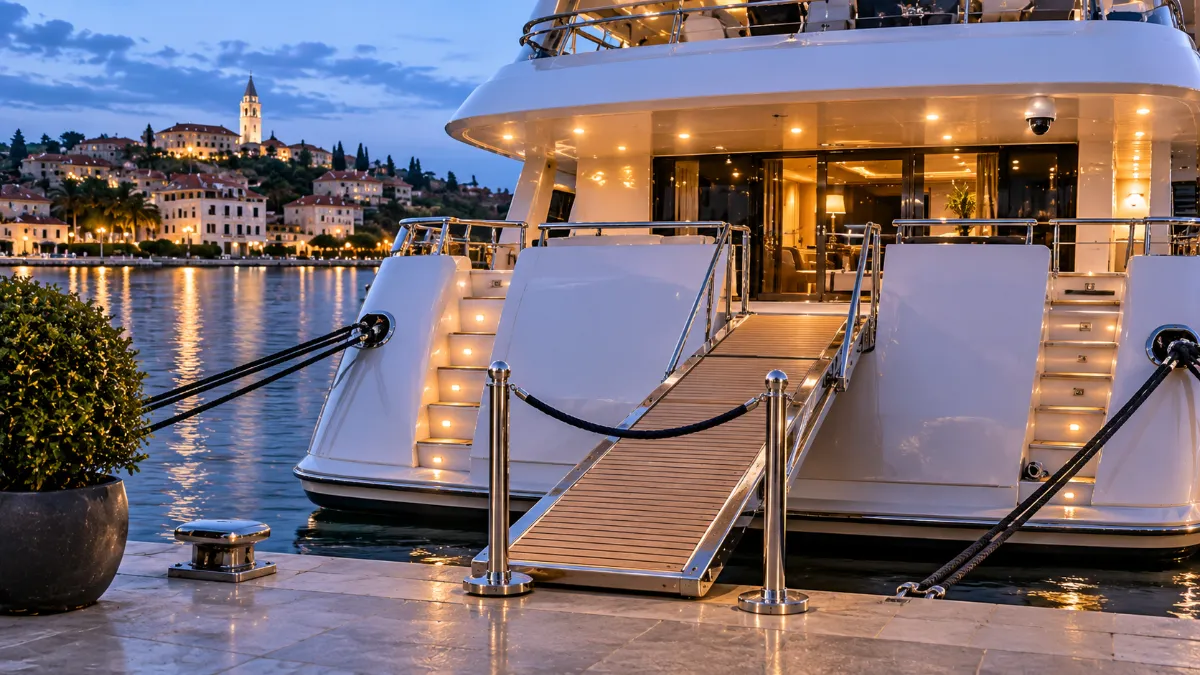
- The gangway is your front door. Access control happens at the passerelle and tender platform. For a 70-guest party on a 60m yacht, one security provider described six staff: two checking bags against the guest list and four mingling in event dress.
- The tender is your motorcade. Advisers recommend unmarked private tenders for transfers. The Göcek accident shows why speed limits and clear authority over tender use belong in the plan.
- Advance work becomes port and anchorage work. Assess the marina or anchorage, the landing point, the route to the venue and the nearest hospital, and agree medical plans with the crew’s designated medical person.
- Insider risk is structurally larger. Crew live inside your security bubble for weeks. Vetting crew and contractors is a core control, not an extra.
- You cannot drive away. There is no road extraction, so plans lean on the yacht’s safety systems, the master’s decisions and pre-agreed shore options.
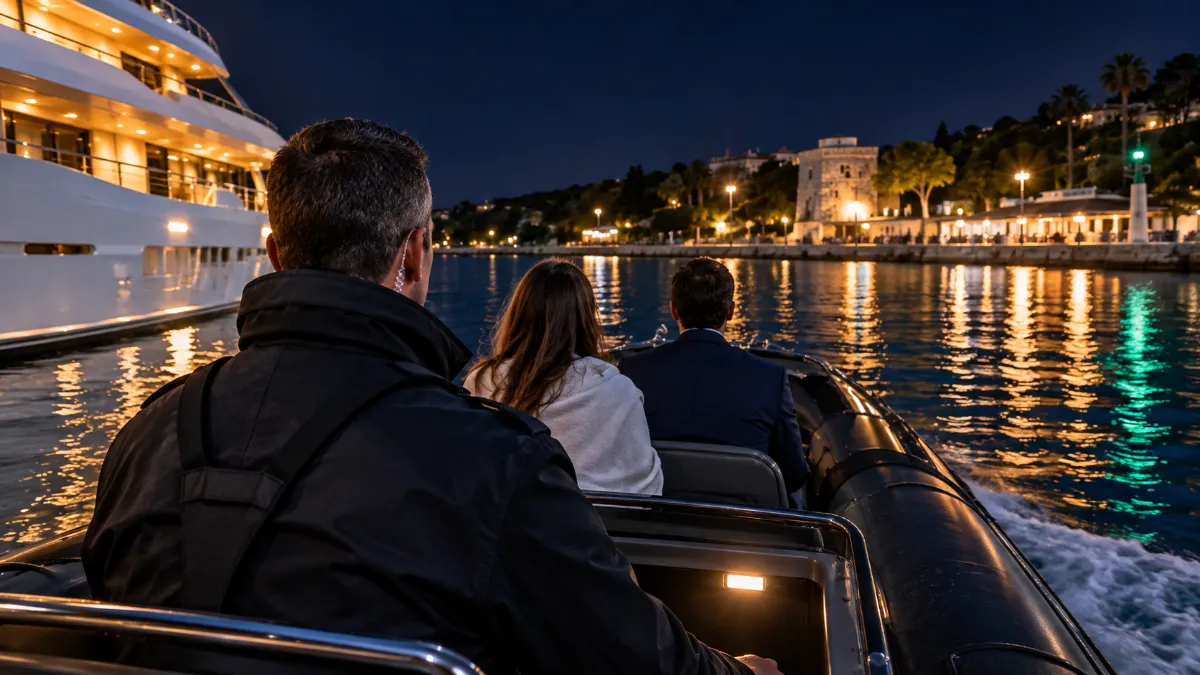
This research found no published standards for CPO night watches, man-overboard roles or yacht medevac planning, so this guide does not prescribe them.
Gear that changes at sea
These picks are research-based, chosen from manufacturer listings for water, tender and shore-run work. We have not tested them on a yacht.
ONYX M-16 Manual Inflatable Belt Pack
Manual inflation · belt pack · 17 lb buoyancy (per listing)
A life jacket you can wear around the waist under a jacket on tender runs and swim platforms. The listing gives 17 lb of buoyancy, for ages 16+ and over 80 lb.
Watch out for: It is manual: you must pull the cord, then put it over your head. Check the label for approval conditions and how it must be worn.
See current price →Earth Pak Waterproof Dry Bag
Roll-top · 500D PVC · waterproof phone case included · 5L to 55L
Keeps a principal’s spare phone, documents and your own kit dry during tender transfers and beach landings.
Watch out for: A roll-top bag is only as good as how you close it. Follow the maker’s closing instructions and pick the smallest size that fits.
See current price →Streamlight ProTac 2L-X
500 lumens · high, low and strobe modes · IPX7 · aluminum body
A compact duty light for night gangway checks, dark landings and boarding ladders. Streamlight rates it IPX7.
Watch out for: IPX7 covers temporary immersion, not diving. Carry a lanyard or holster so it does not go over the side.
See current price →RHINO RESCUE Waterproof Boat First Aid Kit
TPU roll-top dry bag · about 105 items (per listing)
A grab bag of basic supplies for the tender or a shore day, where the yacht’s medical kit is out of reach.
Watch out for: A basic kit. It does not replace the yacht’s medical kit, your first-aid training or a remote-medical plan. Check the contents against your needs.
See current price →Privacy: the threat you will manage most
- AIS is not your privacy switch. Ships of 300 GT and over on international voyages must keep AIS running. IMO guidance lets only the master turn it off, when leaving it on might compromise safety or security, with a logbook entry and a restart once the danger passes.
- Crew and guest social media leak locations. After a deckhand posted a photo showing a yacht’s name in St Barths, the gangway was mobbed that evening. NDAs help but cannot stop careless posts, so pair them with a crew media and device policy.
- Drones are mainly a privacy problem. One security firm’s CEO knew of no aggressive drone attack on a superyacht. Detection is common; jamming or downing drones is legally doubtful on private vessels.
Qualifications: what is required and what gets you hired
No accredited “maritime close protection” qualification with a published 2026 syllabus, price and dates was found. A yacht-ready CPO builds the profile from two separate stacks.
| Qualification | Why it matters | Required or preferred | Example cost and length |
|---|---|---|---|
| Land CP licence for each shore jurisdiction (e.g. UK SIA, France CNAPS, Florida Class D) | Lets you work ashore lawfully | Required where you work ashore | UK SIA licence £204, plus the Level 3 CP course (G4S: 19 days, £3,095) |
| Level 3 first aid (FAW, FPOS or FREC 3) | Prerequisite for UK CP training | Required for the UK route | Varies by provider |
| STCW Basic Safety Training | Survival, firefighting and first aid at sea | Required only if signed on as crew; widely preferred | Part of an 8-day BST + PDSD + Powerboat Level 2 bundle at £1,140 |
| ENG1 seafarer medical | Proves fitness for sea service | Required only as a seafarer | £115, valid up to 2 years |
| PDSD | Security duties under a ship security plan | Required only with plan duties; often asked for | Online about £175–£195 |
| RYA Powerboat Level 2 | Tender handling | Preferred | €550, 2 days (Antibes) |
Yacht job listings also ask for fluent English, references, a clean record and sobriety, and some state appearance rules such as no visible tattoos. Military background is listed as preferred, never required. No yacht listing found asked for FREC 4, TCCC, IPSA or ASIS certifications, or a swim test. Prices from G4S via Yotspot, STCW Direct and Bluewater, checked November 4, 2026.
Pay: public for crew, not for travelling CPOs
Crew security pay is visible in dated listings: €4,000 a month for a 41m deckhand/security post (September 2025) and €7,000 a month on a paid 2:2 rotation for a head of security on a 100m yacht (January 2026). No dated listing or survey gave a day rate for a non-crew CPO travelling with a principal on a yacht. For land CP in the UK, one 2025 job-board summary put experienced day rates at about £180–£350, without stating its method. Treat any published “yacht bodyguard day rate” with caution.
Crew security vs non-crew CP at a glance
| Crew security | Non-crew travelling CPO | |
|---|---|---|
| Employer | Yacht or management company | Principal, family office or EP firm |
| Protects | The vessel and its security plan | A named principal and family, aboard and ashore |
| Status aboard | Seafarer | Occasional worker, passenger or seafarer |
| Mandatory maritime certificates | STCW BST, ENG1, security awareness; PDSD for plan duties | None as occasional worker or passenger; familiarisation |
| Mandatory land licence | None in yacht listings | Each country where you work ashore |
| Pay evidence | €4,000–7,500 a month in dated listings | None found |
FAQ
Do I need to be part of the crew to protect a principal on a yacht? No. Red Ensign yachts can carry a bodyguard as an occasional worker or a passenger. Frequent use can make you a seafarer.
Does a UK SIA licence let me work in the Mediterranean? No. It covers work in the UK. France, Spain, Italy, Greece and Croatia have their own regimes and generally require EU/EEA nationality or local recognition.
Can I carry a firearm on a yacht? Only within the flag and port rules. In the ports checked, weapons must be declared and kept locked aboard or handed to the authorities. Carrying ashore needs a local permit that visiting foreigners rarely qualify for.
Do I need PDSD? Only if the yacht gives you duties under its ship security plan. Many employers still prefer it.
Who has the final word on board? The master, on safety and security. You advise and carry out.
Review status: Researched and checked against the linked sources on November 4, 2026. Not reviewed by a lawyer or a flag administration. Licensing, firearms and maritime rules change; check with the relevant authority before you rely on them.
Legal disclaimer: This page is for general information and education only. It is not legal advice, and reading it does not create an attorney-client relationship. Security Dogma is not a law firm. Laws, licensing rules and court decisions vary by state and change often, and what is written here may not match your situation or be current when you read it. Before you act on anything here, check the official rules from your state licensing agency, follow your employer’s and client site’s policies, and talk to a licensed attorney in your state for legal questions. See our Terms and Conditions and how facts are checked in our Editorial Policy.
Firearms and weapons disclaimer: This page discusses firearms or other weapons for general information only. It is not legal advice, not firearms training, and not a recommendation to buy, carry or use any weapon. Laws on owning, carrying, transporting and using firearms, stun guns, pepper spray, batons and knives vary by state, county and city. They change often, can be different for security work, and breaking them can lead to criminal charges. Before you carry or use any weapon, confirm the current law where you are, get any required permit or license, train with a certified instructor, and follow your employer’s, client’s and property owner’s rules. You alone are responsible for how you buy, carry, store and use any weapon. Security Dogma and its authors accept no liability for any injury, loss, damage or legal consequence that results from acting on this information. A product link does not mean the item is legal where you live, so check local restrictions before you buy.