

Security Dogma is reader-supported. When you buy through links on this page, we may earn a commission at no extra cost to you. As an Amazon Associate I earn from qualifying purchases. Learn more
Quick answer
- A security guard protects people and property on one site. The core duties are the same almost everywhere: control who comes in, patrol, watch alarms and cameras, respond to problems, help people, and write it all down.
- The real job description for any post is the site itself: its layout, its people, what the client expects and its written post orders.
- Guards aren’t police. What you may do, especially detaining someone or using force, is limited by state law and your employer’s policy.
- Hiring? There’s a free, copy-ready job description template below, with armed and supervisor versions.
I started as an entry-level guard and armed officer, then worked nightclub and event security and loss prevention, and later supervised and managed security teams, including security for large telecom companies. This guide is what the job actually involves, from both sides: the guard on post and the supervisor who trains and judges them.
It covers U.S. guard jobs. Licensing, training and what guards may legally do differ by state; check yours in our security guard license requirements by state.
Prefer to watch? This video covers the same ground in about five minutes.
This video is hosted by YouTube (Google). Loading it shares your IP address with Google and may set cookies. See our Privacy Policy.
This video was made with AI tools and summarizes this guide. Scenes are illustrations, not real events.
What does a security guard do?
The U.S. Department of Labor’s O*NET profile for security guards lists the core tasks. The most important ones are locking doors and gates, patrolling the premises for signs of intrusion, giving first aid or getting paramedics, answering alarms and checking disturbances, moving among visitors and staff to keep order, controlling who enters and leaves, writing reports of daily activity and anything unusual, warning people about rule violations, and calling police or fire in an emergency. The Bureau of Labor Statistics describes the same job in shorter form: patrol, enforce the property’s rules, monitor alarms and video, respond to emergencies, deter crime, control access, run security checks and write reports.
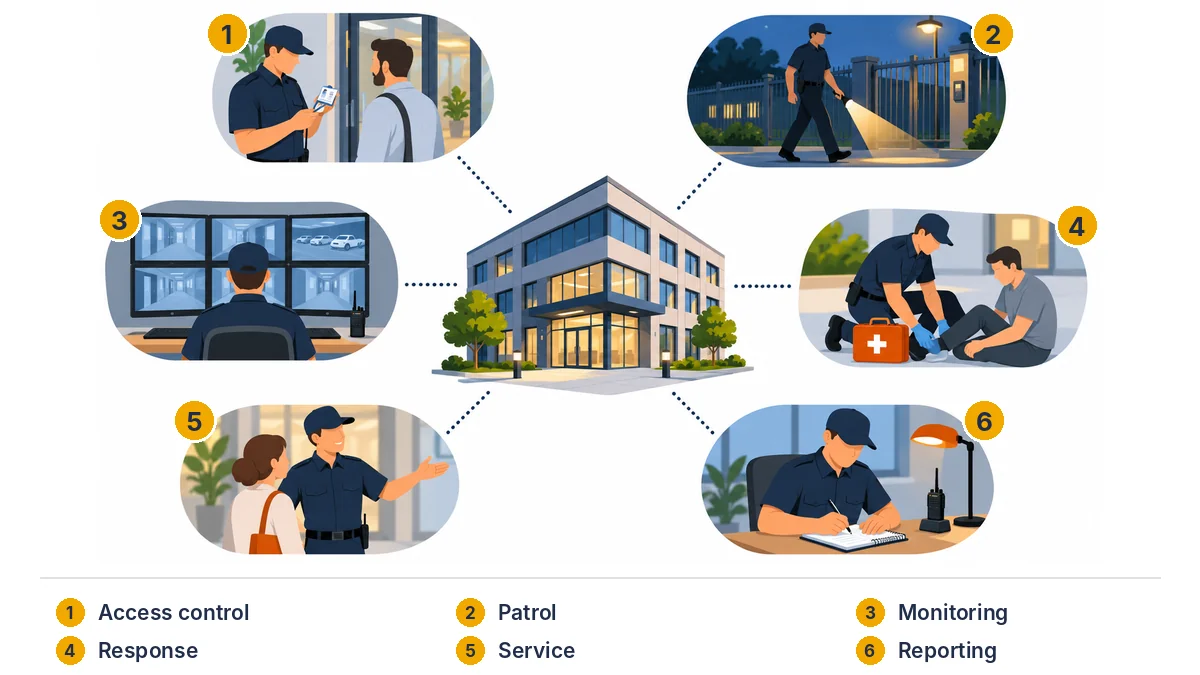
Put together, the duties on almost every post fall into six groups:
| Duty | What it looks like on shift |
|---|---|
| Access control | Checking IDs and badges, signing in visitors and contractors, keeping locked doors locked |
| Patrol | Walking or driving set routes, checking doors, gates, lights and fire equipment |
| Monitoring | Watching cameras, alarm panels and the radio |
| Response | Alarms, medical calls, disputes and trespassers, and calling police, fire or EMS when needed |
| Service | Directions, help and a calm, visible presence for staff and visitors |
| Reporting | Daily activity logs and incident reports |
People often ask for “the five basic functions” of a guard. There’s no official list of five. If you want a short version, think of it as being seen, controlling access, observing, responding and reporting. Everything in a guard job description fits under one of those.
Your first duty on a new post: learn the site
When a new guard joined my team, the first thing I talked about wasn’t patrol routes. It was the site: its layout, the stakeholders and the important people there, and what they expected from us. As the supervisor, I saw it as my responsibility to teach the new guard the whole site or event, in three parts:
- The admin part: who runs the site, who you report to, and who the client contacts are.
- The service part: who the staff, tenants, customers or guests are, and what good service looks like for them.
- The protection part: what you’re protecting, from what, and how.
On top of that come the site’s own policies and procedures, which a new guard has to understand fully. That takes time, especially on a permanent post, so I didn’t count early stumbles as a new guard getting the job wrong. It’s normal. What matters is setting a timeline for the training, so both of you know when the guard is expected to run the post alone. For the practical checklist, see your first week on a new post.
Security guard duties by type of post
The six core duties stay the same, but each post has its own purpose. Nightclub security, for example, is about keeping the peace and protecting the other customers. When I worked loss prevention, the job was stopping and catching shoplifters, although the loss prevention field is a lot more than that. At a telecom company, it was building security: protecting the people who worked there and controlling access.
| Post | Main purpose | Duties on top of the core six | Guide |
|---|---|---|---|
| Office or corporate building | Protect staff and control access | Lobby desk, visitor and contractor passes, badge problems, after-hours checks | — |
| Retail and loss prevention | Reduce theft | Floor presence, watching for theft, working with store staff; some roles detain suspects where state law and company policy allow | Loss prevention |
| Nightclub or bar | Keep the peace | ID checks, door work, crowd control, removing people from the venue safely | Bouncer |
| Events and venues | Keep a crowd safe | Bag checks, entrances and exits, crowd flow, emergency routes | — |
| Hotel | Guests, staff and property | Guest problems, room and floor checks, night patrols | Hotel security |
| Hospital | Patients, visitors and staff | Emergency department support, visitor control, de-escalation | Hospital security |
| Casino | Floor and cash protection | Floor presence, escorts, working with surveillance | Casino security |
| Mobile patrol | Cover several sites | Driving between sites, alarm response, lock-ups and unlocks | — |
| Armed posts | Higher-risk sites | Same core duties, plus carrying and securing a firearm under state rules | Armed vs. unarmed |
Why the post orders are your real job description
A job ad tells you what kind of work it is. The post orders tell you what to do on that site: patrol times, who may enter, who to call, what to log. In my experience the written orders were close to what guards really did on shift. Every site and every event throws up something the orders don’t cover, and adapting to it was fine with me, as long as nothing broke policy or the law.
If you’re starting a new post, ask for the post orders on day one and read them line by line. If you run a site and your orders are thin or out of date, our Post Orders Kit gives you a full template to start from.
What a supervisor actually judges you on
Every guard on a site has the same duties on paper. What made me trust one guard more than another wasn’t on the list. The guards I trusted:
- showed they were serious about the job;
- asked questions when they started;
- thought outside the box, within the post orders and the law;
- understood the service side of the job, not just the protection side;
- wanted to advance.
The ones I didn’t trust were the seat warmers: present for the hours, but not really doing the job.
Reports count more than most new guards think. It was very important to me that reports were very detailed, because a report is often the only part of your shift the client ever sees. Writing a good report is a skill, and it can be developed. Start with our free daily activity report and incident report template.
And expect quiet shifts. The job can be very boring at times, which is a good thing: if things are boring, nothing bad is happening. Shifts are usually about 8 hours on rotating schedules, and night shifts are common, according to the Bureau of Labor Statistics. Our night shift survival guide covers staying sharp when nothing happens for hours.
What is not a security guard’s job?
Knowing the limits is part of the job description. In general, for U.S. private guards:
- You’re not the police. In most states, private guards have the same arrest powers as any private citizen, and carrying a gun doesn’t add to them. Where detaining someone is allowed at all, state law and your employer’s policy set the rules. See armed vs. unarmed security guards.
- Force is a last resort, not a duty. O*NET’s task list includes removing violators “using force when necessary,” but what’s necessary, and legal, is set by state law, your employer’s use-of-force policy and your post orders. I never had a guard I managed cross that line, but colleagues have dealt with guards who were too aggressive and used excessive force. Those guards create risk for the client, the company and themselves.
- Duties outside the post orders need a supervisor’s OK. Adapting to what happens on shift is part of the job. Taking on a new role on your own isn’t.
This is general information, not legal advice. Your state’s rules and your employer’s policy decide what you may do on your post.
What does a security supervisor do?
A supervisor or lead guard does the guard’s job and more. O*NET’s profile for first-line supervisors of security workers lists the same core tasks (investigating disturbances, patrolling, controlling entry, securing doors, writing patrol reports, calling police or fire) plus running the team: checking that guards follow procedures, advising them on problems and complaints, assigning guards to posts and patrols, and recruiting, interviewing and hiring.
What I expected from a supervisor that I didn’t expect from a guard was direction, guidance and training, being able to answer the team’s questions, and developing the team. If you want to move up, start practicing those now. See security career paths, and for the application, what goes on a security supervisor resume.
Security guard job description template (free to copy)
For employers writing a job ad. When I hired guards, my ads asked for the usual: the license and some experience. That’s what most ads ask for. Adding the type of post and the shift helps the right people apply. Replace everything in [brackets], and check your state’s licensing, age and background check rules before you post.
Job title: Security Officer ([unarmed / armed], [post type, e.g. corporate building])
Location and schedule: [site address or area] · [days, shift times, nights/weekends/holidays]
Pay: [hourly rate or range]
About the role: Protect the people, property and assets at [site] by controlling access, patrolling, monitoring security systems, responding to incidents and keeping accurate reports, while giving professional service to staff and visitors.
Duties:
- Control entry: check IDs and badges, sign in visitors and contractors, issue passes.
- Patrol the site on foot or by vehicle on a set schedule; check doors, gates, lighting and fire equipment.
- Monitor cameras, alarms and radio traffic.
- Respond to alarms, medical calls, disputes and suspicious activity; call police, fire or EMS when needed.
- Enforce site rules and post orders and de-escalate conflicts.
- Give directions and help to staff and visitors.
- Write detailed daily activity logs and incident reports.
- [Site-specific duties from your post orders]
Requirements:
- [State] security guard license or registration, current, or eligibility to obtain it before starting [per state law]
- High school diploma or equivalent [if required]
- [Minimum age per state law and company policy]
- Ability to pass the required background check
- Clear spoken and written English; comfortable writing reports
- [Physical demands of this post, e.g. standing or walking for long periods]
- [Experience: e.g. 1 year in security, customer service or the military preferred]
Preferred: CPR/First Aid/AED certification · [site-specific experience]
Armed version, add: current armed license or firearm permit for [state] and completed state-required firearms training [per state law]; meet the employer’s firearm qualification and storage rules. Requirements differ by state; see armed vs. unarmed security guards.
Supervisor version, add: supervise and schedule officers on [site]; train new officers on the site and its post orders; check that procedures are followed; review reports; handle complaints and escalations; take part in hiring. Prior security experience, and leading people, preferred.
Hiring through a security company instead? See how to hire a security guard and how much a security guard costs. Job seekers: check typical pay in security guard salary by state.
Skills and qualities a security guard needs
The Bureau of Labor Statistics lists four important qualities: communication, interpersonal skills (including handling and de-escalating confrontations), observation, and problem-solving. In O*NET’s ratings, the two highest work styles for guards are dependability and integrity. To those I’d add the ones I hired and promoted for: asking questions, understanding the service side of the job, and writing a detailed report.
Gear for the core duties
Some links in this section are affiliate links. If you buy through them, Security Dogma may earn a commission at no extra cost to you. As an Amazon Associate I earn from qualifying purchases. Learn more. These are research picks: I haven’t tested these exact products.
Rite in the Rain Pocket Notebook (No. 754)
3.5″ x 5″ · weatherproof paper · soft cover
A detailed report starts with notes taken on the spot: times, names, what was said. This one fits a shirt pocket and survives rain on an outdoor patrol.
Watch out for: some sites require notes on their own forms or app. Check your post orders first.
See current price →Paid link · opens Amazon.com
Streamlight ProTac HL-X Flashlight
1,300 lumens · IPX7 water rating · aluminum body (per the listing)
Night patrols, stairwells, parking areas and checking doors and fences all need a light you can rely on. See our security guard flashlights guide for the full comparison.
Watch out for: some employers issue lights or set rules on what you carry. Ask before you buy.
See current price →Paid link · opens Amazon.com
CPR Keychain Face Shields, 6-Pack
One-way valve · keychain pouch
Responding to medical emergencies is one of a guard’s core duties. A face shield on your key ring means you’re never without one.
Watch out for: a face shield is not training. Take a CPR and first-aid course too.
See current price →Paid link · opens Amazon.com

FAQ
What are the main duties of a security guard?
Controlling access, patrolling, monitoring alarms and cameras, responding to emergencies and calling police, fire or EMS, helping staff and visitors, and writing reports. Each post adds its own duties through its post orders.
Is a security officer the same as a security guard?
Yes, for most purposes. The Bureau of Labor Statistics notes that security guards are also called security officers, and O*NET’s list of job titles for the occupation includes both. Some employers use “officer” for the same job or for more senior posts, so read the duties, not just the title.
Can I download a security guard job description as a PDF?
Copy the template above into Word or Google Docs, fill in the brackets, and save it as a PDF. That keeps it specific to your site, which a generic PDF can’t do.
Do security guards need experience?
Many entry-level jobs don’t require security experience, but most states require a license or registration, and employers usually ask for some experience or a related background. See how to become a security guard.
Is being a security guard boring?
It can be, and that’s usually a good sign. If things are boring, nothing bad is happening. The guards who do well use quiet time to patrol properly, learn the site and keep their reports detailed.
Sources
- U.S. Department of Labor, O*NET OnLine, 33-9032.00 Security Guards (updated 2026; checked November 15, 2026).
- U.S. Department of Labor, O*NET OnLine, 33-1091.00 First-Line Supervisors of Security Workers (updated 2026; checked November 15, 2026).
- U.S. Bureau of Labor Statistics, Occupational Outlook Handbook: Security Guards and Gambling Surveillance Officers (checked November 15, 2026).
- Arrest powers and armed duties: Security Dogma, Armed vs. Unarmed Security Guards and state licensing guides, sourced to each state’s regulator.
- Author experience: Yair Arad, security guard, armed officer, loss prevention, nightclub and event security, and security supervisor and manager.
Last verified November 15, 2026.
Firearms and weapons disclaimer: This page discusses firearms or other weapons for general information only. It is not legal advice, not firearms training, and not a recommendation to buy, carry or use any weapon. Laws on owning, carrying, transporting and using firearms, stun guns, pepper spray, batons and knives vary by state, county and city. They change often, can be different for security work, and breaking them can lead to criminal charges. Before you carry or use any weapon, confirm the current law where you are, get any required permit or license, train with a certified instructor, and follow your employer’s, client’s and property owner’s rules. You alone are responsible for how you buy, carry, store and use any weapon. Security Dogma and its authors accept no liability for any injury, loss, damage or legal consequence that results from acting on this information. A product link does not mean the item is legal where you live, so check local restrictions before you buy.
Legal disclaimer: This page is for general information and education only. It is not legal advice, and reading it does not create an attorney-client relationship. Security Dogma is not a law firm. Laws, licensing rules and court decisions vary by state and change often, and what is written here may not match your situation or be current when you read it. Before you act on anything here, check the official rules from your state licensing agency, follow your employer’s and client site’s policies, and talk to a licensed attorney in your state for legal questions. See our Terms and Conditions and how facts are checked in our Editorial Policy.