
Security Dogma is reader-supported. When you buy through links on this page, we may earn a commission at no extra cost to you. As an Amazon Associate I earn from qualifying purchases. Learn more
Quick answer
A duty belt is a stiff, wide belt (usually 2 to 2.25 inches) that carries your radio, flashlight, gloves and keys so your hands stay free. Most unarmed guards can work with a strong 1.5-inch belt; armed guards and anyone carrying a full kit need a real two-belt duty system: an inner belt through your pant loops, an outer duty belt that sticks to it, and belt keepers to lock them together.
- Sizing: belt makers such as Bianchi size the duty belt 4 inches over your pant size and the inner belt 2 inches over.
- Nylon or leather: nylon is lighter and easier to care for; leather or leather-look belts are for dress uniforms.
- Weight: carry only what your post needs. Every item is weight on your hips for the whole shift.
- Plainclothes and executive protection: a stiff gun belt, often double-layered leather, not a duty belt.
- What you may carry: handcuffs, pepper spray, batons and firearms depend on your state license, permits and employer.
A confession first: in my armed work I didn’t wear a standard duty belt. Most of my armed roles were executive protection, and when they were security posts, the firearm was concealed. What I wore was a thick, double-layered leather belt made to carry a holster and equipment, bought at my local shooting range. It held the gear, took the wear and tear, and still held up my pants. That experience shapes this guide: the right belt depends on the job, and a duty belt is only one answer.
This guide is for guards choosing their first duty belt, or replacing one that sags, slides or hurts by hour six. It covers what to buy, how to size and set it up, and how to keep the weight off your lower back. For the rest of your kit, see the security guard equipment list.
Prefer to watch? This video covers the same ground in about six minutes.
This video is hosted by YouTube (Google). Loading it shares your IP address with Google and may set cookies. See our Privacy Policy.
This video was made with AI tools and summarizes this guide. Scenes are illustrations, not real events.
Do security guards need a duty belt?
It depends on your post, not on how tactical you want to look. Many unarmed posts, like front desks, lobbies and corporate sites, need only a radio, a flashlight, a phone and a notebook. A good 1.5-inch belt through your pant loops can carry a radio and a light without a full duty rig, and it looks less aggressive to the public.
A real duty belt makes sense when you carry more: patrol posts with a radio, light, gloves and keys; posts where you’re licensed and authorized to carry handcuffs, pepper spray or a baton; and armed posts, where the holster needs a stiff, stable belt that won’t sag or twist. Your employer’s uniform policy often decides it for you, so ask before you buy.
| Belt | Width | Best for | Watch out for |
|---|---|---|---|
| Regular uniform belt | About 1.25–1.5″ | Front desk, lobby, light kit (radio and light) | Sags and twists under a full load |
| Stiff 1.5″ tactical or “EDC” belt | 1.5″ | Unarmed patrol with a few items; also works as an inner belt for some systems | Not wide enough for most duty holsters and pouches made for 2″–2.25″ belts |
| Two-belt duty system | 2″–2.25″ outer over a 1.5″ inner | Armed posts and full kits | Heavier and hotter; worth it only if you carry the gear |
How the two-belt system works
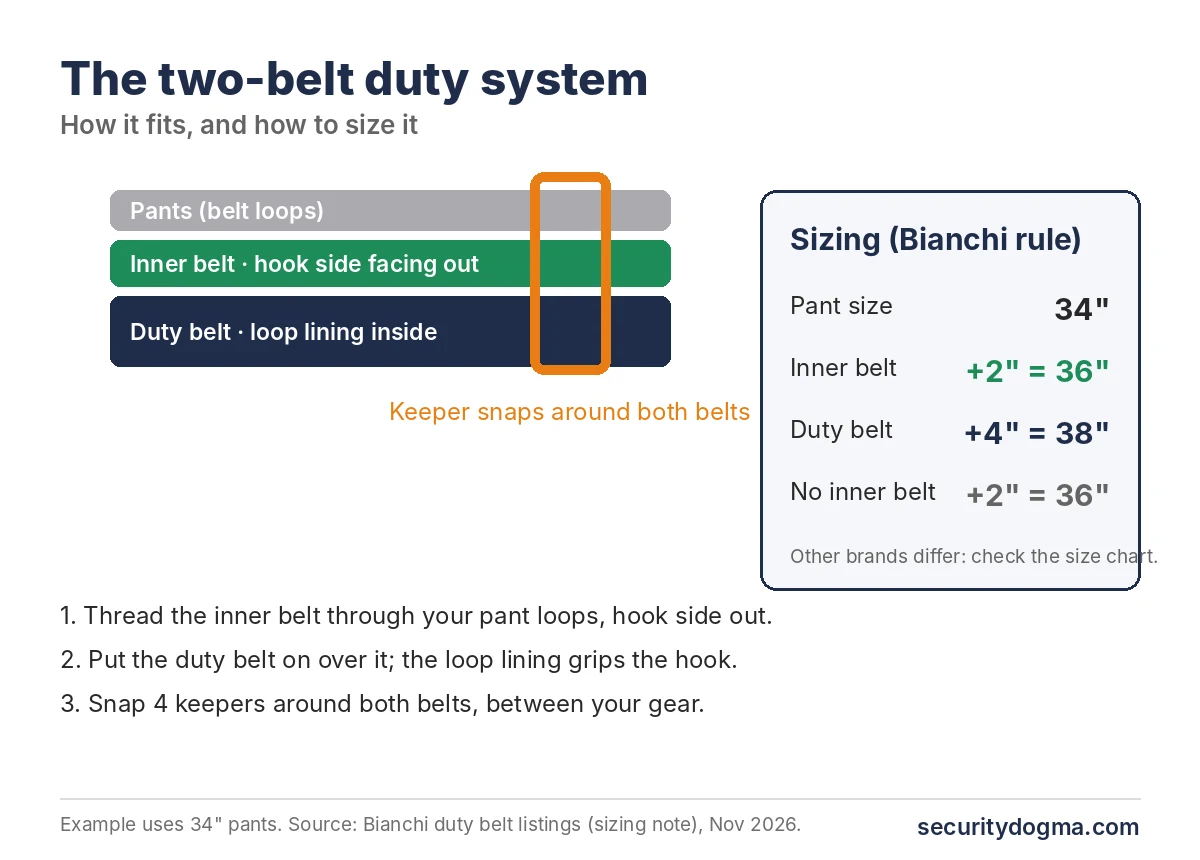
Police and armed guards use two belts for a reason. The inner belt (also called a liner or underbelt) goes through your pant loops like a normal belt, with hook (Velcro) on the outside. The outer duty belt has loop material on the inside, so it grips the inner belt all the way around. Belt keepers, small straps with snaps, wrap around both belts and through the gaps between your gear, so the outer belt can’t ride up or slide when you run, sit or bend.
How to size a duty belt
Don’t order your jeans size. Bianchi’s sizing note, repeated on its duty belt listings, says a duty belt worn over an underbelt should be measured 4 inches over your pant size, and the underbelt 2 inches over. With 34-inch pants, that means a 38-inch duty belt and a 36-inch inner belt. If you won’t use an inner belt, Bianchi says to order 2 inches over pant size. Other brands run differently (5.11 says its TDU belt runs small and to order two sizes up), so check the size chart for the exact belt you buy.
How many keepers?
Four is the common setup: two at the front and two at the back, between your gear. More keepers mean less movement but more snapping on and off at the end of the shift. Place them where the belt has no pouch, so nothing pushes against them.
Nylon vs leather duty belts
| Nylon | Leather or leather-look | |
|---|---|---|
| Weight | Lighter | Heavier |
| Care | Wipe clean; tolerates rain and sweat | Needs polishing; real leather can crack if neglected |
| Look | Tactical, matte | Formal; matches shined shoes and dress uniforms |
| Break-in | Little | Real leather needs breaking in; leather-look synthetics need less |
| Typical use | Patrol, outdoor and armed posts | Dress, executive and front-of-house posts |
Read listings carefully. Some “leather” duty belts are actually a leather-look synthetic: Bianchi’s AccuMold Elite 7950, for example, is listed with a “Duraskin leather-look exterior.” That isn’t a flaw, since synthetics resist cracking and are easier to keep shiny, but it’s not the same as full-grain leather.
I went with leather. For everyday armed work my belts were thick and double-layered so they wouldn’t sag under a holster; for suits at high-end events I wore the same type of belt, just thinner, so it looked like a normal dress belt.
How to set up your belt
There’s no single correct layout, and your employer may set one. The common logic is simple: things you need fast go where your hands fall naturally, heavy items go near your hips, not your spine, and nothing sits where you’ll lean against it in a chair or vehicle seat.
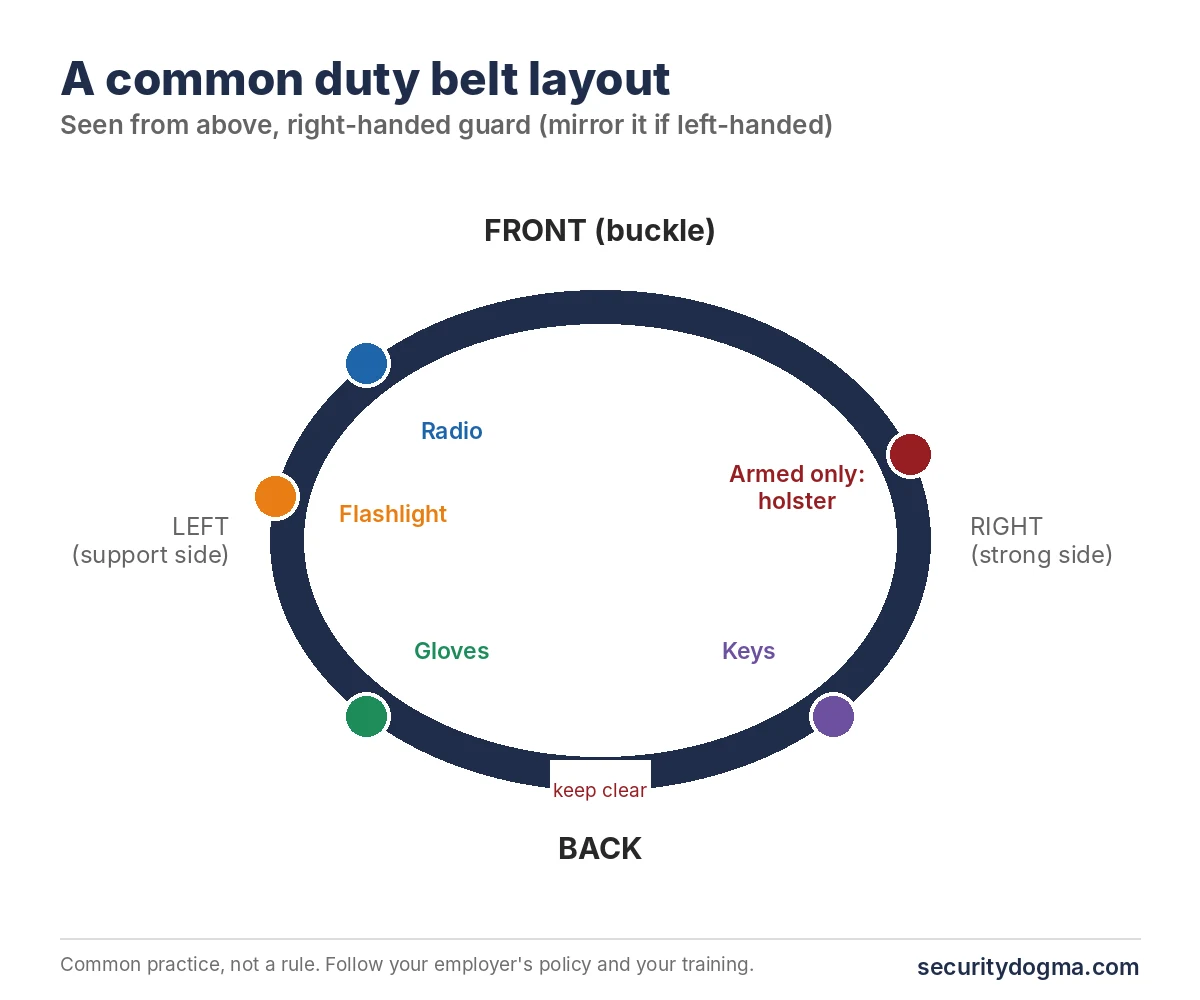
- Radio: in a radio holster on your support side (your non-shooting, non-writing side), so your strong hand stays free.
- Flashlight: where you can draw it with either hand. Many guards keep it support-side front.
- Gloves: in a glove pouch toward the back, so they’re out of the way but reachable.
- Keys: on a silent key holder or keeper toward the back, so they don’t jingle on night patrols.
- Nothing over your spine: leave the center of your back clear. Anything there presses into your spine when you sit and can injure you in a fall.
- Armed guards: the holster goes on your strong side, exactly where your firearms training put it. Don’t change a holster position you qualified with without retraining.
The most common mistake I saw: too much equipment. You’re not Batman. Wear what your post actually needs, and leave the rest in your locker or your car.
⚖️ Legal note: what you’re allowed to carry on your belt is set by your state license and permits, your employer and the site, not by what the belt can hold. Handcuffs, pepper spray, batons, stun guns and firearms each have their own rules, and many states require separate training or permits. Check your state’s licensing rules before you buy anything beyond a radio, light and gloves. See armed vs unarmed security guards and your state’s page in our licensing guides.
How heavy is too heavy? Duty belts and back pain
Back pain is the most common complaint about duty belts, and the research on police officers, who carry heavier belts than most guards, backs it up. A 2023 study in the Journal of Functional Morphology and Kinesiology notes that about 60% of law enforcement officers experience low back pain, with the duty belt often reported as a contributing factor. Its test belts weighed 7.2 kg (about 16 pounds), and the authors note a duty belt can exceed 9 kg depending on the gear. Participants rated a load-bearing vest as more comfortable and less restrictive than either a nylon or leather duty belt. The study couldn’t show the belt itself causes back pain: it measured short sessions, not 8-hour shifts.
Most security guards carry far less than a police officer, which is good news. What helps:
- Carry less. If you haven’t used something in a month, ask whether it belongs on your belt.
- Move weight off your hips where your uniform allows: phone and notebook in a pocket, not a pouch.
- Keep the belt snug, with keepers, so the weight doesn’t bounce or drag on one side.
- Watch your seat. Long stretches seated in a patrol vehicle or booth with a loaded belt are where many officers report problems. Shift items that press into the seat.
- Ask about alternatives. Some employers allow suspenders or a load-bearing vest. It’s their policy, not your choice, so ask.
It didn’t happen to me, but I watched it happen to a colleague, a police officer, who had major back pain after long shifts with a loaded belt. It’s a common story, and it’s why “carry less” is the first tip, not the last.
⚠️ Health note: this is general information, not medical advice. If you have back, hip or leg pain, numbness or tingling that doesn’t go away, see a doctor or physical therapist.
Concealed armed work: a gun belt, not a duty belt
If you’re armed in plain clothes, as in executive protection or some plainclothes security roles, a duty belt is the wrong tool. You need a gun belt: an ordinary-looking belt built stiff enough to carry an inside-the-waistband (IWB) holster without sagging or letting the holster tilt. Thick, double-layered leather is the traditional choice; reinforced nylon belts are the modern alternative.
Two lessons from my own work: get the belt from a place that knows holsters, as I did at my local shooting range, rather than a department store, and match the belt to the clothes. The same type of belt in a thinner, dressier version worked under a suit at high-end events. My holster preference was Fobus, though the leather holsters worked well too; whatever you choose, train with exactly the belt and holster you’ll carry on duty.
⚖️ Legal note: carrying a concealed firearm for work requires the licenses and permits your state and employer require, which often differ from an exposed-carry security permit. Confirm the rules where you work before you carry.
Metal detectors and secure posts
If you work a post with metal detectors (courthouses, stadiums, airports, events), a belt with a metal buckle means removing it at every screening. Some belts use non-metallic buckles for exactly this reason: 5.11’s TDU belt, for example, is listed with a non-metallic plastic buckle and described as metal-detector friendly.
Duty belts and accessories worth considering
These are research picks, not products I’ve tested: chosen from manufacturer listings, specifications and long-term buyer ratings, for a mix of posts and budgets. Prices change, so check the listing. Some links are affiliate links: if you buy through them, Security Dogma may earn a commission at no extra cost to you. As an Amazon Associate I earn from qualifying purchases.
Bianchi 7200 AccuMold Duty Belt
Nylon, fits 2.25″ (58 mm) belt loops · five-part laminate · hook-and-loop closure · polymer buckle with 3-point release · loop lining to pair with an inner belt (per the listing)
A long-standing police and security staple: stiff enough for a holster, light, and easy to wipe clean. The loop lining grips a hook-faced inner belt, so it’s the core of a proper two-belt system.
Watch out for: it needs an inner belt to work as designed, and it fits 2.25″ gear, so check your holster and pouches fit that width. Size it 4″ over your pant size.
See current price →Paid link · opens Amazon.com
5.11 Tactical Sierra Bravo Duty Belt
2″ wide · dual-layer 1680D ballistic nylon with water-resistant finish · slim-lock buckle · hook-and-loop inner lining (per the listing)
A modern take on the duty belt from a brand many agencies use, with a low-profile buckle and a 2″ width that fits much current duty gear. A good choice if you want one belt for years of armed or patrol work.
Watch out for: it’s 2″, not 2.25″: gear made for 2.25″ belts can ride loose. It costs more than the Bianchi, and it has fewer buyer ratings so far.
See current price →Paid link · opens Amazon.com
Bianchi 7205 Nylon Liner Belt
1.5″ wide · nylon web · hook-and-loop closure · designed to pair with Bianchi duty belts (per the listing)
The belt that goes through your pant loops and holds your duty belt in place. Bianchi lists its leather-look 7950 duty belt as made “for use with” this liner, and it pairs with any duty belt that has a loop lining.
Watch out for: size it 2″ over your pant size, not your duty belt size. It only works with a duty belt lined with loop material.
See current price →Paid link · opens Amazon.com
5.11 Tactical TDU Belt 1.5″
1.5″ nylon webbing · non-metallic plastic buckle · quadruple-stitched · listing notes sizing runs small (order 2 sizes up)
For unarmed posts with a radio and a light, this is often all you need, and the non-metallic buckle means you can walk through a metal detector without taking it off.
Watch out for: it’s not a full duty belt: it won’t carry a holster and a full kit as stably as a 2″–2.25″ two-belt system.
See current price →Paid link · opens Amazon.com
Bianchi AccuMold Elite 7950 Duty Belt
Fits 2.25″ (58 mm) belt loops · Duraskin leather-look exterior · closed-cell foam · polymer buckle with 3-point release · loop lining for the 7205 liner (per the listing)
The formal look of a leather duty belt that you can keep shiny for executive, corporate and front-of-house posts, without the care real leather needs.
Watch out for: despite “leather” in some listing titles, it’s a leather-look synthetic, not full-grain leather. Size it 4″ over your pant size if you wear the liner.
See current price →Paid link · opens Amazon.com
Ullnosoo Belt Keepers, 8-Pack
1000D nylon · double snaps · hook-and-loop · fit 2″–2.25″ belts (per the listing)
Keepers lock your duty belt to your inner belt so it doesn’t slide or ride up. An 8-pack covers the usual four plus spares, because keepers are the first thing to go missing.
Watch out for: check the width matches your duty belt (2″ or 2.25″). A no-name brand, so judge it by the buyer ratings and replace worn snaps.
See current price →Paid link · opens Amazon.com
Your radio holster, glove pouch and earpiece go on this belt too. We cover those in the two-way radios guide and the equipment list, and flashlights in our flashlights guide.
Frequently asked questions
Do security guards need a duty belt?
Not always. Many unarmed posts only need a radio, flashlight and phone, which a strong 1.5-inch belt can carry. A full duty belt makes sense for patrol posts with more gear and for armed guards, whose holster needs a stiff, stable belt. Your employer’s uniform policy often decides.
What size duty belt should I get?
Not your pant size. Bianchi’s sizing note says to order a duty belt 4 inches over your pant size when you wear it over an inner belt, and the inner belt 2 inches over. Without an inner belt, order 2 inches over. Other brands differ, so check the size chart for the belt you buy.
What is an inner belt on a duty belt?
An inner belt, also called a liner or underbelt, goes through your pant loops with hook material facing out. The outer duty belt has loop lining, so it grips the inner belt all the way around, and belt keepers snap around both to stop the duty belt sliding or riding up.
Is nylon or leather better for a duty belt?
Nylon is lighter, tolerates rain and sweat, and needs little care, so it suits patrol and armed posts. Leather or leather-look belts are more formal and suit dress and front-of-house posts. Some belts sold as leather are actually leather-look synthetics, so read the listing.
How many belt keepers do I need?
Four is the common setup, two at the front and two at the back, placed between your gear where there’s no pouch. More keepers mean less movement but more snaps to undo at the end of the shift.
Can a duty belt cause back pain?
It can contribute. About 60% of law enforcement officers report low back pain, and the duty belt is often named as a factor, though research hasn’t proven the belt causes it. Carrying less, keeping the belt snug and moving items off your hips help. See a doctor if pain persists.
What belt do armed executive protection agents wear?
Usually not a duty belt. Plainclothes and executive protection work calls for a gun belt: a normal-looking but stiff belt, often thick double-layered leather, that carries an inside-the-waistband holster without sagging. A thinner dress version works under a suit. Concealed carry requires the right licenses and permits.
What can a security guard carry on a duty belt?
A radio, flashlight, gloves and keys are standard. Handcuffs, pepper spray, batons, stun guns and firearms depend on your state license and permits, your employer and the site, and many states require separate training or permits for each.
Sources
- Kearney et al., “Effect of the Law Enforcement Duty Belt on Muscle Activation during Hip Hinging Movements in Young, Healthy Adults,” Journal of Functional Morphology and Kinesiology, 2023
- Manufacturer listings for the products above (Bianchi, 5.11 Tactical, Ullnosoo), including Bianchi’s published sizing note, read November 19, 2026
Checked November 19, 2026. Product details and prices change; check the listing before you buy. This guide is general information, not legal or medical advice.
Legal disclaimer: This page is for general information and education only. It is not legal advice, and reading it does not create an attorney-client relationship. Security Dogma is not a law firm. Laws, licensing rules and court decisions vary by state and change often, and what is written here may not match your situation or be current when you read it. Before you act on anything here, check the official rules from your state licensing agency, follow your employer’s and client site’s policies, and talk to a licensed attorney in your state for legal questions. See our Terms and Conditions and how facts are checked in our Editorial Policy.
Firearms and weapons disclaimer: This page discusses firearms or other weapons for general information only. It is not legal advice, not firearms training, and not a recommendation to buy, carry or use any weapon. Laws on owning, carrying, transporting and using firearms, stun guns, pepper spray, batons and knives vary by state, county and city. They change often, can be different for security work, and breaking them can lead to criminal charges. Before you carry or use any weapon, confirm the current law where you are, get any required permit or license, train with a certified instructor, and follow your employer’s, client’s and property owner’s rules. You alone are responsible for how you buy, carry, store and use any weapon. Security Dogma and its authors accept no liability for any injury, loss, damage or legal consequence that results from acting on this information. A product link does not mean the item is legal where you live, so check local restrictions before you buy.