
Security Dogma is reader-supported. When you buy through links on this page, we may earn a commission at no extra cost to you. As an Amazon Associate I earn from qualifying purchases. Learn more
Quick answer
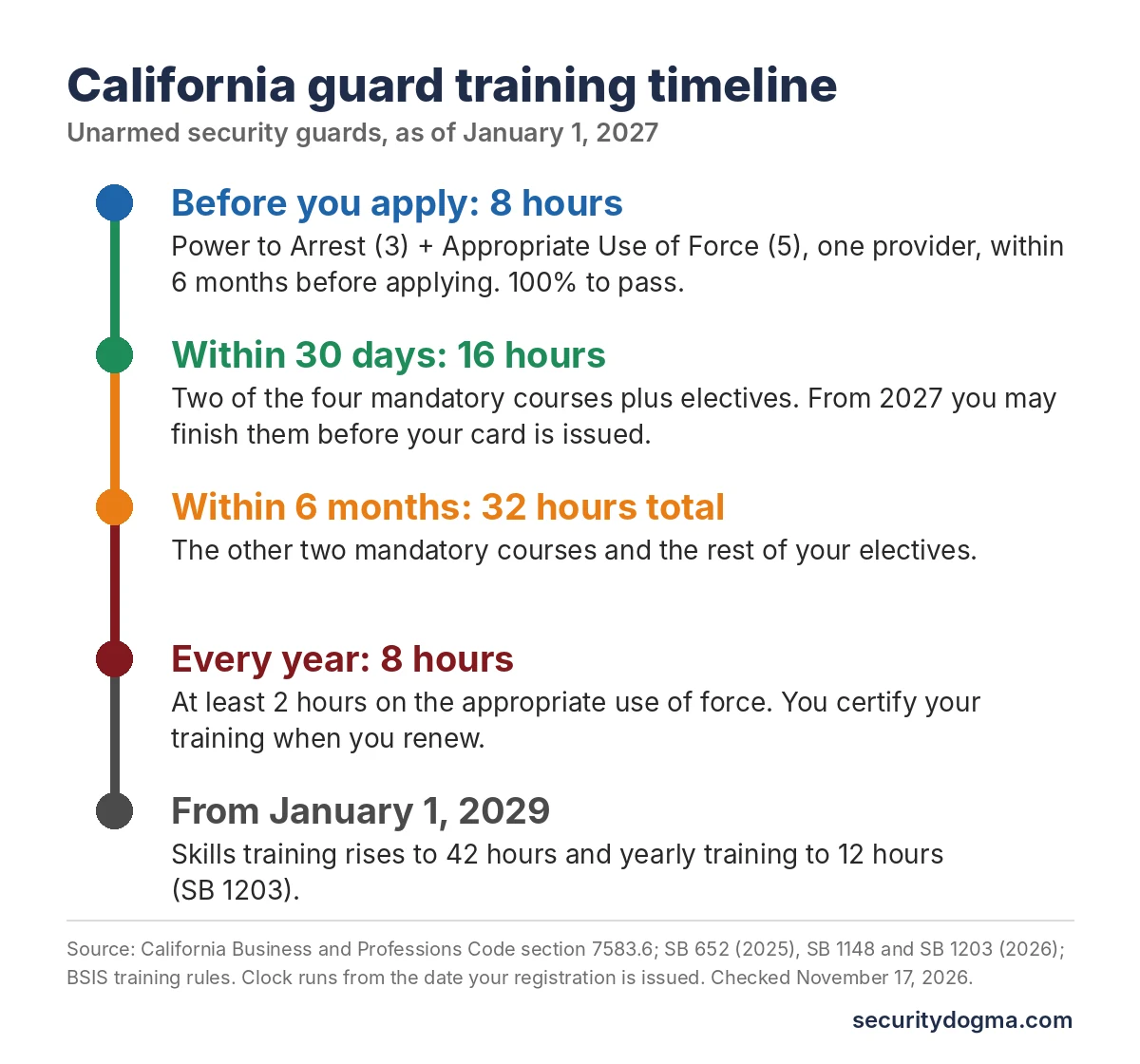
- Before you apply: an 8-hour course, 3 hours of Power to Arrest and 5 hours of Appropriate Use of Force, passed with a score of 100%. Since 2026 it must come from one provider and be finished within the 6 months before you apply.
- After your guard card is issued: 32 hours of security officer skills training, 16 within 30 days and all 32 within 6 months. Starting January 1, 2027, you may also finish them before your card is issued.
- Every year: 8 hours of continuing training, including at least 2 hours on the appropriate use of force.
- Armed or carrying a baton: you need a separate BSIS permit with its own course, and firearm permit holders requalify at the range four times every two years.
- Coming in 2029: a law signed in 2026 raises the skills training to 42 hours and the yearly training to 12 hours, starting January 1, 2029.
I held a California guard card and an armed guard permit in the early 2000s, and I later supervised guards. I honestly don’t remember the basic guard card course. I do remember the firearms training and qualifying at my local range, and the short course our nightclub owners sent us to with the Department of Alcoholic Beverage Control. The rules have changed a lot since then, so every requirement below comes from California law and BSIS’s current rules, checked November 17, 2026.
This guide covers the training itself: every course, hour and deadline for each type of guard. For the whole application process, see how to get a guard card in California. For renewal, see California guard card renewal.
This guide is general information about California’s training rules, not legal advice. Requirements change, so confirm with BSIS before you enroll or apply.
California guard training at a glance
| Guard type | Before registration | After registration | Every year |
|---|---|---|---|
| Security guard (unarmed) | 8-hour Power to Arrest and Use of Force course | 32 hours within 6 months (16 within 30 days) | 8 hours (2 on use of force) |
| Armed guard | Same as above, plus a firearms permit: personality assessment, firearms course and range qualification | Same 32 hours | Same 8 hours, plus 4 range requalifications every 2 years |
| Guard with a baton | Same as above, plus a baton permit and an 8-hour baton course | Same 32 hours | Same 8 hours; baton course again before each 2-year renewal |
| Proprietary (in-house) security officer | 8-hour Power to Arrest and Use of Force course | 16 hours of mandatory courses within 6 months | 8 hours (2 on use of force) |
| School security guard | Same as the guard row | 24-hour school security course (replaces the 32 hours) | 8 hours |
Step 1: The 8-hour course before you apply
You can’t get a California guard card (BSIS calls it a security guard registration) until you finish a course in the power to arrest and the appropriate use of force (Business and Professions Code section 7583.6). BSIS splits it into two parts:
- Power to Arrest, 3 hours: your authority to make a private person’s (citizen’s) arrest, its limits, and the responsibilities and ethics that come with it.
- Appropriate Use of Force, 5 hours: the legal standards for force, the duty to intercede, de-escalation and communication, implicit bias, interacting with people with disabilities or behavioral health issues, use-of-force scenarios and active shooter situations.
The course ends with an exam, and you need a score of 100% to pass (California Code of Regulations, title 16, section 628).
Three rules catch people out:
- One provider, both parts. Since January 1, 2026 (SB 652), the whole course must be taught and certified by a single course provider. You can’t take Power to Arrest at one school and Use of Force at another.
- A 6-month window. You must finish the course within the 6 months before you submit your application. An older certificate no longer counts.
- Part of it is in a classroom. The use-of-force portion must be traditional classroom instruction, with the instructor physically present for at least half of the course (section 7583.7). That’s why you can’t get a guard card entirely online.
Older guides still say the 8 hours are Power to Arrest plus Weapons of Mass Destruction (WMD) and Terrorism Awareness. That changed in 2023: the law now says WMD may be an elective topic only.
Step 2: The 32 hours of skills training
After your guard card is issued, you have 30 days to complete 16 hours of security officer skills training, and 6 months to complete all 32 (section 7583.6). If you can’t show your employer your certificates, the same clock runs from the day you start the job instead.
New for 2027: starting January 1, 2027 (SB 1148), you may complete the 32 hours before your registration is issued, as long as you’ve already finished the 8-hour course. It’s an option, not a requirement. Schools may sell “40-hour” packages, but the law still requires only the 8-hour course before you apply.
The four required courses
Half of the 32 hours are four mandatory 4-hour courses. Take any two within your first 30 days, and the other two within 6 months.
| Mandatory course | Hours |
|---|---|
| Public Relations (Community and Customer) | 4 |
| Observation and Documentation | 4 |
| Communication and Its Significance | 4 |
| Liability and Legal Aspects | 4 |
Electives: the other 16 hours
You pick the rest from BSIS’s list of 27 electives. Each one counts for up to a set number of hours, usually 4. Among them:
- Officer Safety, Handling Difficult People, Workplace Violence and Crowd Control (up to 4 hours each)
- First Aid/CPR, Trespass, and Arrests, Search and Seizure (up to 4 hours each)
- Access Control, Radio Procedures, and Parking and Traffic Control (up to 2 hours each)
- Weapons of Mass Destruction and Terrorism Awareness, Chemical Agents, and Stun Gun or Air Taser (up to 4 hours each)
- The BSIS firearms course (up to 8 hours) and the BSIS baton course (up to 4 hours)
- School Security Guard Training (up to 8 hours) and Introduction to Executive Protection (up to 4 hours)
If you’ve already completed BSIS’s 24-hour school security course, you’re exempt from the 32 hours.
Which electives to pick for your post
Pick electives that match the work, not the cheapest bundle. My advice: everyone should take First Aid/CPR. Beyond that, the elective titles map to posts fairly directly:
- Nightclubs and events: Crowd Control and Handling Difficult People. Club owners may also send you to training from the Department of Alcoholic Beverage Control, as mine did. It isn’t a BSIS course, but it helped with the work.
- Corporate, lobby and front desk: Access Control, Public Relations (already mandatory) and Evacuation Procedures.
- Patrol: Officer Safety, Radio Procedures, Driver Safety, and Parking and Traffic Control.
- Armed posts: the BSIS firearms course itself counts for up to 8 elective hours.
Step 3: The yearly 8 hours
Every year after that, you must complete 8 hours of review or practice of security officer skills (section 7583.6). BSIS requires at least 2 of those hours to review the appropriate use of force. The rest can come from the mandatory and elective courses, and you may repeat courses you’ve taken before. A baton course, or a 4-hour baton refresher every other year, may also count.
Your employer is required by law to provide this yearly training (section 7583.2) and to keep a training record for each guard. When you renew your guard card, you certify that you’ve completed both the 32 hours and the yearly hours, under penalty of perjury.
Can you take California guard card training online?
- The 8-hour course: not fully. The use-of-force portion must be taught in a classroom with the instructor present for at least half of the course. A common format is Power to Arrest online and Use of Force in person.
- The 32 hours and the yearly 8 hours: current law sets no in-person requirement for these courses, and many approved providers teach them online. BSIS hasn’t published a statement on this, so confirm with your provider and employer.
- From January 1, 2029: the new 42-hour skills training must be traditional classroom instruction, and its de-escalation hours must include in-person role-play (SB 1203).
Who can train you, and how to check a school
Only three kinds of providers can give guard training (section 7583.6):
- a licensed private patrol operator, but only for its own job applicants and employees
- a BSIS-certified training facility
- a BSIS-approved organization or school, using BSIS-approved instructors
Before you pay, look the provider up on the state’s DCA License Search: choose “Security and Investigative Services, Bureau of”, then a license type such as “Approved Trainer- Security Guard Curriculum”, “Firearm Training Facility” or “Baton Training Facility”, and search by name. Your application must list the provider’s BSIS number, the instructor’s name and the certificate’s serial number, so a provider that can’t give you those is a problem.
Your training certificates
Every course ends with a certificate of completion. Each one must show the course name, hours, the provider and instructor, the date, and a serial number (California Code of Regulations, title 16, section 643). Keep yours until your registration expires or is canceled, and give them to BSIS if it asks. Your employer keeps its own records for as long as you work there.
As a supervisor, I checked guards’ certificates and expiration dates, and when I saw one coming up, I reminded the guard. Don’t count on someone else doing that for you: keep copies of everything in one folder.
Armed guards: firearms permit training
To carry a gun on duty, you need a BSIS exposed firearm permit on top of your guard card. You must be at least 21 and legally able to own a firearm, and you can work armed only for a licensed private patrol operator or a government agency.
- Assessment first: new applicants who are security guards must pass BSIS’s firearms assessment, a personality questionnaire (the 16PF) taken at a PSI test center for $69, within the 6 months before applying. It isn’t a session with a psychologist, and it isn’t repeated at renewal.
- The firearms course: at least 8 classroom hours, including 3.5 hours on the appropriate use of force, plus range training, taught at a BSIS-certified firearm training facility. Since 2025 it must be certified within the 6 months before you apply.
- Range qualification: 50 rounds with live ammunition, and you need 80% (200 of 250 points) to pass. Your permit covers only the calibers you qualify with.
- To keep it: the permit lasts 2 years. You must requalify at the range four times, twice in each 12 months and at least 4 months apart, each after a 2-hour classroom review on use of force and de-escalation, and pass the written exam with at least 85% to renew. It can’t be renewed once it expires.
My advice for armed guards: the four requalifications are the minimum, not the goal. Train at your local range on your own time, and keep up with the regulations yourself, because they change.
A firearms permit covers carrying an exposed firearm in your security work, only with the calibers on your permit, and you can work armed only for a licensed private patrol operator or a government agency. You must also follow California and federal firearms laws and your employer’s policies. This isn’t legal advice: for a specific situation, ask BSIS, your employer or a California attorney.
Baton permit training
Since January 1, 2024, baton permits are issued by BSIS and last 2 years. You need a BSIS baton course of at least 8 hours at a certified baton training facility, completed within the 6 months before you apply. To renew, you complete the baton training again within the 6 months before your permit’s expiration month, and an expired baton permit can’t be renewed. The “4 hours” listed for baton among the electives is only how much it counts toward your 32 hours. Carry a baton only with a current BSIS baton permit, and only if your employer allows it.
Pepper spray and stun guns
BSIS doesn’t issue a pepper spray or stun gun permit. Under California law, uniformed guards employed by a licensed private patrol operator may carry tear gas weapons on the job after completing a course approved by the Department of Consumer Affairs (Penal Code section 22835). Chemical Agents and Stun Gun or Air Taser are both optional electives. The rules for carrying chemical agents and stun guns depend on your role and your employer, and they can be complicated. Check your employer’s policy, and ask a California attorney if you’re unsure, before you carry either on duty.
Proprietary (in-house) security officers
If a business employs you directly to protect its own property, you’re a proprietary private security officer (PPSO), not a security guard. PPSOs are unarmed by law: no firearm, baton, pepper spray or stun gun. Your training is the same 8-hour course before registration, then 16 hours of mandatory courses within 6 months and 8 hours every year, at least 2 on use of force. Your employer must provide it. The 2027 option to finish the skills training before registration also applies to PPSOs.
School security guards
Security guards working at K-12 schools, county offices of education, charter schools and community colleges must complete BSIS’s 24-hour school security course, developed with California POST (section 7583.45). It covers your role and responsibilities, laws and liability, security in a school setting, mediation and conflict resolution, emergencies and student behavior. School district security officers need the same course under the Education Code, and since July 1, 2021 that includes officers who work 20 hours a week or less. For a security guard, completing it exempts you from the regular 32 hours.
Cannabis dispensary security
Licensed cannabis storefronts must have security on site during business hours, and those guards must be licensed by BSIS and at least 21 years old (California Code of Regulations, title 4, section 15045). There’s no separate cannabis training course: you complete the same guard or PPSO training as anyone else.
What changes in 2027 and 2029
Two things change on January 1, 2027: you may finish the 32 hours before your card is issued (SB 1148), and the maximum BSIS citation fine rises from $2,500 to $10,000 per violation (SB 1203).
The bigger changes start January 1, 2029 (SB 1203). Skills training rises from 32 to 42 hours, 18 of them within 30 days, taught as classroom instruction. Eight of those hours practice de-escalation through in-person role-play, and two cover workers’ rights. Yearly training rises from 8 to 12 hours, at least 4 of them on de-escalation, and the employer pays for the de-escalation training. In-house security officers move from 16 to 42 hours. Firearms and baton permit training don’t change.
For everything SB 1203 changes and how to prepare, see security guard training changes in 2027 and beyond. As of November 17, 2026, BSIS hadn’t published guidance on either law.
Gear for training and range day
Some links in this section are affiliate links. If you buy through them, Security Dogma may earn a commission at no extra cost to you. As an Amazon Associate I earn from qualifying purchases. Read our affiliate disclosure. These are research picks: I haven’t tested these exact products.
Peltor Sport SecureFit Safety Eyewear, 3-Pack
Clear, amber and gray lenses · anti-fog, scratch-resistant · meets ANSI Z87.1 · low-profile temples for wearing with hearing protection (per the listing)
Keeping a California firearm permit means at least four range qualifications every two years, plus the range time you put in on your own. Eye protection is part of every one. A 3-pack gives you a clear lens for indoor ranges and tinted lenses for outdoor ones.
Watch out for: these aren’t prescription glasses. Ask your range or instructor about their eye and ear protection rules before qualification day.
See current price →Paid link · opens Amazon.com
2026 California Peace Officers’ Penal Code Law Summaries (Qwik-Code)
Staple-bound quick reference · summaries of California Penal Code statutes · written for law enforcement and criminal justice students (per the listing)
The Power to Arrest course is about your authority under California law, and BSIS’s Arrests, Search and Seizure elective refers to the Penal Code’s arrest sections (836 and 837). A summary guide lets you look up the statutes behind what you’re taught.
Watch out for: it’s written for peace officers, whose arrest powers are broader than a security guard’s. It summarizes the law; it doesn’t replace your course or legal advice, and the law changes every year, so buy the current edition.
See current price →Paid link · opens Amazon.com
What guard training costs
Schools set their own prices for the courses, so compare a few BSIS-approved providers. The state fees, for applications submitted on or after October 1, 2025, are:
| Fee | Amount |
|---|---|
| Guard card (initial registration) | $60 |
| Guard card renewal | $44 |
| Firearms assessment (PSI) | $69 |
| Exposed firearm permit | $110 (renewal $126) |
| Baton permit | $66 (renewal $44) |
Beyond the minimum
Take the required training seriously. It’s the law, and it’s what you’ll lean on when a situation goes wrong. Then add whatever helps on your post: first aid for everyone, the Alcoholic Beverage Control training if you work clubs, and range time if you’re armed. And keep up with the regulations on your own. As this guide shows, they change almost every year.
Frequently asked questions
How many hours of training do you need for a California guard card?
Eight hours before you apply (the Power to Arrest and Appropriate Use of Force course), then 32 hours within 6 months of getting your card, and 8 hours every year after that. From January 1, 2029, the 32 hours become 42 and the yearly 8 become 12.
Can I get my California guard card training completely online?
No. The use-of-force part of the 8-hour course must be taught in a classroom with the instructor present for at least half of the course. Current law sets no in-person rule for the 32 hours or the yearly 8 hours.
Does guard card training expire?
The 8-hour course must be finished within the 6 months before you apply. After that, your certificates don’t expire, but you must complete 8 hours of training every year, and keep your certificates until your registration expires or is canceled.
Is Weapons of Mass Destruction training still required?
No. Since the 2023 changes, WMD and Terrorism Awareness is an elective, not part of the required 8-hour course.
Can I complete the 32 hours before I get my guard card?
Yes, starting January 1, 2027, as long as you’ve finished the 8-hour course first. Before 2027, the 32 hours were completed after the card was issued.
What score do you need to pass the guard card exam?
100% on the Power to Arrest and Appropriate Use of Force exams. For the firearms permit, the range qualification pass mark is 80%, and renewal requires at least 85% on the written exam.
Sources
- Business and Professions Code section 7583.6 (training hours, providers, certificates)
- Business and Professions Code section 7583.7 (course topics, classroom instruction)
- SB 652 (2025), SB 1148 (2026) and SB 1203 (2026), chaptered text
- BSIS security guard training course (mandatory courses and electives)
- 16 CCR 628 and 16 CCR 643 (exam score, certificates)
- BSIS Firearms Permit fact sheet and firearms assessment
- BSIS Baton Permit fact sheet
- BSIS proprietary private security officer FAQ
- BSIS school security guard training syllabus
- BSIS fee schedule (on or after October 1, 2025)
Requirements checked November 17, 2026. This guide is general information about California law, not legal advice. Confirm current requirements with BSIS before you enroll.