

Picture a security guard and you probably picture a badge. But in real security work the answer to “Do security guards wear badges?” is “sometimes.” It depends on the state, the employer and the type of post. Some guards wear a metal badge, some wear only a cloth patch, some wear a company ID on a lanyard, and some, like nightclub or executive protection staff, deliberately wear none. This guide explains what the rules actually say, why the badge is more legally sensitive than it looks, and what to check before you put one on.
Quick answer: many uniformed guards wear a badge or patch that identifies their company, but it is not universal. State regulators set the rules, they differ, and almost all of them forbid anything that makes a guard look like a police officer. Always check your state regulator and your employer’s approved uniform policy.
Disclosure: This page contains affiliate links. If you buy through them, Security Dogma may earn a commission at no extra cost to you. See our affiliate disclosure.
Do security guards wear badges?
It depends on the type of work. Contract guards at a mall, hospital, office building or construction site often wear a uniform with a company patch, and in some states a badge as well. In-house (proprietary) guards who work directly for the company they protect may wear a plainer uniform, or a blazer and an ID card. Armed guards in many states have additional marking requirements; our guide to armed vs. unarmed security guards explains how those licenses differ. Guards in plain clothes, such as store detectives, nightclub staff or executive protection agents, may wear no badge at all, because their job relies on blending in.
The main reason there is no single answer is that private security is licensed by the states, not the federal government. Each state regulator decides what a guard may and may not wear, so a uniform that is legal in one state can be a violation in another. If you are new to the field, start with how to become a security guard, which covers licensing, training and pay.
Badge, patch or ID card: what is the difference?
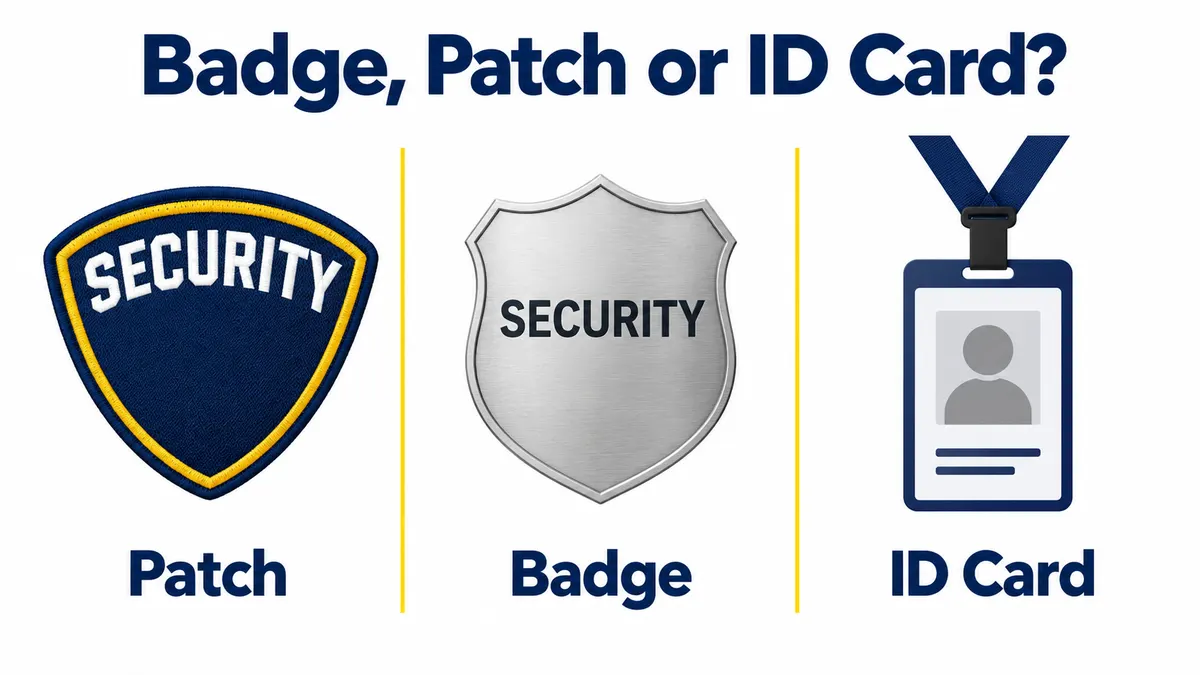
- Patch: a cloth emblem sewn on the shoulder, chest or back, normally showing the company name and often the word “Security.” It is the most common identifier and the easiest for regulators to approve.
- Badge: a metal or embroidered shield worn on the chest. It carries more symbolic weight, so it gets more scrutiny, and some states require pre-approval of the design.
- ID card or license: a photo identification issued by the employer, the client or the state. Many states require guards to carry their license while on duty, and many clients require a site ID or access badge on a lanyard.
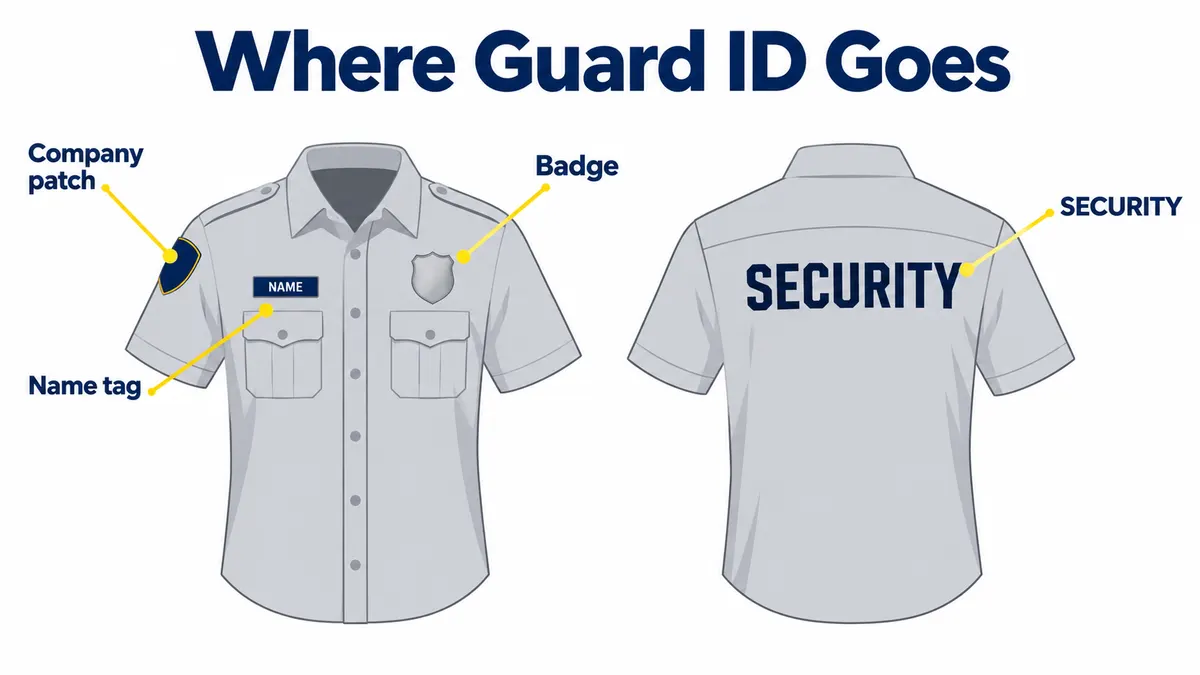
In practice, a guard on a typical commercial post wears a combination: company patches on the shoulders, a name tag, sometimes a badge on the chest, and a license and site card carried on duty. The badge is the piece most likely to be optional, and the piece most likely to get a company in trouble if it is the wrong design.
What state rules actually say
Here are five examples from state laws and regulators. They show how different the rules can be. This is general information, not legal advice. Rules change, so check the current version with your regulator. These rules were last checked in October 2026.
- California: The Bureau of Security and Investigative Services (BSIS) says a badge may be worn only on the upper left breast of a distinctive uniform, and only by a licensee who is doing guard or patrol work. Badge designs must be approved by the Bureau. Badge and patch rules apply if a licensee carries a baton or an exposed firearm, or wears a badge. Licensees must return uniforms, badges and patches to the employer when employment ends. Proprietary private security officers must wear a distinctive uniform that identifies them as security but are not required to wear a badge or patch. See our California security guard license guide.
- Arizona: The rules require an agency-name patch on each shoulder (at least 2 by 3 inches) and a patch or badge on the left chest (at least 1.5 by 2 inches). If the patches do not already say “Security” or “Security Guard,” those words must appear below them. Casual uniforms need a back patch reading “Security” or “Security Guard.” Markings similar to those of law enforcement are prohibited, as are words such as “Police,” “Officer,” “Deputy,” “Sheriff” or “Agent.” Some color combinations for traditional uniforms, such as black over black or tan over tan, are not allowed. See our Arizona license guide.
- Florida: Under section 493.6305 of the Florida Statutes, Class “D” security officers must work in a uniform with at least one patch or emblem, visible at all times, that clearly identifies the employing agency. Plain clothes are allowed only on a limited special-assignment basis when the duty or the client requires it, and the uniform and issued equipment must be returned when the job ends. See our Florida license guide.
- Louisiana: Under Louisiana Revised Statutes 37:3290, a security officer on duty may not wear or display any badge, patch or insignia that suggests they are a sworn peace officer or that contains the word “police.” Badges and insignia must be submitted to the state board for approval, and uniforms must be described with a full-length picture submitted for approval. See our Louisiana license guide.
- Michigan: Uniforms must be approved by the state before use, and a badge or shield needs its own separate approval and must not be worn until it is approved. Shoulder patches must show the licensed agency name and measure at least 3 by 5 inches. Uniforms and insignia that could deceive or confuse the public, or that match those of law enforcement in the licensee’s community, are barred. See our Michigan license guide.
Notice the pattern. Regulators care about two things: that the public can tell you are security, and that the public cannot mistake you for the police. For other states, the starting point is your state’s security regulator, and our state-by-state license guides link to each one.
The “cop-clone” problem
The riskiest mistake a security company can make is dressing guards to look like police: dark blue or black uniforms, star-shaped badges, shoulder patches with eagles or the word “Patrol,” or a vehicle painted like a cruiser. It can be tempting, because it commands attention, but it creates legal and safety problems for the guard and the company.
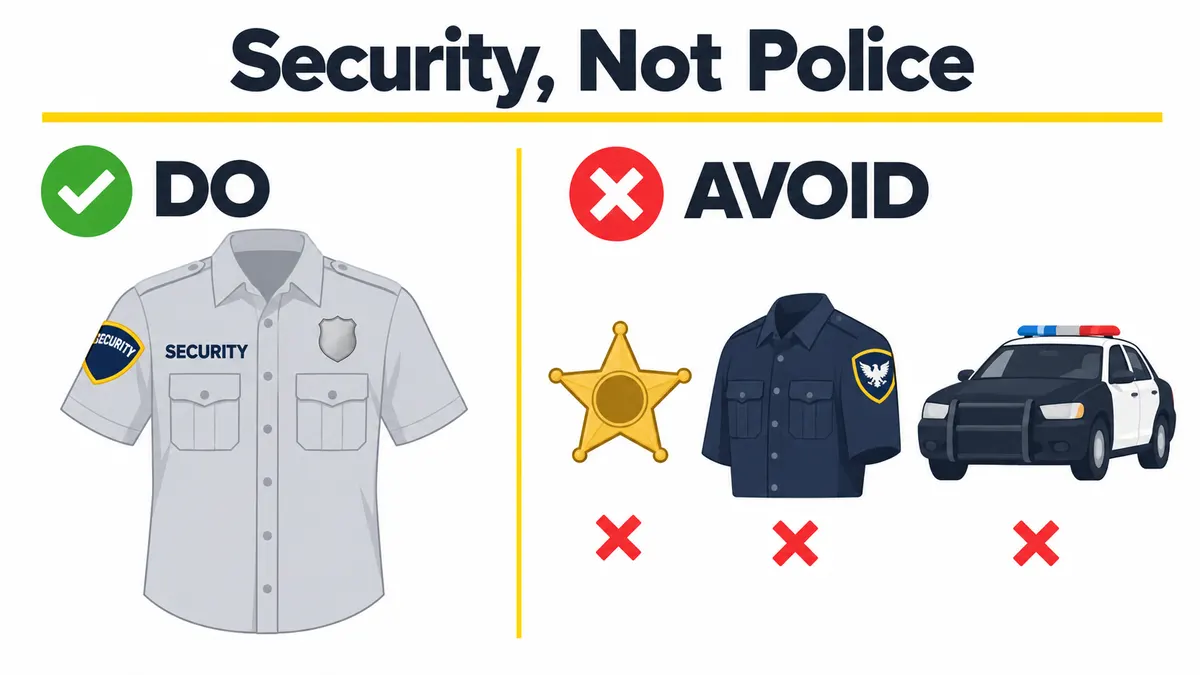
- Legal exposure: most states have laws against impersonating a peace officer, and the licensing rules above prohibit lookalike markings. A company can lose its license, and a guard can face discipline or criminal charges.
- Public confusion: people may give a guard the deference or the compliance they would give an officer, which can go wrong when the guard has far less authority. See our guide on whether security guards can detain people.
- Safety: a guard who looks like a police officer can be treated like one by people who do not like police, and may be drawn into situations that they are not trained or authorized to handle.
The professional standard is the opposite: a uniform that is clearly security, with a company name, and nothing that suggests law enforcement.
When a badge is a disadvantage
In some jobs, looking official works against you. Nightclub and venue staff often wear a plain black shirt marked “Security” rather than a badge, because a badge can invite challenges and gets in the way in a crowd. See our guide to becoming a bouncer. Executive protection agents aim to blend in with the people they protect, often called the “gray man” approach, because a visible badge advertises who the principal is. See how to become a bodyguard.
Loss prevention and store detectives work in plain clothes for the same reason: you cannot spot a shoplifter if you are announcing yourself. Our guide on how to become a loss prevention officer covers that role in detail. In these jobs, the license and a photo ID, shown when needed, do the work a badge would. For an overview of every path, see security careers.
Smart cards and access badges are replacing metal badges at many sites
At many corporate, hospital and campus sites, the most important piece of identification is not a metal badge but a photo access card. It opens doors, logs where a guard has been, and shows the client that the person on post is authorized to be there. Some companies also use a visible lanyard or a name tag in place of a badge. If you work at a client site, ask what the site requires, because the client’s rule may be stricter than the state’s.
Technology is also changing what “visible identification” means. Some officers now wear a body camera on the chest where a badge might otherwise sit, and many patrol checkpoints are now logged with scannable tags rather than on paper. See our body cameras for security guards guide and our overview of guard tour systems.
Uniform ID gear worth having
Never buy a badge on your own. Badges come from your employer, in the design that your employer and, where required, your state have approved. But there is plenty of everyday identification gear that guards buy themselves or that companies issue. These suggestions are based on research, not hands-on testing. Before you wear any marked item on duty, confirm it fits your employer’s approved uniform policy.
1. Hook-and-loop SECURITY patches
A removable “SECURITY” patch lets you mark a jacket, vest or plate carrier quickly and move it between garments. Choose high-contrast lettering that can be read from a distance, and use one only where your employer’s uniform policy allows it.
2. High-visibility SECURITY vest
A reflective vest marked “SECURITY” makes you easy to spot at events, in parking lots and on construction sites, and it fits over a jacket in cold weather. For roadside or traffic work, look for a vest that meets the ANSI/ISEA 107 high-visibility standard.
3. Heavy-duty ID holder with belt clip
A rigid holder with a belt clip or retractable reel keeps your guard license and site access card on you and easy to show, without a lanyard swinging around your neck.
4. Breakaway lanyard
If a client site requires a lanyard, choose one with a breakaway clasp. It releases when pulled hard, so the lanyard cannot easily be used to grab or choke you.
Working outside in winter? Jackets and rain shells marked “SECURITY” keep you identifiable in bad weather. See our cold weather gear guide.
For the rest of the kit, from flashlights and radios to boots, see our security guard equipment list.
How to check what you can wear
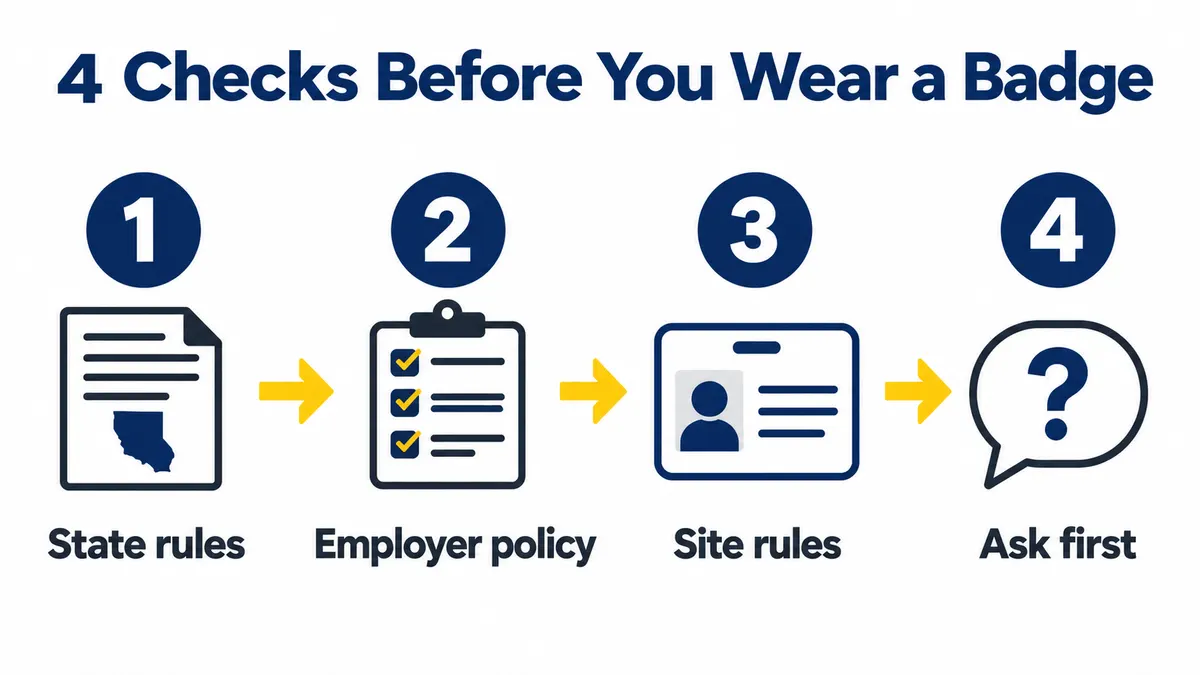
- Find your state’s security regulator and read its uniform rules. Many publish a uniform FAQ or a design-approval process.
- Ask your employer for the approved uniform policy in writing, and wear only what is on it.
- Never buy or wear a badge, patch or insignia that you found online without checking that it matches the approved design.
- If you are unsure, ask your supervisor or the regulator before you wear it, not after.
Common uniform mistakes that cause trouble
Most uniform violations are not dramatic. They are small things that nobody checked. The usual ones are wearing an old patch after the company name changed, adding a badge or pin that was never approved, wearing a lookalike jacket or hat from a surplus store, mixing police-style items such as rank insignia or “K-9” or “SWAT” patches with a private uniform, and continuing to wear company items after leaving the job. In states that require approved designs, any of these can be reported to the regulator by a client, a competitor or a member of the public.
Another common mistake is forgetting that the rules apply off duty as well. Wearing a uniform or badge while off duty, or using it to get into a venue, get a discount or settle an argument, can count as misuse. Treat the uniform as a tool for the job, not a status symbol. Misusing company uniform items can also lead to a complaint against your license, so it is worth knowing how regulators review a guard’s record. See our guide on becoming a security guard with a criminal record.
What to do if someone challenges your authority
You will eventually meet someone who asks, “Are you a cop?” or “What gives you the right?” The best answer is calm and honest: you are a licensed security officer working for your company at this site. Do not suggest you have police powers, do not argue about the badge, and do not escalate. Our de-escalation guide for security guards covers how to keep these conversations calm.
If the person will not comply with a site rule, your job is usually to observe, document and call the police or your supervisor, not to force the issue. Write it up during the same shift, while the details are fresh; our free incident report template gives you a clean format.
Frequently asked questions
Do all security guards wear badges?
No. Many wear a patch or a company ID instead, and some, such as nightclub staff, executive protection agents and store detectives, wear none. State rules and employer policy decide.
Can a security guard wear a police-style badge?
No. Regulators in states like Arizona, Louisiana and Michigan prohibit uniforms and insignia that resemble law enforcement or could confuse the public, and impersonating a police officer is a crime in most states.
Are security guards allowed to carry a badge in plain clothes?
Rules differ by state. In California, for example, a badge may be worn only on a distinctive uniform by a licensee who is doing guard or patrol work. Check your state’s rules before you carry or show one.
What should a security guard’s ID show?
Usually the guard’s name or number, the company, and a photo. Many states require guards to carry their license while on duty. Your employer or client may also require a site badge.
Does a security guard have the same authority as a police officer?
No. A guard’s authority comes from the employer and the law that applies to every private citizen, not from a badge. See our guide on armed vs. unarmed guards for how licensing and authority differ.
Who decides what my uniform looks like?
Your state regulator sets the limits and your employer picks the uniform within them. Some states, such as Michigan and Louisiana, require the state to approve the uniform and any badge before use.
Do security guards have to wear a uniform?
Usually, yes. In Florida, for example, licensed security officers must work in a uniform with at least one visible patch or emblem that identifies their employer, and may work in plain clothes only on limited special assignments. In California, in-house (proprietary) security officers must wear a distinctive uniform that identifies them as security. Check your state’s rules for the details.
Can a security guard wear a badge off duty?
In many states, no. In California, for example, a licensee may wear a badge only while doing guard or patrol work and wearing a distinctive uniform. Using a badge or uniform off duty to get into places or settle disputes can count as misuse.
Can I buy my own security badge online?
You should not. A badge must match your employer’s approved design, and some states, such as California, Michigan and Louisiana, require the state to approve the badge before it is worn. Get your badge from your employer, not from an online seller.
Sources
- California BSIS: Uniform Requirements for Private Security
- Arizona Administrative Code R13-6-501: Uniforms, Badges, and Insignia
- Florida Statutes 493.6305: Uniforms, required wear; exceptions
- Louisiana R.S. 37:3290: Insignias; markings; clothing; restrictions
- Michigan LARA: Private Security Guard Uniform Requirements
Last verified: October 2026.
Legal disclaimer: This page is for general information and education only. It is not legal advice, and reading it does not create an attorney-client relationship. Security Dogma is not a law firm. Laws, licensing rules and court decisions vary by state and change often, and what is written here may not match your situation or be current when you read it. Before you act on anything here, check the official rules from your state licensing agency, follow your employer’s and client site’s policies, and talk to a licensed attorney in your state for legal questions. See our Terms and Conditions and how facts are checked in our Editorial Policy.
Firearms and weapons disclaimer: This page discusses firearms or other weapons for general information only. It is not legal advice, not firearms training, and not a recommendation to buy, carry or use any weapon. Laws on owning, carrying, transporting and using firearms, stun guns, pepper spray, batons and knives vary by state, county and city. They change often, can be different for security work, and breaking them can lead to criminal charges. Before you carry or use any weapon, confirm the current law where you are, get any required permit or license, train with a certified instructor, and follow your employer’s, client’s and property owner’s rules. You alone are responsible for how you buy, carry, store and use any weapon. Security Dogma and its authors accept no liability for any injury, loss, damage or legal consequence that results from acting on this information. A product link does not mean the item is legal where you live, so check local restrictions before you buy.