

Security Dogma is reader-supported. When you buy through links on this page, we may earn a commission at no extra cost to you. As an Amazon Associate I earn from qualifying purchases. Learn more
Quick answer
Most security guards need one or two pairs, picked for the post, not the look:
- Night and outdoor posts: insulated, water-resistant gloves you can still work a radio and a pen in. For most guards this is the pair that gets the most use.
- Patrol and general duty: a thin, close-fitting work glove with a touchscreen palm or fingertips.
- Searches, first aid and anything messy: disposable nitrile gloves. Keep a few pairs in a pouch.
- Dress and executive posts: plain leather gloves that go with a suit, and only when it’s cold.
- Cut-resistant gloves: only if your post involves bag searches, pat-downs or sharp objects. Check the cut rating, and remember they’re cut-resistant, not cut-proof.
- Skip hard-knuckle “tactical” gloves unless you’re in a heavy tactical role. They protect your hands but can work against you.
This guide is for guards buying gloves for a new post, or replacing a pair that left their hands numb by 3 a.m. It covers which types are worth owning, what cut ratings on the label actually mean, and the one style I’d steer most guards away from. For the rest of your kit, see the security guard equipment list.
Prefer to watch? This video covers the same ground in about five minutes.
This video is hosted by YouTube (Google). Loading it shares your IP address with Google and may set cookies. See our Privacy Policy.
This video was made with AI tools and summarizes this guide. Scenes are illustrations, not real events.
From the field: why I wore gloves
Honestly, mostly to stay warm. The shifts where I wore gloves were night guard shifts and nightclub security, standing outside for hours after dark. I didn’t chase a particular brand or type; the test was whether they kept my hands warm and still let me work. A second benefit I came to appreciate was hygiene: at a nightclub door you handle IDs, bags, and sometimes people, and a pair of gloves keeps a layer between you and all of it.
In executive protection I wore gloves much less. When the dress code was formal and it was cold, I wore a dressier leather pair that matched the suit. But on armed EP work I preferred not to wear gloves at all, because I didn’t like shooting with them on. That’s a personal preference, not a rule: if you’ll wear gloves on an armed post, train and qualify in them, so your grip and trigger feel are the same on duty as on the range.
The five kinds of gloves guards actually use
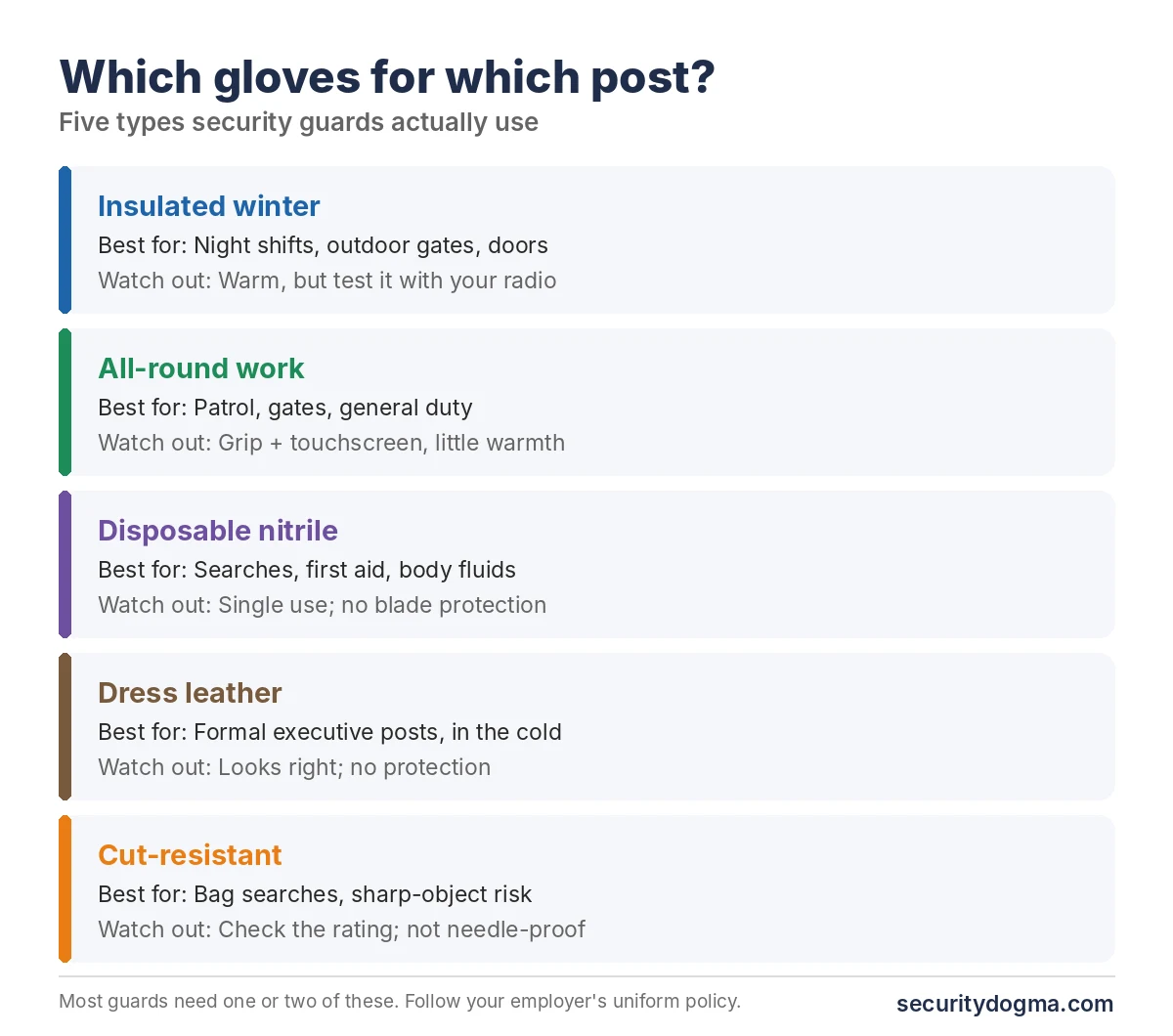
| Type | Best for | Look for | Watch out for |
|---|---|---|---|
| Insulated winter gloves | Night shifts, outdoor gates, parking lots, doors | Insulation, a waterproof or water-resistant insert, grip on the palm | Thick gloves make radio buttons, pens and zips hard. Try them with your radio. |
| All-round work gloves | Patrol, opening gates and doors, general duty | Thin synthetic leather palm, touchscreen-capable palm or fingertips, a snug cuff | Little warmth; little cut protection |
| Disposable nitrile gloves | Searches, first aid, handling bodily fluids or found property | Powder-free, non-latex, your size | Single use. They protect against fluids, not sharp objects. |
| Dress leather gloves | Executive, corporate and front-of-house posts in the cold | Plain design, thin lining, touchscreen fingertips | Not for work: little grip, no protection |
| Cut-resistant gloves | Bag searches, pat-downs, posts with a risk of needles, blades or broken glass | A labeled cut rating (ANSI/ISEA 105 or EN 388) | Cut-resistant isn’t needle-proof: most offer little protection against puncture |
Winter gloves: the pair most guards need
If you work nights or outdoors, warm gloves are the pair you’ll wear most. The trap is buying the warmest glove you can find. A thick ski glove keeps you warm, but you can’t key a radio, write in a notebook or handle an ID in it, so you end up taking it off, which defeats the point.
What works better is an insulated work glove: warm enough for a long night, with a grippy palm and fingers thin enough to work a radio. In real cold, a thin liner glove under a heavier glove or mitten lets you pull the outer layer off for fine work without exposing bare skin. Our cold-weather gear guide covers the rest of a winter kit.
Disposable gloves for searches and first aid
Disposable gloves are the cheapest protection on your belt, and the most overlooked. Any time you might touch blood or other body fluids (first aid, an injured person, a cleanup) or handle something you’d rather not touch, a pair of nitrile gloves keeps it off your skin.
Choose nitrile, not latex. NIOSH, the U.S. government’s occupational safety research institute, advises using non-latex gloves for work that isn’t likely to involve infectious material, and considering vinyl, nitrile or polymer gloves for work that is, because latex can cause allergic reactions. Keep two or three pairs in a pouch or pocket, and change them after each use.
⚠️ Health note: disposable gloves aren’t a substitute for your employer’s bloodborne pathogens procedures. If you’re exposed to blood or body fluids on duty, follow your site’s exposure procedure and report it.
Cut-resistant gloves and what the ratings mean
I never used cut-resistant gloves for searches myself, so this section is based on the standards and the manufacturers, not my own experience. They make sense if your post involves bag checks, pat-downs or handling objects that could hide a blade, needle or broken glass: venue and event security, some retail loss prevention, and posts where you search people or property.
In the U.S., the label to look for is an ANSI/ISEA 105 cut level. The 2024 edition rates cut resistance from A1 to A9, based on how many grams of force it takes a blade to cut through the material in a lab test. The higher the level, the more force it takes:
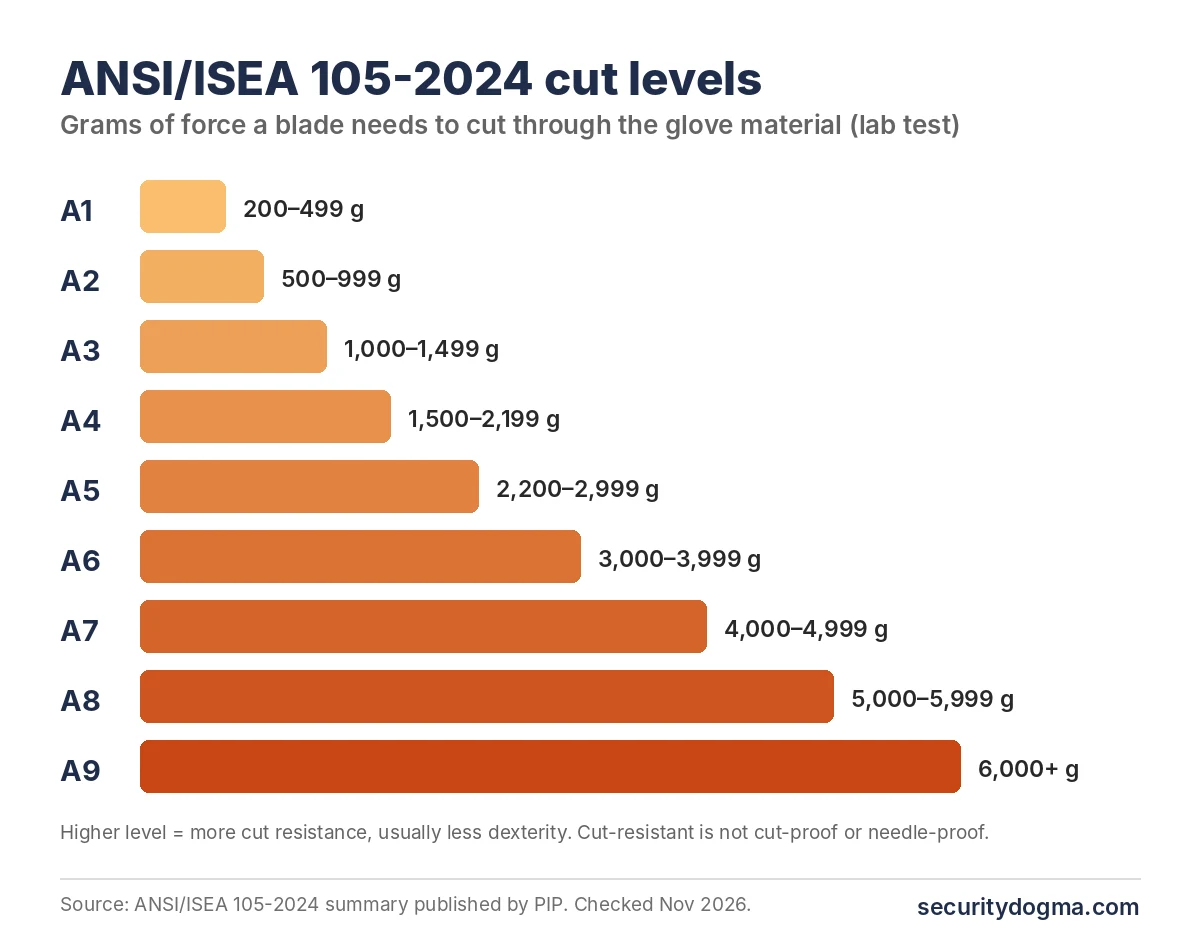
| ANSI/ISEA 105 cut level | Grams to cut through |
|---|---|
| A1 | 200–499 |
| A2 | 500–999 |
| A3 | 1,000–1,499 |
| A4 | 1,500–2,199 |
| A5 | 2,200–2,999 |
| A6 | 3,000–3,999 |
| A7 | 4,000–4,999 |
| A8 | 5,000–5,999 |
| A9 | 6,000 or more |
Gloves sold internationally often carry an EN 388 rating instead: a shield symbol with four numbers and one or two letters. The numbers are abrasion, blade cut, tear and puncture; the first letter is a cut level from A to F, from a lab test under ISO 13997, where A is the lowest. An “X” means that property wasn’t tested.
Three things the label won’t tell you:
- Cut-resistant isn’t cut-proof. Manufacturers say so themselves: the ratings come from controlled lab tests, not a knife in a real struggle.
- Cut isn’t puncture. A glove that resists a blade sliding across it may do little against a needle pushed into it. Searching by touch is still risky; where your policy allows, look before you reach.
- Higher levels cost dexterity. Thicker, stiffer gloves make it harder to feel through a bag or handle an ID, so pick the level your post needs, not the highest one.
Why I’d skip hard-knuckle “tactical” gloves
Some tactical and motorcycle gloves have hardened plastic or carbon knuckle guards, the Oakley-style tactical glove being a well-known example. They protect your hands very well. But in my view they can be a liability on a security post. To a member of the public, or to anyone reviewing an incident afterward, gloves with armored knuckles can look like you came dressed for a fight, and that’s the last impression you want if you ever have to use force.
My rule: don’t wear them unless it’s really necessary, and for me necessary means a heavy tactical, operational role, where the threat and the job justify the gear. For lobby, patrol, door and event work, a plain glove does the job without sending the wrong message.
⚖️ Legal note: what you wear and carry on duty is set by your employer, the site and the law where you work. Some employers don’t allow knuckle-armored or weighted gloves. Ask before you buy, and never wear gloves designed to add force to a strike. See what security guards can legally do.
How to choose and look after your gloves
- Test them with your radio. If you can’t find the push-to-talk button by feel in the store, you won’t find it at 3 a.m.
- Check the touchscreen claim. Some gloves work only at the fingertips, others across the palm.
- Fit snugly, not tight. Tight gloves cut circulation and feel colder; loose ones catch on everything. Use each brand’s size chart, since sizes vary.
- Carry them where you can reach them: a glove pouch on your duty belt or a jacket pocket.
- Keep a spare pair for wet nights. Wet gloves are colder than no gloves.
- Armed posts: if you’ll carry a firearm in gloves, practice and qualify in the same gloves.
Gloves worth considering
These are research picks, not products I’ve tested: chosen from manufacturer listings, specifications and long-term buyer ratings, one for each kind of glove above. Prices change, so check the listing. Some links are affiliate links: if you buy through them, Security Dogma may earn a commission at no extra cost to you. As an Amazon Associate I earn from qualifying purchases.
Carhartt Waterproof Insulated Knit Cuff Glove
Polyester and softshell shell, synthetic palm · waterproof insert · synthetic insulation · FastDry lining · fleece cuff with adjustable wrist strap (per the listing)
A warm, waterproof work glove with a grippy palm, built for working outdoors rather than skiing, so it keeps your hands warm without turning them into mittens.
Watch out for: it’s an insulated glove, so fine work like writing takes some practice, and the listing doesn’t claim touchscreen fingertips. Pair it with a thin liner if you need your phone often.
See current price →Paid link · opens Amazon.com
Mechanix Wear Original Covert Tactical Gloves
0.8 mm synthetic leather palm with touchscreen capability · snag-reducing mesh back · welded fingertip panels with ANSI Level 3 abrasion resistance · vented palm padding (per the listing)
A thin, close-fitting glove you can wear for a whole shift: good grip on doors, gates and railings, and you can use your phone without taking it off. A long-time favorite with very high buyer ratings.
Watch out for: it’s not warm and it’s not cut-resistant. The ANSI rating on the listing is for abrasion, not cut.
See current price →Paid link · opens Amazon.com
MED PRIDE Blue Nitrile Exam Gloves, 100 Count
Nitrile · powder-free and latex-free · textured fingertips · beaded cuff · ambidextrous · box of 100 (per the listing)
Non-latex exam gloves for searches, first aid and anything messy. A box of 100 lasts a long time when you carry two or three pairs a shift.
Watch out for: single use, and they protect against fluids, not blades or needles. Order your size: the listing comes in several.
See current price →Paid link · opens Amazon.com
Alepo Genuine Sheepskin Leather Gloves
Genuine sheepskin leather · cashmere lining · touchscreen fingertips · 5 sizes (per the listing)
Plain leather gloves that go with a suit or overcoat, warm enough for an outdoor arrival in winter, and you can still use your phone.
Watch out for: these are dress gloves: little grip for physical work and no protection. Check the size chart; the listing gives sizes by hand measurement.
See current price →Paid link · opens Amazon.com
Hatch FM2000 Cut Resistant Duty Glove
Goat grain leather · full Honeywell Spectra liner for cut resistance · rated EN 388:2016 3242B · elastic cuff (per the listing)
A leather duty glove marketed to police, with a cut-resistant liner for posts where you search bags or handle sharp objects. It looks like a plain black glove, not tactical gear.
Watch out for: its EN 388 cut level is B, the second of six, so it’s a moderate cut glove, not a high one. Like all cut gloves, it isn’t needle-proof. Fewer buyer ratings than the others.
See current price →Paid link · opens Amazon.com
Gloves are one part of a winter kit and a duty setup. See our cold-weather gear guide, the duty belt guide and the night shift survival guide.
Frequently asked questions
What gloves do security guards wear?
It depends on the post. Most wear insulated gloves on night and outdoor shifts, thin work gloves for patrol, and disposable nitrile gloves for searches and first aid. Dress leather gloves suit formal executive posts, and cut-resistant gloves suit posts with bag searches or sharp-object risk.
Do security guards need cut-resistant gloves?
Only if the post involves bag searches, pat-downs or handling objects that could hide a blade, needle or broken glass. Check the cut rating on the label (ANSI/ISEA 105 or EN 388), and remember they are cut-resistant, not cut-proof, and usually not needle-proof.
What do ANSI cut levels mean on gloves?
ANSI/ISEA 105-2024 rates cut resistance from A1 to A9 by the grams of force a blade needs to cut through the material in a lab test. A1 is 200 to 499 grams; A9 is 6,000 grams or more. Higher levels resist more but usually cost dexterity.
Should security guards wear nitrile or latex gloves?
Nitrile. NIOSH advises non-latex gloves for work not likely to involve infectious material, and vinyl, nitrile or polymer gloves for work that is, because latex can cause allergic reactions. Change disposable gloves after each use.
Are hard-knuckle tactical gloves good for security guards?
They protect your hands well, but on most security posts they can be a liability: armored knuckles can look like you came ready for a fight. Unless you work in a heavy tactical role, a plain glove is the better choice. Check your employer’s policy too.
Can you shoot with gloves on?
You can, but gloves change your grip and trigger feel. If you’ll carry a firearm in gloves on duty, practice and qualify in the same gloves. Some armed professionals prefer not to wear gloves on duty for this reason.
What are the best winter gloves for security guards?
Insulated, water-resistant work gloves with a grippy palm, thin enough at the fingers to key a radio and write. In real cold, a thin liner under a heavier glove or mitten lets you remove the outer layer for fine work.
Sources
- PIP, ANSI/ISEA 105-2024 standard summary (cut levels A1–A9)
- NIOSH, latex allergy fact card, Publication 2012-119 (February 2012)
- uvex safety, EN 388 safety gloves against mechanical risks (marking explained)
- Manufacturer listings for the products above (Carhartt, Mechanix Wear, MED PRIDE, Alepo, Hatch), read November 22, 2026
Checked November 22, 2026. Product details and prices change; check the listing before you buy. This guide is general information, not legal or medical advice.
Legal disclaimer: This page is for general information and education only. It is not legal advice, and reading it does not create an attorney-client relationship. Security Dogma is not a law firm. Laws, licensing rules and court decisions vary by state and change often, and what is written here may not match your situation or be current when you read it. Before you act on anything here, check the official rules from your state licensing agency, follow your employer’s and client site’s policies, and talk to a licensed attorney in your state for legal questions. See our Terms and Conditions and how facts are checked in our Editorial Policy.
Firearms and weapons disclaimer: This page discusses firearms or other weapons for general information only. It is not legal advice, not firearms training, and not a recommendation to buy, carry or use any weapon. Laws on owning, carrying, transporting and using firearms, stun guns, pepper spray, batons and knives vary by state, county and city. They change often, can be different for security work, and breaking them can lead to criminal charges. Before you carry or use any weapon, confirm the current law where you are, get any required permit or license, train with a certified instructor, and follow your employer’s, client’s and property owner’s rules. You alone are responsible for how you buy, carry, store and use any weapon. Security Dogma and its authors accept no liability for any injury, loss, damage or legal consequence that results from acting on this information. A product link does not mean the item is legal where you live, so check local restrictions before you buy.