

Security Dogma is reader-supported. When you buy through links on this page, we may earn a commission at no extra cost to you. As an Amazon Associate I earn from qualifying purchases. Learn more
Quick answer
Three things decide what a security guard can carry: state law, the license or permit you hold, and your employer’s post orders. You need all three to say yes. In most jobs, an unarmed guard carries a radio and a flashlight. Pepper spray, batons and Tasers often need extra training or a permit, and some states restrict them outright. Handcuffs are usually an employer decision. A firearm always needs an armed license or permit.
How this page was made: the California parts draw on my own years as an unarmed guard, armed officer, nightclub security, loss prevention agent and executive protection agent, all in California. The other states are research only, from the official sources listed at the end, checked on November 25, 2026. Laws and employer policies change, so confirm with your state’s licensing agency and your employer before you carry anything. This page is general information, not legal advice.
Prefer to watch? This video covers the same ground in about seven minutes.
This video is hosted by YouTube (Google). Loading it shares your IP address with Google and may set cookies. See our Privacy Policy.
This video was made with AI tools and summarizes this guide. Scenes are illustrations, not real events.
What decides what you can carry
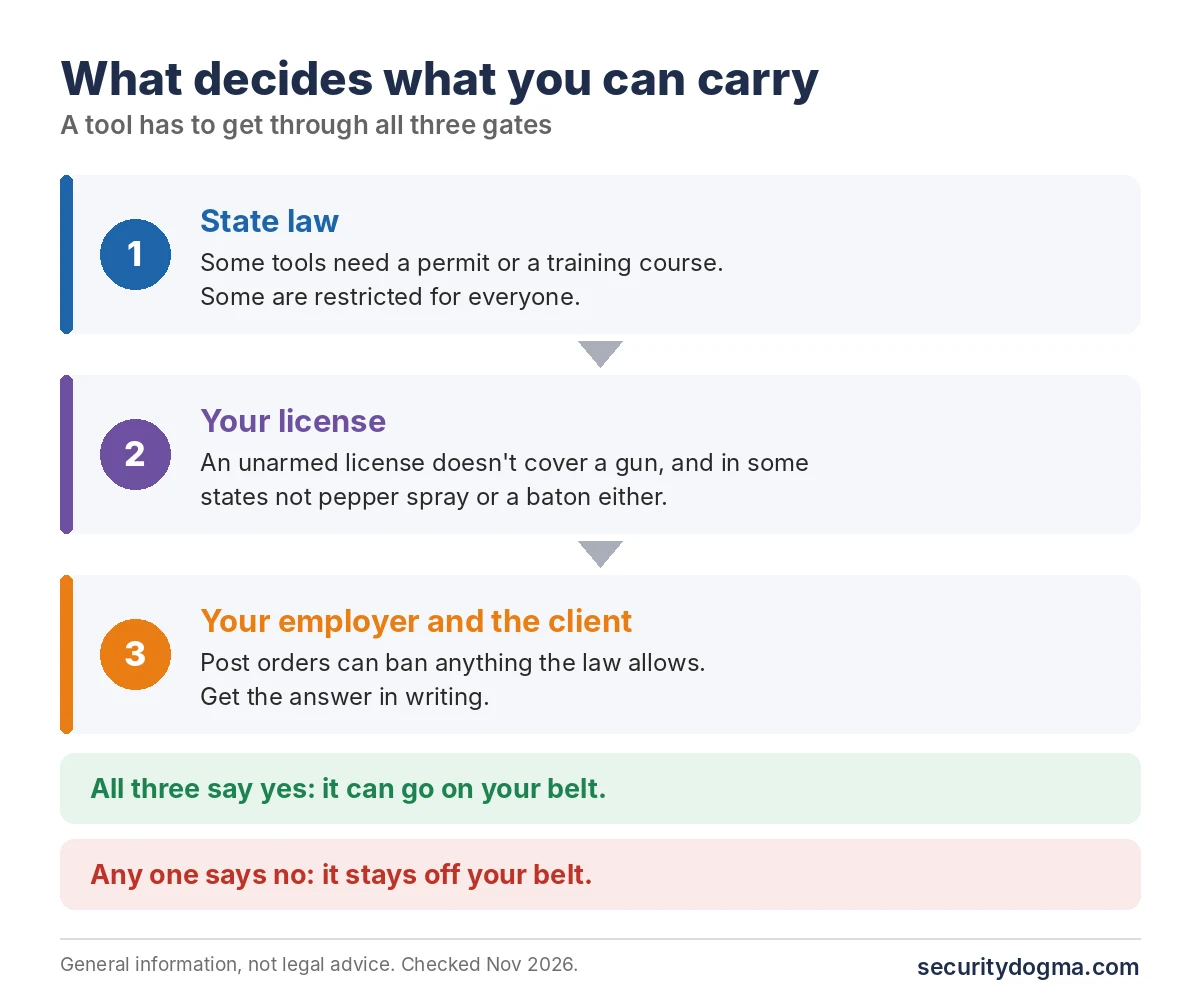
Think of it as three gates. A tool has to get through all of them before it goes on your belt:
- State law. Some tools are legal for anyone, some need a permit or training, and some are restricted for everyone. A few states have rules written just for guards.
- Your license. An unarmed guard license doesn’t cover a gun. In some states it doesn’t cover pepper spray or a baton either until you finish a separate course.
- Your employer and the client. Post orders can ban anything the law allows. Many companies don’t want guards carrying weapons at all, because the company carries the liability.
In my own California jobs, the post decided far more than the law did. In nightclub security, I carried a flashlight and nothing else. In loss prevention, handcuffs were the only tool allowed. On unarmed posts, it was a radio and a flashlight. As an armed officer, most of the time I carried just the firearm, with extra magazines, a radio and sometimes a small Streamlight flashlight. On executive protection details I also carried a pocket knife. Apart from the firearm, I never needed a separate permit for anything I carried.
Tool by tool: what usually applies
| Tool | What usually applies | Check before you carry |
|---|---|---|
| Radio, flashlight, notebook | No permit anywhere we checked | Your post orders |
| Pepper spray (OC) | Often allowed, sometimes only after a training course (California, Texas) | State training rules, canister size limits, employer policy |
| Baton | Often needs a permit or certification, and some states restrict it for everyone | State permit rules, where you can carry it, employer policy |
| Taser or stun gun | Varies the most: some states treat it like a firearm | State law, whether your license covers it, employer policy |
| Handcuffs | Usually an employer decision | Employer policy and training; arrest and detention law |
| Firearm | Always needs an armed license or permit | State armed license, training and requalification |
Pepper spray (OC spray)
Pepper spray is the tool guards ask about most, and the rules differ more than people expect. Some states let any adult carry a small canister for self-defense. Others want guards to finish a course before they carry it on duty. In California, a guard employed by a private patrol operator must complete training under Penal Code § 22835 before carrying tear gas, which includes pepper spray, and in-house (proprietary) security officers may not carry it at all. In Texas, carrying a chemical dispensing device is a crime with a defense for security officers who completed approved training; Texas DPS says the Private Security Board approves it once an officer has completed Level III training.
Even where it’s legal, size and type matter. Florida’s self-defense exception covers a compact spray with no more than two ounces of chemical. New York limits who can buy it and where.
Batons
Batons are where guards get into the most trouble, because a baton strike is serious force. California requires anyone carrying a baton on duty to be a registered guard who has completed baton training at a bureau-approved facility. Pennsylvania’s Act 235 regulations treat a billy club as a lethal weapon, which puts it under the state’s lethal weapons certification. Texas has no baton certification for guards, but its Penal Code bans clubs in a list of places. In New York, “billy” is still listed among the weapons in Penal Law § 265.01.
I heard about two loss prevention agents at another store, not one I worked at, who used ASP batons during an altercation on a stop. They were fired, and criminal charges were filed against them. I didn’t see it myself, but it stuck with me: a baton used in a fight can end your job and follow you to court.
Tasers and stun guns
Electronic weapons vary the most from state to state. In Illinois, you need a FOID card to possess a stun gun or Taser, the same card required for a firearm. In Texas, the Private Security Act doesn’t address them, but a device classified as a firearm (Texas DPS gives the Taser 10 as an example) can only be carried by commissioned officers certified for a firearm. California’s bureau says licensees need an active guard or private patrol operator license to carry a Taser on duty, and proprietary officers may not carry stun guns or other electronic control devices. In New York, “electronic stun gun” is still listed in Penal Law § 265.01, even though a federal court ruled the ban unconstitutional in 2019.
Handcuffs
None of the official guard pages we checked list a separate handcuff permit. That doesn’t make handcuffs a free choice: whether you carry them is usually up to your employer, and using them is a restraint that has to be justified under your state’s arrest and detention law. In loss prevention, handcuffs were the one tool I carried, and the company decided that, not the state. More on when a guard can hold someone in can security guards detain people.
Firearms
A gun always takes an armed license or permit, plus training and regular requalification. California’s armed guards need a bureau firearms permit; Pennsylvania’s privately employed agents need Act 235 certification; most states have their own version. The differences in training, pay and liability are covered in armed vs. unarmed security guards.
The rules in 6 states
These six states publish clear official rules on non-lethal tools. The table is a starting point: read the linked source, check for changes, and ask your employer. For licensing in every state, see security guard license requirements by state.
| State | Pepper spray | Baton | Taser or stun gun | Source |
|---|---|---|---|---|
| California guard card | Guards employed by a private patrol operator: allowed on duty after training under Penal Code § 22835. Proprietary officers: not allowed | Registered guard plus baton training from a bureau-approved facility (B&P Code § 7583.33) | Needs an active guard or private patrol operator license on duty. Proprietary officers: not allowed | California BSIS |
| Texas | Penal Code § 46.05 defense for officers with approved training; Texas DPS says the board approves it after Level III | No guard certification; clubs banned in places listed in Penal Code § 46.03 | Not addressed by the Private Security Act; if classified as a firearm, commissioned officers only | Texas DPS |
| Florida | Self-defense chemical spray (2 oz or less) can be carried for lawful self-defense | “Billie” is a weapon under § 790.001; carrying a concealed weapon needs authorization under § 790.01 | Nonlethal stun guns can be carried for lawful self-defense (§ 790.01(5)(b)) | Florida Statutes |
| New York | Adults 18+ without a felony or assault conviction; bought from a licensed firearms dealer, pharmacist or approved vendor, 2 at a time | “Billy” is listed in Penal Law § 265.01 | Listed in § 265.01; a 2019 federal ruling found the ban unconstitutional, but the law hasn’t been changed | NY Penal Law; NY Courts |
| Illinois | Use of non-lethal force (spray, baton, stun gun, Taser) is a required topic in the 20-hour basic training | Covered in the same training topic | FOID card required to possess one | Illinois Compiled Statutes |
| Pennsylvania | Chemical mace is not a lethal weapon under the Act 235 rules | A billy club is a lethal weapon under the Act 235 rules | Not addressed in the sources checked | Pennsylvania State Police; 37 Pa. Code § 21.1 |
Two things the table can’t show. First, a tool being legal for the public doesn’t mean you can carry it on duty: your license and employer still decide. Second, cities and properties add their own rules. Schools, airports, courthouses and government buildings often ban items that are legal elsewhere.
Can security guards wear body armor?
Body armor isn’t a weapon, so the questions are who can buy it and whether your employer allows it. Of the rules we checked, New York limits who can buy it (guards qualify) and federal law bars people with violent felony convictions. I never wore a vest, including on executive protection details. Whether you need one depends on the post: armed posts, cash transport and high-risk sites are where guards are most likely to wear one. If you’re looking at that kind of work, see armored car guard.
- Protection levels have new names. NIJ Standard 0101.07, first published in November 2023, renamed the levels: Level II became HG1, Level IIIA became HG2, Level III became RF1, Level IV became RF3, and a new RF2 level sits between them. NIJ says officers should keep wearing their current armor, and it expects to keep the old 0101.06 compliant products list through at least the end of 2029.
- New York restricts who can buy it. Since 2022, only people in eligible professions can buy body armor in New York. Security guard has been on the Department of State’s eligible list since July 6, 2022. The seller can ask for your license or an employer credential.
- A violent felony conviction bars it under federal law, with a narrow defense when an employer certifies in writing that the armor is needed for the work.
What your employer can ban
Your employer can be stricter than the law, and usually is. Post orders and the client’s contract can ban pepper spray, batons, knives, even handcuffs. In my experience, the post decided almost everything: one allowed a flashlight only, another allowed handcuffs only. And using a tool on someone can cost you far more than the job (see the baton story above).
Before your first shift, ask your supervisor three questions: what am I allowed to carry, what training do I need for it, and where is that written down? Get the answer in writing, in your post orders or the company handbook.
If you carry it, you’ll have to explain using it
Every tool you carry is something you may have to justify later, to your supervisor, the police, an insurer or a court. That’s why de-escalation comes first and why reports matter. I included every detail in all my reports, whether I used a tool or not. On surveillance investigations, the tool I most often had to write up was a hidden camera: what kind it was and how the video was taken.
If you ever use pepper spray, a baton, handcuffs or a Taser, the report needs what led up to it, what you said, what the person did, exactly what you used and for how long, injuries, who you notified and what happened after. See security incident report examples for complete samples, and de-escalation for security guards for the steps that come before any tool.
Buying your own gear
My advice to new guards: invest smartly at the beginning, and don’t assume the most expensive option is the best. Start with what every post allows, a good flashlight, a radio holder and a solid belt, then add only what your license and employer approve. See security guard equipment list, flashlights and duty belts.
These are research picks, not products I’ve tested: chosen from the manufacturers’ listings. Buy them only if your post allows the tool. Prices change, so check the listing. Some links are affiliate links: if you buy through them, Security Dogma may earn a commission at no extra cost to you. As an Amazon Associate I earn from qualifying purchases.
Bianchi 7934 AccuMold Elite Open Handcuff Case
Holds one pair of standard or chain handcuffs · pull-through style · fits 2″ and 2.25″ duty belts · molded trilaminate with knit lining (per the listing)
An open-top case keeps cuffs secure on a duty belt without a flap to fight with.
Watch out for: it fits duty belts, not a regular trouser belt; check your belt width first.
See current price →Paid link · opens Amazon.com
Bianchi 7907 Mace/OC Spray Pouch Holder
Large size for 7.5″ MK-IV and similar canisters · full flap · fits 2″ and 2.25″ duty belts (per the listing)
A covered pouch keeps the canister from falling out or discharging by accident.
Watch out for: it comes in sizes; match it to the canister your employer issues or approves.
See current price →Paid link · opens Amazon.com
Free for your next shift: the free shift forms, a daily activity report, patrol log and pass-down log you can print.
Frequently asked questions
What can unarmed security guards carry?
Usually a radio, a flashlight, a notebook and sometimes handcuffs. Pepper spray, batons and Tasers depend on your state, your license and your employer: some states require a separate course or permit, and many employers ban them.
Can security guards carry pepper spray?
Often, but not everywhere without training. California requires a training course before guards carry it on duty and bars in-house security officers from carrying it. In Texas, the defense for carrying it applies to officers with approved training. Your employer can still ban it.
Can security guards carry a Taser?
It depends on the state. Illinois requires a FOID card. Texas limits Tasers classified as firearms to commissioned officers. California requires an active guard or patrol operator license to carry one on duty. Check your state and employer first.
Do security guards need a permit to carry a baton?
In some states, yes. California requires baton training at a bureau-approved facility, and Pennsylvania treats a billy club as a lethal weapon under Act 235. Texas has no baton certification for guards but bans clubs in certain places.
Can security guards carry handcuffs?
Usually, if their employer allows it. The state guard pages we checked don’t list a handcuff permit, but using handcuffs has to be justified under arrest and detention law, and many employers require training first.
Sources
- California BSIS, Security Guard Fact Sheet (revised January 2022)
- California BSIS, Clarification regarding tear gas and other deadly weapons
- California BSIS, Baton permits memo (September 19, 2014)
- Texas DPS Private Security, Non-lethal weapons (club, pepper spray, Tasers) (updated March 17, 2026)
- Florida Statutes § 790.01 (2025)
- Florida Statutes § 790.001, definitions (2026)
- New York Penal Law § 265.20 (revision of August 28, 2026)
- New York State Courts, Ask a Law Librarian: Is pepper spray legal in New York? (updated May 4, 2026)
- New York State Courts, Ask a Law Librarian: Are stun guns legal in New York? (updated June 3, 2026)
- New York Department of State, Body armor: list of eligible professions
- Illinois Compiled Statutes, 430 ILCS 65/2 (FOID Card Act)
- Illinois Compiled Statutes, 225 ILCS 447/25-20 (security training)
- Pennsylvania State Police, Lethal Weapons Training Program (Act 235) FAQ
- Pennsylvania Code, 37 Pa. Code § 21.1, definitions
- National Institute of Justice, Ballistic Resistance of Body Armor, NIJ Standard 0101.07
- 18 U.S.C. § 931, body armor and violent felons
Checked November 25, 2026. Rules on weapons change and differ by city, property and employer. This page is general information, not legal advice: for a decision about your situation, ask your state licensing agency, your employer or a lawyer.
Firearms and weapons disclaimer: This page discusses firearms or other weapons for general information only. It is not legal advice, not firearms training, and not a recommendation to buy, carry or use any weapon. Laws on owning, carrying, transporting and using firearms, stun guns, pepper spray, batons and knives vary by state, county and city. They change often, can be different for security work, and breaking them can lead to criminal charges. Before you carry or use any weapon, confirm the current law where you are, get any required permit or license, train with a certified instructor, and follow your employer’s, client’s and property owner’s rules. You alone are responsible for how you buy, carry, store and use any weapon. Security Dogma and its authors accept no liability for any injury, loss, damage or legal consequence that results from acting on this information. A product link does not mean the item is legal where you live, so check local restrictions before you buy.
Legal disclaimer: This page is for general information and education only. It is not legal advice, and reading it does not create an attorney-client relationship. Security Dogma is not a law firm. Laws, licensing rules and court decisions vary by state and change often, and what is written here may not match your situation or be current when you read it. Before you act on anything here, check the official rules from your state licensing agency, follow your employer’s and client site’s policies, and talk to a licensed attorney in your state for legal questions. See our Terms and Conditions and how facts are checked in our Editorial Policy.