
Security Dogma is reader-supported. When you buy through links on this page, we may earn a commission at no extra cost to you. As an Amazon Associate I earn from qualifying purchases. Learn more
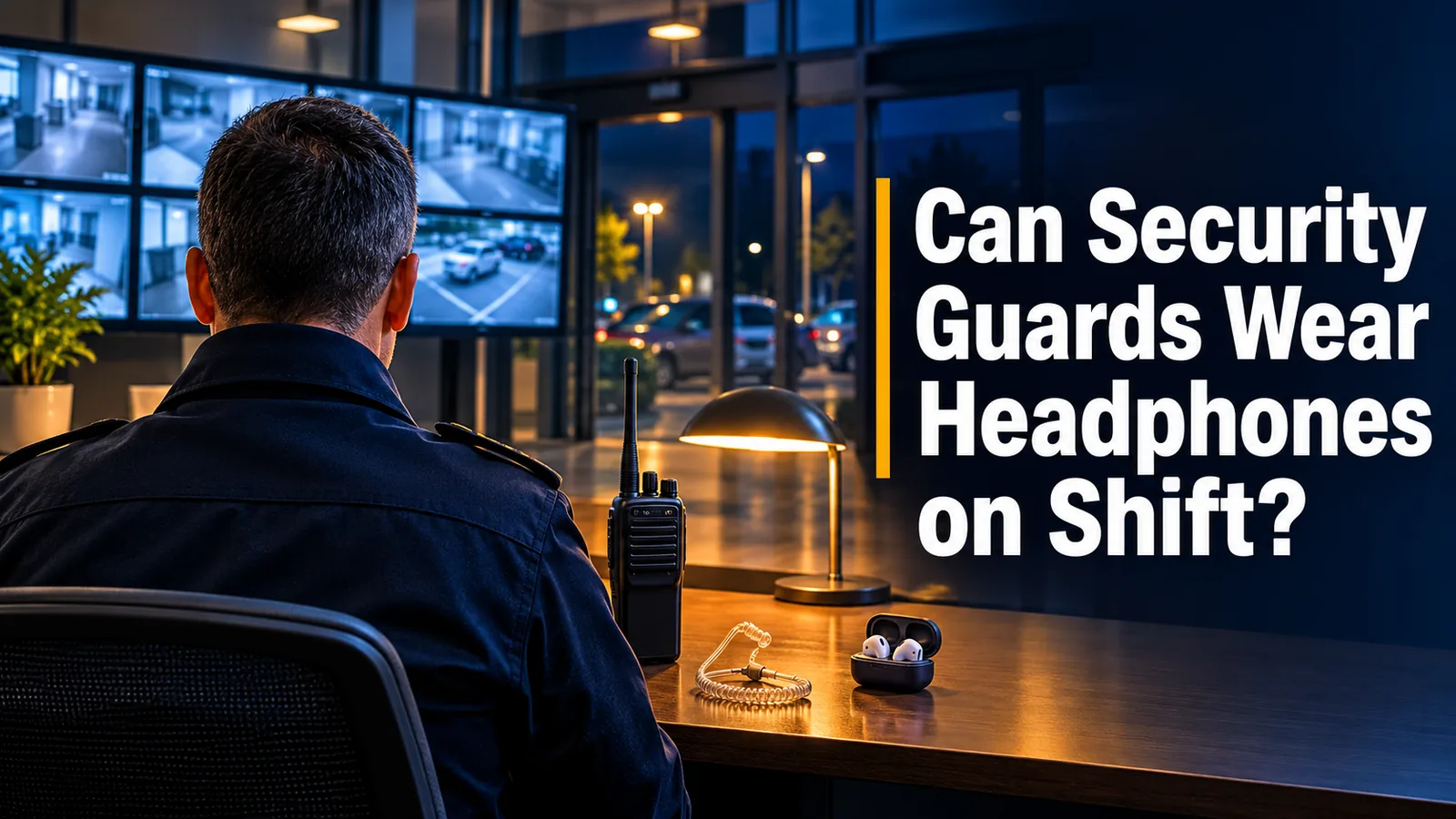
Short answer: only if your employer and your post orders allow it, and some sites do not. There is no universal rule. Some security and police employers have banned music and earbuds outright. Others allow audio as long as it never gets in the way of the job. Ask in writing before you plug in.
This is general information, not legal or employment advice. Rules differ by employer, client site, state and country. The examples below come from the United States and British Columbia, Canada. UK and EU rules differ and are not covered here.
Who decides?
Three layers usually apply, and the strictest one wins:
- Your post orders or site instructions. These often say what you may do at the post.
- Your employer’s handbook. Handbooks often cover phones, earbuds and personal devices.
- The client. A hospital, school or government building can set rules your company must follow.
If none of them mention audio, do not assume yes. Ask your supervisor and keep the answer in writing, such as a text or an email.
What real policies say
Policies vary widely. Two published examples, one historical, show the range:
- Maryland Capitol Police, former Directive 5-109 “Attention to Duty” (issued April 2016). It applied to police officers, security officers and communications officers. Section IV.G said employees would not listen to music or wear headphones or earbuds while on duty, and the directive treated violations as neglect of duty. It listed no specific penalty. The directive is no longer available at its original web address, and we could not find the rule in the department’s current directives, so treat it as a historical example, not a current rule.
- Brewster Ambulance, a medical transport service, not a security employer (effective March 13, 2023). Staff may listen to audio if a manager or supervisor allows it and it does not disrupt work or reduce their ability to monitor the radio or hear phones, doorbells and alarms. A single earbud is limited to stationary, controlled settings, and earbuds are not allowed near moving vehicles, at an assigned incident or around patients (Brewster Ambulance policy).
Neither is your rule. They show what employers worry about: missing a radio call, an alarm or a person approaching.
Pros and cons of audio on shift
The cons are backed by the policies and guidance above. The pros are reasoning, not research: we found no study showing that audio improves a guard’s performance or alertness.
Possible pros (reasoned, not tested)
- It may help you stay awake on a night shift. Something to listen to may make a quiet overnight post easier to stay alert on. We found no study that shows this, so treat it as a possible benefit that is unproven, and never as a substitute for sleep.
- You can keep learning. Audio fits continuing professional development: security podcasts, training material, licensing study guides or audiobooks on the job. It only works where your rules allow audio at your post, and it should never pull your attention off the site.
- A dull or lonely post feels shorter. Long, quiet stretches at a desk or gate, especially on a solo post, are boring and isolating, and low-volume audio can take the edge off. That is a comfort benefit, not proof of better performance.
- Some employers will say yes. Brewster Ambulance allows audio under conditions, so asking can get you a conditional answer.
- It is a free way to use quiet time. Podcasts and library audiobooks cost nothing, if your rules allow them at your post.
Cons
- You can miss what matters. A radio call, an alarm, a door or a person approaching can all be masked. This is the main concern in both the Brewster policy and the WorkSafeBC guidance.
- You can break the rules. A former Maryland Capitol Police directive treated music and earbuds on duty as neglect of duty. Where no one has told you the rule, assuming it is fine is the risky choice.
- Earbuds are not hearing protection. WorkSafeBC notes that workers often turn the volume up to drown out background noise, which increases exposure.
- It is worse on foot. Brewster bars earbuds near moving vehicles, in active garages and at incidents, which are the places a guard patrols.
- It may look inattentive. Visitors and clients may read headphones as a guard who is not watching. This is a judgment, not a sourced finding.
- Do not count on it to keep you awake. Sleep, light and breaks do more, as covered below, and a tired guard with headphones on can miss even more.
When it is a bad idea, even if nobody has said no
- You work a front desk, gate or access point. People need your attention, and you need to hear them.
- You are on patrol, especially alone, outdoors, in a garage or near traffic.
- You rely on a radio or phone for check calls or emergency instructions. See our two-way radio guide for earpieces made for that job.
- Your job requires hearing protection. WorkSafeBC, the workers’ compensation and safety regulator in British Columbia, says consumer earbuds are not hearing protection and that personal audio devices can reduce awareness of alarms and warnings (WorkSafeBC).
- The site is higher risk: crowds, alcohol, hospitals, or any post where a missed word can hurt someone.
If audio is allowed, keep it safe
- Ask what is allowed: one ear, a small speaker, or nothing at all.
- Keep the volume low enough to hear a normal voice, a door and your radio.
- Pause or remove it whenever someone approaches, you move, or something feels off.
- Radio and phone come first. Never let audio cover a call you are meant to answer.
- Choose audio you can pause instantly.
We did not find solid evidence in the sources reviewed for this article that music or podcasts keep guards awake. Treat audio as a way to cope with boredom, not as a fix for fatigue.
What helps with fatigue more than audio
Night shifts work against your body clock. A 2011 EHSLeaders article (formerly EHS Daily Advisor) summarizing NIOSH shift-work guidance says most accidents occur between 1 a.m. and 6 a.m., near the end of a shift, and on the first nights after days off (EHSLeaders). That is a trade-press summary, not a NIOSH publication. Things that help:
- Sleep first. Protect your sleep time after and before the shift. Nothing on your headphones replaces it.
- Light. NIOSH shift-work training for nurses says more time in a brightly lit area during the first half of a night shift can help alertness (NIOSH).
- Caffeine early, not late. Safety+Health, citing the National Sleep Foundation, advises caffeine in the first half of the shift and none for some hours before bed (Safety+Health, 2022).
- Move. Short walks and rounds break up a long stretch.
If you keep nodding off despite good sleep, tell your supervisor or a doctor. Do not drive home drowsy. Night posts are covered in our hotel security guide, and our equipment list covers what to carry on a long shift.
Free options, and one paid one
You do not need to pay for anything. Many podcast apps are free, and many public libraries lend audiobooks through apps. If you want a paid audiobook service for your commute or breaks, Audible is one option.
Questions
Can I wear one earbud on duty?
Only if your rules allow audio at all. A former Maryland Capitol Police directive banned earbuds outright, so one earbud was no exception there. Brewster Ambulance allows a single earbud only when you are stationary in a safe, controlled area, and not near moving vehicles, at an incident or around patients.
One earbud leaves one ear open, but it can still mask a voice, a radio call or an alarm. If your employer says yes, keep the volume low, take it out when anyone approaches, and do not use it on patrol or near traffic. Get the permission in writing, and ask whether it covers every post you work.
Is it a firing offense?
It depends on your employer, your post orders and the client site. The former Maryland Capitol Police directive called a violation neglect of duty but listed no specific penalty, so the outcome depends on the employer’s own discipline policy. Brewster allows audio under conditions, so it is not an automatic violation everywhere.
We did not research disciplinary outcomes, so this page cannot say how often it leads to firing. Check your handbook for its discipline steps, and get the rule on audio in writing before you rely on it.
What about phones at the desk?
Many sites restrict personal phones as well, and a phone playing audio falls under both rules. Brewster handles phones in a separate cellular phone and camera policy, which shows employers often treat them as their own subject.
On some posts a phone is part of the job, for example for reporting apps or calls to a supervisor, while personal use is limited. Ask which uses are allowed, and whether personal phones must stay out of sight at the desk or gate. Raise it in the same message as the audio question.
What should I ask my supervisor?
Ask: “Am I allowed to use audio at this post? If so, which device, how many ears, and are there times or areas where it is not allowed?” Ask about phones too, and about whether the answer changes on patrol, at the gate or at the front desk.
Put the question in a text or email so the answer is in writing. If your supervisor is not the decision maker, ask who is: the site manager or the client may have the final say. If the answer is no, accept it and save the audio for your breaks and commute.
Sources
- Maryland Capitol Police, former Directive 5-109, Attention to Duty (April 2016); no longer available at its original web address; text reviewed 2026-11-08.
- Brewster Ambulance, Ear Bud and Headphone Use (effective March 13, 2023)
- WorkSafeBC, Ask an officer (Spring 2026)
- EHSLeaders, 7 Practical Strategies for Fighting Shiftwork Fatigue (June 2011)
- NIOSH, Training for Nurses on Shift Work, Module 9: Light (reviewed March 2020)
- Safety+Health, shift work tips for dealing with fatigue (January 2022)
Sources last checked 2026-11-08. Policies and offers change.
Legal disclaimer: This page is for general information and education only. It is not legal advice, and reading it does not create an attorney-client relationship. Security Dogma is not a law firm. Laws, licensing rules and court decisions vary by state and change often, and what is written here may not match your situation or be current when you read it. Before you act on anything here, check the official rules from your state licensing agency, follow your employer’s and client site’s policies, and talk to a licensed attorney in your state for legal questions. See our Terms and Conditions and how facts are checked in our Editorial Policy.