
Security Dogma is reader-supported. When you buy through links on this page, we may earn a commission at no extra cost to you. As an Amazon Associate I earn from qualifying purchases. Learn more
Pirates still attack ships, but most attacks fail. That isn’t luck. Merchant ships crossing risky waters follow an industry playbook that stacks protection in layers, so attackers are spotted early, slowed down at every step, and kept away from the crew even if they get on board. This guide explains those layers in plain language: what crews do before the voyage, what they do when a suspicious boat approaches, what the ship’s “citadel” is, and where armed guards fit. If you’re thinking about a job in maritime security, it’s also a good picture of what that work actually protects.
I served in the Israeli Navy from 1994 to 1996. That was military service close to shore, not commercial ship security, so everything below comes from the industry’s own published guidance and the International Maritime Bureau’s figures, checked November 28, 2026.
This guide is general information for readers and job seekers. It isn’t operational security advice for any ship or company. Ship operators should follow the current BMP Maritime Security publication, their flag state, and their own risk assessment.
Quick answer
- The playbook: BMP Maritime Security (BMP MS), written by the main shipping associations. It was first published in 2025, updated in June 2026, and replaced the older regional guides, including BMP5.
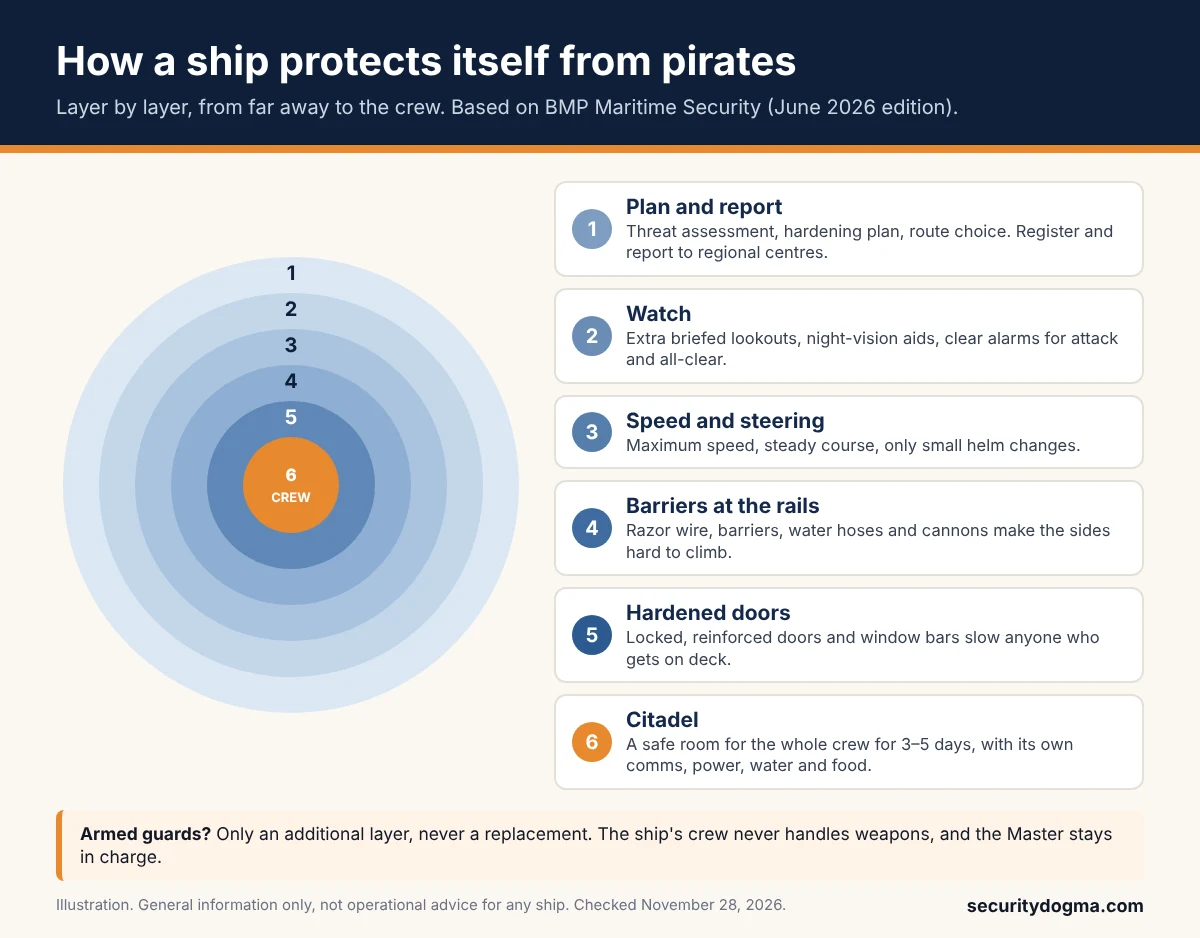
- The idea: layers. Plan the route, keep a sharp lookout, run fast, block the ship’s rails, harden the doors, and give the crew a safe room called a citadel.
- The citadel: a protected space where the whole crew can shelter for 3 to 5 days, with its own communications, power, water and food, while naval forces respond.
- Armed guards: BMP MS treats them as only an additional layer, not a replacement. It doesn’t recommend them in general, and the ship’s crew must never handle the weapons.
- Does it work? The International Maritime Bureau said in October 2026 that ships following the latest best management practices kept stopping hijacking attempts, even when pirates managed to board.
- Free printable: Ship Anti-Piracy Layers, a one-page reference (PDF)
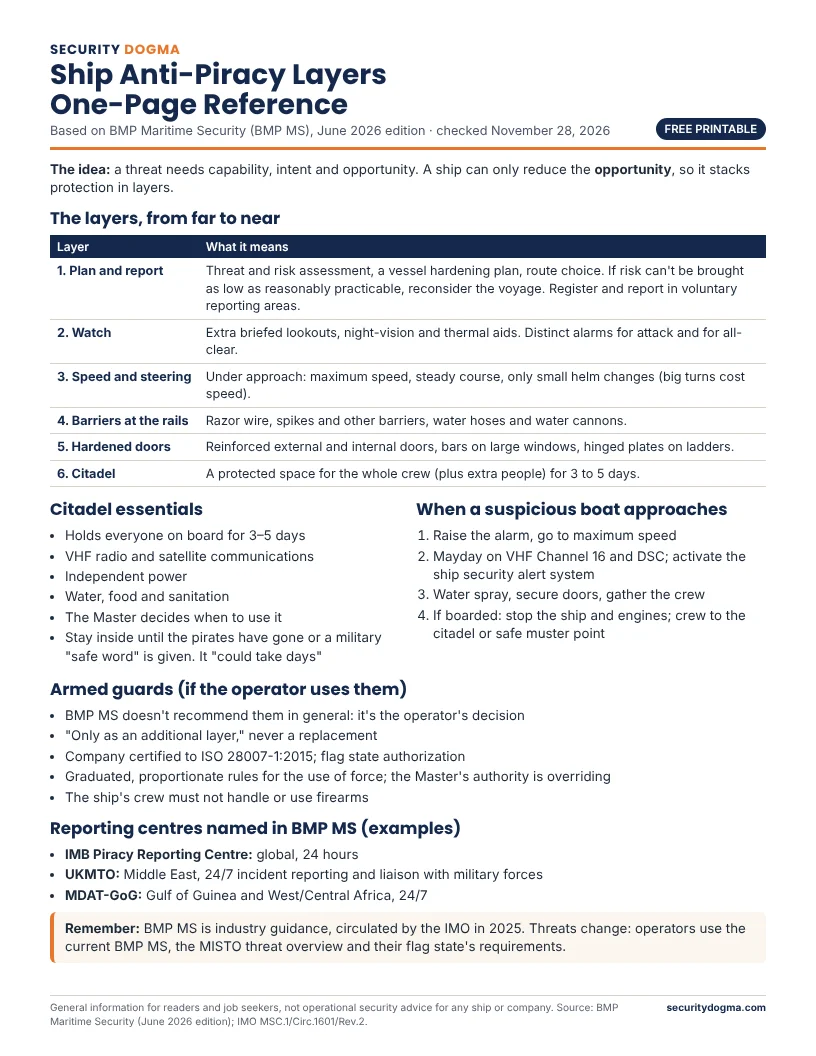
Ship Anti-Piracy Layers — One-Page Reference
A one-page reference to the protection layers, the citadel and the reporting steps in BMP Maritime Security. One page, no email needed.
⬇ Download the reference (PDF)Prefer to watch? This video covers the same ground in about five minutes.
This video is hosted by YouTube (Google). Loading it shares your IP address with Google and may set cookies. See our Privacy Policy.
This video was made with AI tools and summarizes this guide. Scenes are illustrations, not real events.
Why most pirate attacks fail now
Piracy is at historic lows, but it hasn’t gone away. The International Maritime Bureau (IMB) recorded 51 incidents of piracy and armed robbery against ships worldwide in the first nine months of 2026, down from 116 in the same period of 2025 and the lowest nine-month total since 1992. Still, 36 vessels were boarded, 8 were hijacked (all by Somali pirates), and the number of crew directly affected rose to 105.
The IMB’s own explanation of why hijackings fail is the subject of this guide. It said ships following the latest best management practices continued to prevent hijacking attempts, even when pirates managed to board, and its director, Michael Howlett, called strict adherence to BMP “one of the most effective ways to deter hijacking attempts.”
Where piracy happens today, region by region, is covered in Are there still pirates?.
The rulebook: BMP Maritime Security
What it is. Best Management Practices Maritime Security (BMP MS) is industry guidance on threat assessment, planning, protection, incident response and what to do afterward. It was published by shipping associations including BIMCO, the International Chamber of Shipping (ICS), INTERCARGO, INTERTANKO, OCIMF and IMCA, and first released on March 31, 2025. A June 2026 edition added guidance on boardings by activists.
What it replaced. It brings the earlier regional guides into one global publication. The IMO circular that circulates it says it replaces the Global BMP, BMP5 and BMP West Africa.
Is it law? BMP MS is industry guidance, not an IMO convention. The IMO’s Maritime Safety Committee circulated it in June 2025 and invited governments to advise the ships flying their flags to act on it. It sits alongside a separate threat overview, the Maritime Industry Security Threat Overview (MISTO), which covers five regions and is updated every three to six months.
Who’s in charge. Throughout BMP MS, the ship’s Master keeps overriding authority, including over any security team on board.
Before the ship sails: planning
Most of the protection happens before the ship reaches risky waters. BMP MS describes a simple idea: a threat needs capability, intent and opportunity. A ship can’t change what attackers can do or want, but it can reduce their opportunity.
- Threat and risk assessment: the company and the Master look at the latest threat information, recent attack locations and the ship itself (for example its speed and how high its deck sits above the water).
- A vessel hardening plan: the assessment becomes a plan for which protective measures to fit and use. BMP MS says the aim is to bring risk down to a level that is as low as reasonably practicable, and if that can’t be done, the voyage should be reconsidered.
- Routing: consider recent attack locations and recommended transit corridors, or avoid the area altogether.
- Registering and reporting: in the voluntary reporting areas, ships register and report their positions, suspicious activity and incidents to regional centres, such as UKMTO in the Middle East and MDAT-GoG for the Gulf of Guinea. The IMB’s Piracy Reporting Centre is a 24-hour global point of contact.
- Quiet communications: BMP MS also suggests limiting what’s shared about the voyage, including on social media.
The layers, from far to near
1. Watch: see them first
Early warning buys time for every other layer. BMP MS calls for extra, briefed lookouts, night-vision and thermal aids, and distinct alarms that every crew member recognises, one for an attack and one for the all-clear.
From my own Navy service, I can tell you watches could be boring and cold. That’s exactly why the foundation of every security role is the same: being observant, detailed and disciplined, hour after hour.
2. Speed and steering: be hard to catch
Pirates usually approach in small, fast boats and need to come alongside. Under approach, BMP MS tells ships to go to maximum speed and keep a steady course, making only small helm changes, because large turns cost speed.
3. Barriers at the rails: be hard to climb
The first physical layer is at the ship’s sides, where attackers would try to climb aboard. BMP MS lists measures such as razor wire, spikes and other barriers, water hoses and water cannons, and similar measures that make the hull and rails hard to scale.
4. Hardened doors: slow them down
If someone gets on deck, the next layer is time. BMP MS describes hardened external and internal doors, bars on large windows and hinged plates on ladders, so that attackers can’t quickly reach the bridge, the engine room or the crew.
5. The citadel: keep the crew out of reach
The last layer protects the people.
The citadel: the ship’s safe room
A citadel is a protected space the whole crew can retreat to if pirates get on board. Under BMP MS:
- It should hold the entire crew, plus any extra people on board, for 3 to 5 days.
- It needs its own communications (VHF radio and satellite), independent power, water, food and sanitation.
- The Master decides when to use it.
- Naval forces may need to know all crew are accounted for inside before they act.
- In a piracy case, the crew stays inside until they’re sure the pirates have gone or they hear a military “safe word”. BMP MS warns this “could take days.”
A citadel works because it changes what pirates can achieve. If they can’t reach the crew, they can’t control the ship, and they’re left on deck with a warship on the way.
When a suspicious boat approaches
BMP MS sets out a short sequence for the crew (summarized here, not a checklist for any ship):
- Raise the alarm and go to maximum speed.
- Call for help: a Mayday on VHF Channel 16 and by DSC, and activate the ship’s security alert system.
- Use the protection: water spray, secure the doors and gather the crew.
- If pirates board: stop the ship and its engines and get the crew to the citadel or the safe muster point.
If people are taken hostage, BMP MS’s advice is to stay calm and cooperate.
Where armed guards fit
Armed guards are what most people picture, but in BMP MS they come last:
- BMP MS doesn’t recommend or endorse the general use of armed guards. It’s the ship operator’s decision.
- If they’re used, it’s “only as an additional layer” of protection, on top of everything above.
- The security company should be certified to ISO 28007-1:2015, and the ship needs flag state authorization.
- Rules for the use of force must be graduated and proportionate, and the Master’s authority stays overriding.
- The ship’s crew must not handle or use firearms.
Who decides, how a team is set up and how weapons get on board are covered in Do cargo ships have armed guards?.
What this means if you want a job at sea
If you’re aiming at maritime security, this is the work you’d be part of. Armed teams advise the Master, help harden the ship, and stand long lookout watches long before anyone talks about weapons. Teams are put on board for a ship’s passage through high-risk waters and get off once it’s through.
- Start with the overview: Maritime security jobs.
- The route in: How to become a maritime security contractor.
- Not sure if it’s for you? Maritime security vs cruise ship security.
Keep the layers on one page: download the Ship Anti-Piracy Layers reference (PDF).
Gear for lookout watches
Some links in this section are affiliate links. If you buy through them, Security Dogma may earn a commission at no extra cost to you. As an Amazon Associate I earn from qualifying purchases. Read our affiliate disclosure. These are research picks: I haven’t tested these exact products.
Bushnell Marine 7×50 Waterproof Binoculars with Compass
7x magnification · 50 mm lenses · built-in compass and illuminated rangefinding reticle · waterproof and fogproof · floating rubber armor (per the listing)
The 7×50 is the traditional marine binocular: a wide, bright view that’s easier to hold steady on a moving deck than higher magnifications.
Watch out for: porro-prism 7x50s are bulky; that’s the trade-off for a bright, steady view.
See current price →Paid link · opens Amazon.com
Barska Floatmaster 7×50 Marine Binoculars
7×50 · fully multi-coated optics · nitrogen-purged, waterproof and fogproof · floats · carrying case included (per the listing)
A lower-cost marine binocular for practising lookout skills or keeping a spare in your kit bag.
Watch out for: no compass or rangefinder.
See current price →Paid link · opens Amazon.com
Black Diamond Spot 400-R Headlamp
Up to 400 lumens · rechargeable 1500 mAh battery · IP67 waterproof · red night-vision mode · lock mode (per the listing)
A red light lets you check your gear and notes on deck at night without a bright white beam.
Watch out for: it charges by micro-USB, not USB-C.
See current price →Paid link · opens Amazon.com
Frequently asked questions
How do ships protect themselves from pirates?
With layers. They plan the route and report their position, keep extra lookouts, run at maximum speed, block the rails with barriers like razor wire and water hoses, harden doors, and keep a citadel where the crew can shelter. The industry guidance for this is BMP Maritime Security.
What is a citadel on a ship?
A protected space where the whole crew can shelter if pirates board. BMP MS says it should hold everyone for 3 to 5 days, with its own communications, power, water, food and sanitation. The Master decides when to use it.
Why don’t ship crews carry guns?
Under BMP MS, the ship’s crew must not handle or use firearms. If a ship carries armed protection, it’s a team from a private security company, authorized by the flag state and working under the Master’s authority.
Do all ships have armed guards?
No. BMP MS doesn’t recommend armed guards in general and treats them as only an additional layer on top of the other measures. Whether to use them is the ship operator’s decision.
What is BMP5?
BMP5 was the earlier best management practices guide for the Red Sea, Gulf of Aden, Indian Ocean and Arabian Sea. It was replaced by the consolidated BMP Maritime Security (BMP MS), first released in 2025.
Is BMP mandatory?
BMP MS is industry guidance, not an international convention. The IMO circulated it in 2025 and invited governments to advise the ships flying their flags to act on it. Individual flag states, insurers and companies can set their own requirements.
What happens if pirates board a ship?
Under BMP MS, the crew stops the ship and its engines and goes to the citadel or safe muster point, then waits for naval forces. In a piracy case they stay inside until they’re sure the pirates have gone or they get a military “safe word,” which can take days.
Is piracy still a problem in 2027?
Less than in the past, but yes. The IMB counted 51 incidents in the first nine months of 2026, the lowest since 1992, but 8 ships were hijacked, all by Somali pirates, and more crew were affected than a year earlier.
Related guides
- Maritime security jobs
- Are there still pirates?
- Do cargo ships have armed guards?
- How to become a maritime security contractor
- Maritime security vs cruise ship security
Sources
- BMP Maritime Security (BMP MS), June 2026 edition (PDF, BIMCO)
- IMO, MSC.1/Circ.1601/Rev.2, Revised industry counter piracy guidance (June 30, 2025) (PDF)
- Gard, New BMP released as global piracy rises (2025)
- UK P&I Club, BMP MS and the Maritime Industry Security Threat Overview (MISTO)
- Baird Maritime, IMB records 51 piracy incidents in nine months (October 16, 2026)
Checked November 28, 2026. Threat levels change; ship operators should use the current BMP MS, MISTO and the regional reporting centres.
Firearms and weapons disclaimer: This page discusses firearms or other weapons for general information only. It is not legal advice, not firearms training, and not a recommendation to buy, carry or use any weapon. Laws on owning, carrying, transporting and using firearms, stun guns, pepper spray, batons and knives vary by state, county and city. They change often, can be different for security work, and breaking them can lead to criminal charges. Before you carry or use any weapon, confirm the current law where you are, get any required permit or license, train with a certified instructor, and follow your employer’s, client’s and property owner’s rules. You alone are responsible for how you buy, carry, store and use any weapon. Security Dogma and its authors accept no liability for any injury, loss, damage or legal consequence that results from acting on this information. A product link does not mean the item is legal where you live, so check local restrictions before you buy.
Legal disclaimer: This page is for general information and education only. It is not legal advice, and reading it does not create an attorney-client relationship. Security Dogma is not a law firm. Laws, licensing rules and court decisions vary by state and change often, and what is written here may not match your situation or be current when you read it. Before you act on anything here, check the official rules from your state licensing agency, follow your employer’s and client site’s policies, and talk to a licensed attorney in your state for legal questions. See our Terms and Conditions and how facts are checked in our Editorial Policy.