

Security Dogma is reader-supported. When you buy through links on this page, we may earn a commission at no extra cost to you. As an Amazon Associate I earn from qualifying purchases. Learn more
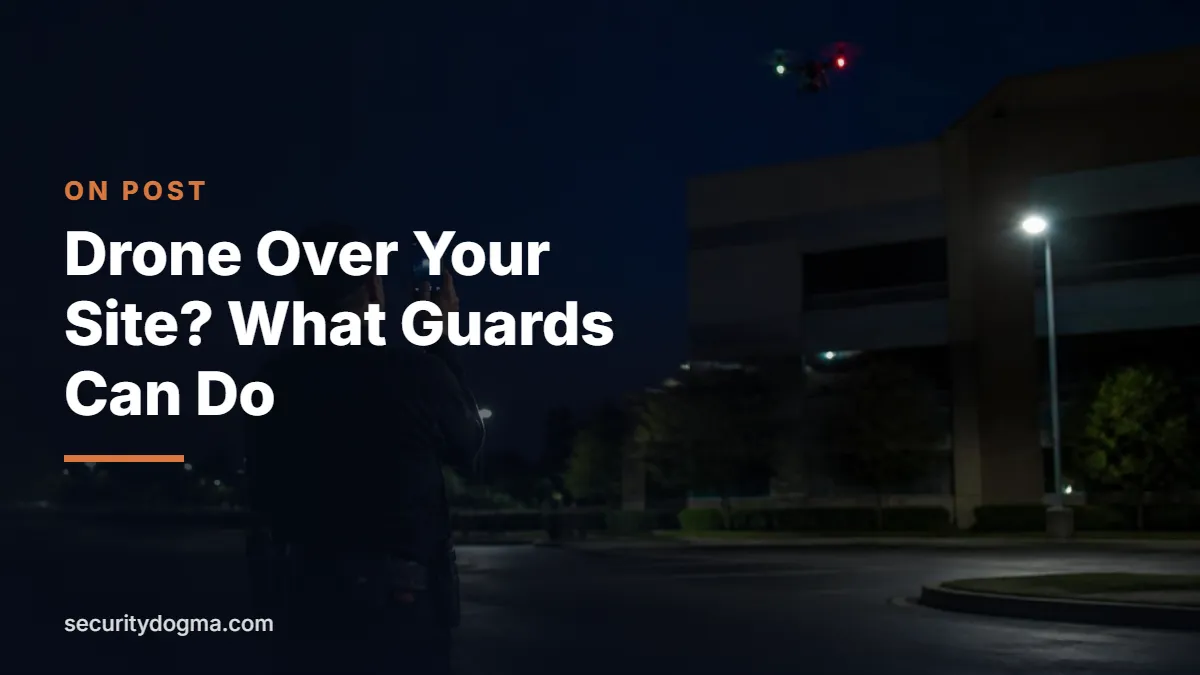
A drone is hovering over the loading dock, or it has made three passes over the fence line in the last hour. Your client wants it gone. Your instinct says do something about it.
Here is the blunt truth: as a security guard, you have almost no legal power over a drone in the air, and the wrong move can turn you into the one facing federal charges. What you do have is the power to observe, document, find the pilot and get the right people involved. Done well, that is usually enough.
Quick answer
- Never shoot, throw things at, net, jam or try to take control of a drone. Drones are aircraft under federal law, and damaging one is a federal crime.
- Do watch it, record video, note the time, direction and behavior, and look for the pilot nearby.
- Report threats, surveillance or dropped objects to your supervisor and police, and unsafe flying to the FAA.
- Only certified police and corrections agencies may take down drones under the federal SAFER SKIES rule that took effect July 1, 2026. Private security may not.
Is it illegal to fly a drone over private property?
Not by itself. The FAA controls the airspace, and a property owner does not own the sky above their roof. A drone flight over your site becomes a legal problem when it breaks a specific rule, for example:
- Restricted airspace such as near airports, stadiums during events, or temporary flight restrictions.
- Unsafe or careless flying, like flying low over people or vehicles.
- Harassment, stalking or voyeurism, such as hovering near windows.
- State drone surveillance laws. In Texas, using a drone to capture images of a person or private property with intent to conduct surveillance is a crime (Gov’t Code § 423.003). Florida bars drone recording of private property or its occupants with intent to surveil in violation of a reasonable expectation of privacy (§ 934.50).
- Taking off or landing on the property without permission, which is trespass.
You do not have to decide which law applies. Your job is to document what you see so police, your client or a lawyer can decide.
What you must never do
- Shoot at it. Under 18 U.S.C. § 32, destroying or damaging an aircraft can carry up to 20 years in prison and fines up to $250,000. In 2024 a Florida man was charged after shooting at a delivery drone over his property.
- Jam it. Signal jammers are illegal for private use under federal law, and they can knock out other radios, including yours.
- Throw objects, use nets or launch your own drone at it. You own whatever it hits on the way down.
- Grab the controller from the pilot or detain them for flying. Unless your state’s detention rules clearly apply to a crime you saw, that is assault. See can security guards detain people?
- Promise the client you will “take care of it.” You cannot legally.
What to do, step by step

- Stay calm and keep watching. Note where it came from, how high it is and what it is doing: passing, hovering, circling or following.
- Start recording on your phone or body camera. Capture the drone and anything it seems to be filming.
- Notify your supervisor by radio or phone right away.
- Look for the pilot. Most drones must stay within the pilot’s line of sight, so check parked cars, nearby lots, rooftops and the street.
- If you find the pilot and it is safe, talk to them. Be polite, identify yourself and ask what they are doing. Many are hobbyists or contractors who will move on. Do not touch them or their equipment. Use your de-escalation skills.
- Call 911 if the drone threatens people, drops anything, follows someone, or flies over a restricted or critical area.
- Report unsafe flying to the FAA through the FAA Safety Hotline at 1-800-255-1111 or hotline.faa.gov.
- Write it up before the end of your shift and preserve all footage.
A body camera lets you record the drone and anything the pilot says while keeping your hands free. Check price
Some sites use Remote ID receivers. Remote ID broadcasts a drone’s ID, position, altitude and the location of the control station. It does not tell you who owns it; only the FAA and authorized public safety officials can link a drone to an owner. Give the data to police.
What to put in your drone sighting report
- Date, start and end time
- Exact location on site, and where the drone came from and went
- Estimated height and flight pattern: passing, hovering, circling, following or repeated passes
- Description: size, color, number of rotors, lights, markings or anything attached
- What it appeared to film or approach
- Remote ID data, if your site captures it
- Pilot location and description, vehicle and plate if seen, and anything they said
- Who you notified and when, plus any police report or case number
- Photos and video, with the original files preserved
Use the same discipline as any incident report: facts, times and what you saw, not guesses about intent.
If a drone lands or crashes on the property
Leave it where it is if that is safe, keep people away from the propellers and battery, and call your supervisor and police. Do not open it, pull the memory card or look through its footage. It is someone else’s property and may be evidence. If the owner shows up, get their name and contact details, call your supervisor, and let police or the client decide whether it is returned.
Sites where drones are a bigger threat
Some posts need a stricter drone plan:
- Prisons and jails, where drones are used to drop contraband.
- Stadiums and large events, where flights are often restricted and police may have counter-drone teams on site.
- Power plants, refineries, ports and other critical infrastructure, where repeated overflights can be reconnaissance.
- Data centers, labs and corporate campuses, where a drone can photograph sensitive areas.
On these sites, report every sighting, even one that seems harmless, and let investigators connect the dots.
Sample drone post order
Post order: drones (unmanned aircraft)
If you see a drone over or near the site: (1) do not attempt to disable, strike, capture or interfere with it; (2) observe and record the time, location, direction, height and description; (3) record video if safe; (4) locate the operator if visible and, if safe, politely ask their purpose without physical contact; (5) notify the shift supervisor immediately; (6) call 911 if the drone threatens people, drops any object, or flies over a restricted area; (7) complete a drone sighting report before the end of shift and preserve all footage.
Want to know how security teams use drones themselves? Read our drones for security guide.
Frequently asked questions
Can a security guard shoot down a drone?
No. Drones are aircraft under federal law, and damaging one is a federal crime under 18 U.S.C. § 32, with penalties of up to 20 years in prison. Private security has no authority to take down or jam a drone.
Who can legally take down a drone?
Since July 1, 2026, certified state, local, tribal and territorial police and corrections agencies may detect and, with FBI training, mitigate dangerous drones. Federal agencies also have counter-drone authority. Private security and contractors do not.
Is it illegal for a drone to fly over private property?
Not automatically. The FAA controls the airspace. A flight can become illegal because of restricted airspace, unsafe flying, harassment, voyeurism or state drone surveillance laws such as those in Texas and Florida.
How do I find out who is flying a drone?
Look for the pilot, who usually must keep the drone in sight. Remote ID receivers can show the drone’s position and the control station’s location, but only the FAA and authorized public safety officials can link a drone to its owner.
Where do I report a drone flying over my property?
Report threats, surveillance or dropped objects to local police. Report unsafe flying to the FAA Safety Hotline at 1-800-255-1111 or hotline.faa.gov. On a guarded site, always tell your supervisor and file a written report.
Sources
- Crowell & Moring: SAFER SKIES Act interim final rule
- Guardian RF: the SAFER SKIES Act explained
- UAV Coach: can you shoot down a drone?
- FAA: Remote Identification for drone pilots
- Texas Government Code § 423.003
- Florida HB 649 (2015): § 934.50
Reviewed October 14, 2026. Drone rules are changing quickly; check the FAA and your state before you fly.
Legal disclaimer: This page is for general information and education only. It is not legal advice, and reading it does not create an attorney-client relationship. Security Dogma is not a law firm. Laws, licensing rules and court decisions vary by state and change often, and what is written here may not match your situation or be current when you read it. Before you act on anything here, check the official rules from your state licensing agency, follow your employer’s and client site’s policies, and talk to a licensed attorney in your state for legal questions. See our Terms and Conditions and how facts are checked in our Editorial Policy.