

Security Dogma is reader-supported. When you buy through links on this page, we may earn a commission at no extra cost to you. As an Amazon Associate I earn from qualifying purchases. Learn more
Quick answer
Yes. Most cruise ships have a small, locked holding room called the brig, and cruise lines’ own conduct policies say a passenger can be “detained” or “confined in a stateroom or holding cell.” The ship’s security team runs it, but the decision to hold someone rests with the captain, and serious crimes involving U.S. voyages must be reported to the FBI.
- Who decides: the captain has overriding authority; the Chief Security Officer’s team carries it out.
- What gets you there: violence, threats, serious intoxication, theft, sexual misconduct, or refusing security’s instructions.
- What usually happens instead: confinement to your cabin, or being put off the ship at the next port.
- Whose law applies: it depends on where the ship is, the flag it flies, and who was involved.
I never worked on a cruise ship. I did spend more than 15 years in security on land: nightclub doors, large events, executive protection, hotel night shifts, and running a private investigation firm. In loss prevention, when we caught a shoplifter, we detained them until the police arrived, and most of the time the police came quickly. The difference at sea is that there’s no patrol car coming. The ship’s security team has to hold the situation until the ship reaches a port.
This guide answers the curious question, then shows you the people behind the answer. If you’re thinking about the job, our cruise ship security guide covers how the department works, what it pays and how to get hired.
Prefer to watch? This video covers the same ground in about seven minutes.
This video is hosted by YouTube (Google). Loading it shares your IP address with Google and may set cookies. See our Privacy Policy.
This video was made with AI tools and summarizes this guide. Scenes are illustrations, not real events.
Yes, cruise ships have jails: meet the brig
On a ship, a jail is called a brig. On a cruise ship it’s usually a small, secure room rather than a row of barred cells. Cruise lines don’t publish floor plans or photos of their brigs, and for good reason: it’s a security space. What they do publish is the rule. Royal Caribbean Group’s Guest Health, Safety, and Conduct Policy, for example, lists among its enforcement actions being “detained, quarantined or confined in a stateroom or holding cell.”
A brig is also rarer in practice than social media makes it look. Most incidents end with a warning, a cabin confinement, or a passenger walking off the ship at the next port with their luggage and a flight home at their own expense. The holding cell is for when someone is a danger to others and can’t be trusted on their own in a cabin.
Security’s role: Holding someone is a responsibility, not a punishment. In any security job, the person you detain is in your care: someone controls access to the room, logs who goes in and out and when, and checks on the detainee’s welfare, especially if they’re drunk or injured. The ship’s medical team gets involved when there’s any doubt about the person’s health.
Who has the authority to lock someone up?
The captain, also called the master, has the final word. Cruise line policies say so directly: Royal Caribbean’s conduct policy is “subject to the captain’s overriding authority under national or international law” to make decisions needed to keep the ship safe and secure.
Under the captain sits the security department. On most large ships it’s led by a Chief Security Officer who reports to the Staff Captain, the captain’s second in command. The International Ship and Port Facility Security (ISPS) Code also requires every ship to have a designated Ship Security Officer, responsible for the ship’s security plan. U.S. law defines that person as the one who, “with the master’s approval, has full responsibility for vessel security.”
In practice, security acts first and the decision goes up the chain. If someone is swinging at another passenger, officers don’t wait for the captain’s signature to separate them. What happens next, whether that’s a warning, cabin confinement, the brig or disembarkation, is decided by ship management.
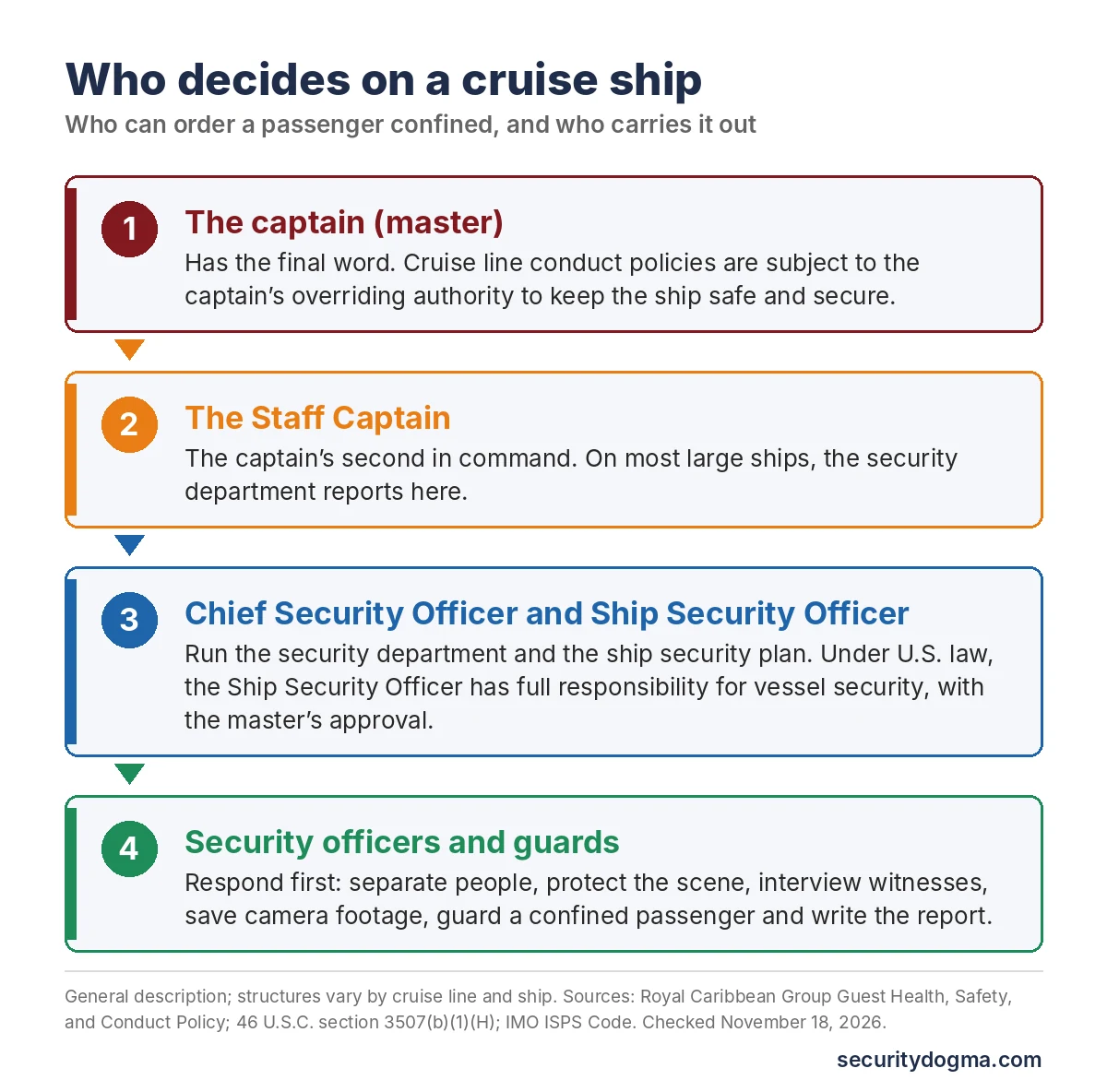
Security’s role: Security responds, contains the situation, and reports up the chain with facts: what happened, who was involved, what witnesses said, and what the cameras show. A security officer’s job is to give the captain a clear, accurate picture to decide on.
What gets you put in the brig
Cruise lines’ conduct policies list the behavior that can trigger enforcement: violence, harassment, uninvited physical contact, theft, vandalism, possession of illegal items, underage drinking, and refusing to follow crew instructions, among others. The brig is at the serious end of that list. It’s typically for situations like these:
- Violence: fights between passengers, or an attack on a crew member.
- Threats: threatening to hurt someone, or making threats against the ship.
- Extreme intoxication: when a drunk passenger becomes aggressive or a danger to themselves or others.
- Sexual misconduct and assault: the most serious allegations, which also trigger FBI reporting on U.S. voyages.
- Theft: especially large thefts; thefts over $10,000 are on the list of crimes reported to the FBI.
| Incident | What security does | Who makes the call |
|---|---|---|
| Drunk, disruptive passenger | Calms and separates them, escorts them to their cabin, checks on them, and calls medical if needed | Ship management decides on cabin confinement or other action |
| Fight | Separates the people involved, gets medical help, identifies witnesses, saves camera footage, writes the report | Captain decides on confinement, the brig or disembarkation |
| Theft | Takes the report, reviews cameras and stateroom access records, documents everything | Ship management; FBI notified if over $10,000 on covered voyages |
| Assault, including sexual assault | Protects the victim, gets medical help, preserves the scene and evidence, limits access | Captain; the FBI is called as soon as possible on covered voyages |
| Threat to people or the ship | Locates and contains the person, raises the alarm through the chain of command, protects the area | Captain, with the ship’s security plan |
| Person overboard alert | Reviews camera footage, checks the person’s cabin and announcements, supports the search | The bridge (captain) leads the response; a missing U.S. national is reported to the FBI |
My rule on any post was to stop it before it turns physical. Stay aware and read people’s behavior: if people were arguing, looked upset or had clearly had too much to drink, we’d go over and talk to them to see if they were OK. On a ship, where the same passengers are on board for days, that early conversation matters even more.
Security’s role: Most incidents are won or lost in the first minute. Security’s first job is to calm things down and separate people, using no more force than the situation requires and only what the cruise line’s policy allows. Then the paperwork starts: witness statements, a timeline, and saving the camera footage before it’s overwritten. On covered ships, the law requires video to be kept at least 20 days, and footage relevant to an FBI-reported crime must be preserved for at least 4 years.
The alternatives: cabin confinement and getting put off the ship
The brig is the last resort. The two outcomes you’re far more likely to see are:
- Cabin confinement: the passenger stays in their own stateroom, sometimes with a security officer posted outside the door.
- Disembarkation: the passenger is removed at the next port. Royal Caribbean’s policy says passengers removed for violating it pay for their own accommodation and travel home, and can be banned from future cruises. In some cases, the whole travel party can be removed too.
Security’s role: A posted guard outside a cabin is a real assignment: you note who comes and goes, deliver meals, and make sure the person doesn’t leave. If the passenger is put ashore, security coordinates the handover with the port and, when a crime is involved, with local police or federal agents waiting at the pier.
Which laws apply at sea?
⚖️ Legal note: this section is general information, not legal advice. Which law applies to an incident depends on the ship’s flag, where it was, the itinerary and the nationality of the people involved. If you’re involved in an incident at sea, talk to a lawyer who handles maritime cases.
This is where cruise ships get complicated. There isn’t one police force at sea, so several sets of laws can overlap:
- The flag state: every ship is registered in a country and flies its flag. On the high seas, that country’s law generally governs what happens on board.
- The port state: inside a country’s territorial waters, up to 12 nautical miles from its coast, and in its ports, that country’s laws apply too.
- The United States: U.S. federal law reaches crimes by or against U.S. nationals on foreign ships during voyages that start or end in the United States, to the extent international law allows (18 U.S.C. section 7). The FBI investigates those crimes.
The Cruise Vessel Security and Safety Act (CVSSA)
Passed in 2010, the CVSSA applies to ships that carry 250 or more passengers overnight and embark or disembark passengers in the United States. Among other things, it requires the cruise line to:
- call the nearest FBI office as soon as possible after a homicide, suspicious death, missing U.S. national, kidnapping, assault with serious bodily injury, sexual assault, tampering with the vessel, or theft over $10,000
- keep a log of all crime complaints, available to the FBI and the Coast Guard
- keep video surveillance, with signs telling passengers it’s there
- give passengers a security guide explaining who to contact and which law enforcement applies
- have at least one crew member trained and certified in preventing, detecting, preserving evidence of, and reporting crimes at sea
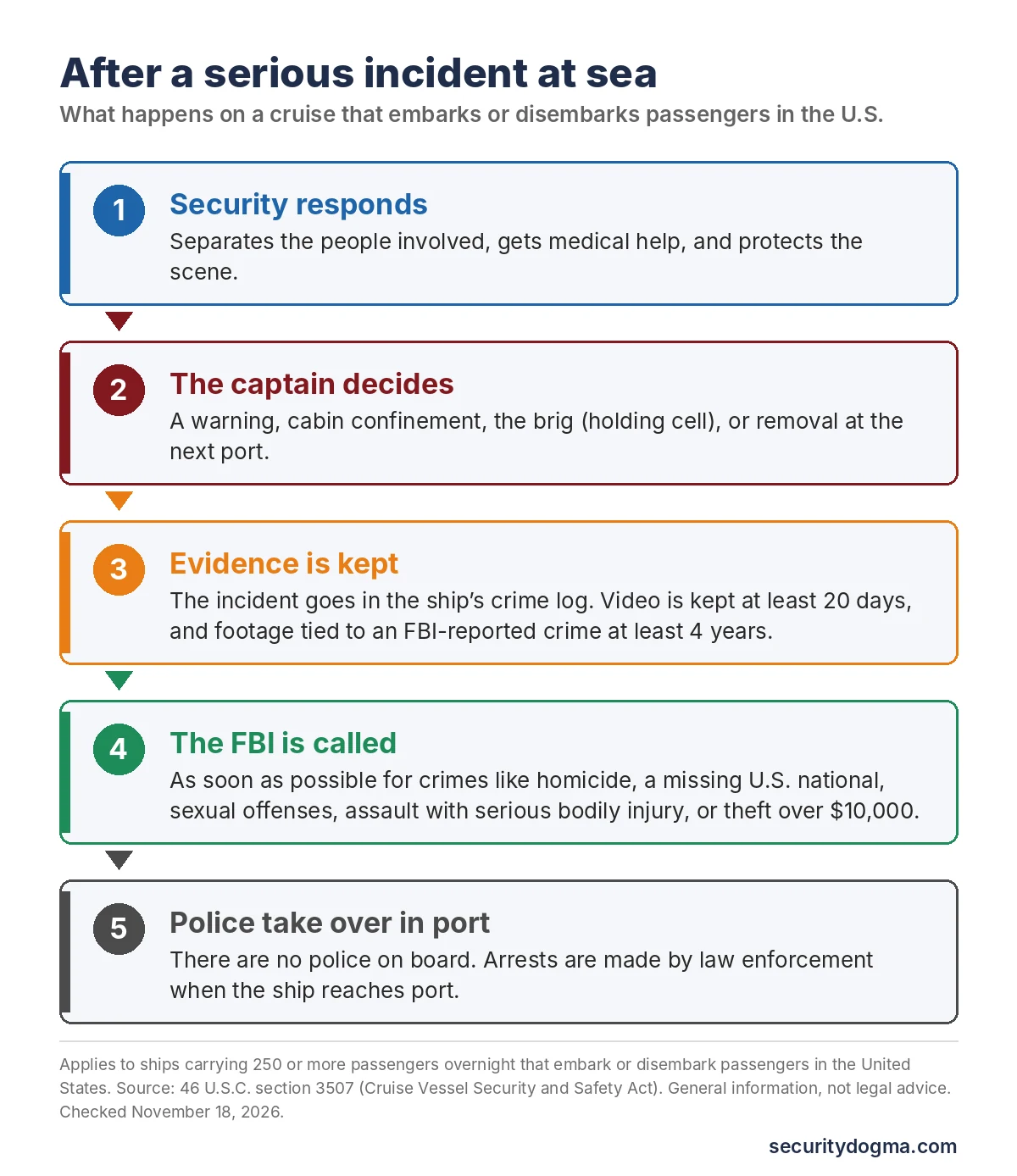
The Department of Transportation publishes these reports every quarter. For July through September 2026, cruise lines reported 54 alleged crimes to the FBI; 40 of them were sexual assault allegations, including rape. These are allegations reported, not convictions.
Security’s role: When a serious crime happens on a covered voyage, security protects the scene, preserves the evidence, and keeps people out until law enforcement takes over. The security team also feeds the crime log and the report to the FBI. Careful notes and an unbroken chain of evidence are what make a case possible once the ship docks. Our incident report template shows what a good report covers.
Who are the security officers on a cruise ship?
Every big cruise ship carries a dedicated security department. Its size depends on the ship and the cruise line, and lines don’t publish exact numbers. The structure usually looks like this:
- Chief Security Officer: runs the department and reports to the Staff Captain.
- Deputy or assistant security officers: supervise shifts and investigations.
- Security officers and guards: handle the gangway, patrols, cameras and incidents.
Many come from military, police or private security backgrounds. Every seafarer needs basic safety training under the international STCW convention, security crew also need security training for their duties, and the officer responsible for the ship’s security plan needs a Ship Security Officer certificate.
Are cruise ship security guards armed? Cruise lines don’t make their weapons arrangements public, and they vary by line and flag state. Don’t expect to carry a firearm as a cruise ship guard. Cargo ships in high-risk waters are a different world, which we cover in do cargo ships have armed guards.
A day in the life of cruise ship security
- Gangway and screening: checking every passenger and crew member on and off, X-raying bags, and confiscating prohibited items.
- Patrols: walking decks, bars, pools and crew areas, day and night.
- Camera monitoring: watching live feeds and pulling footage after incidents.
- Crowd control: at shows, deck parties, tender boats and embarkation day.
- Drills: taking part in the ship’s regular safety and security drills.
- Reports: writing up every incident, because the log has to stand up to a federal agent’s questions.
On reports, my rule has always been details, details, details. The more detailed and factual the report, the better it holds up when someone else reads it later, whether that’s the captain, the cruise line or an FBI agent.
Thinking about this career? Here’s how to get hired as a cruise ship security officer: the training, the certificates and where to apply. For armed work at sea, see our guide to maritime security jobs.
Books for future cruise and maritime security officers
Some links in this section are affiliate links. If you buy through them, Security Dogma may earn a commission at no extra cost to you. As an Amazon Associate I earn from qualifying purchases. Read our affiliate disclosure. These are research picks based on the publishers’ descriptions, not books I’ve reviewed in full.
Maritime Security: An Introduction (2nd edition)
Michael McNicholas · Butterworth-Heinemann · paperback, 514 pages (per the listing)
A broad introduction to how seaports and ships work, the threats they face, and the security policies, procedures and systems used against them. It covers the ship side and the port side, so it helps you see where the cruise security department fits in the bigger maritime picture before an interview.
Watch out for: it’s a 2016 edition, so check current rules and your cruise line’s own procedures. It’s a textbook, not a job guide.
See current price →Paid link · opens Amazon.com
Guide to Maritime Security and the ISPS Code, 2021 Edition
International Maritime Organization (IMO) · paperback, 413 pages (per the listing)
The IMO’s own guide to the ISPS Code and the maritime security framework behind every ship security plan and Ship Security Officer. If you’re working toward security duties at sea, this is the rulebook the training refers to.
Watch out for: it’s expensive and dense, and written for officers and administrators. Your STCW security course covers what you need for the certificate.
See current price →Paid link · opens Amazon.com
If something happens to you on a cruise: how to work with ship security
⚠️ Safety note: in an emergency on board, contact ship security, Guest Services or any crew member right away, and follow the crew’s instructions. This section is general guidance, not legal advice.
- Report it right away to security or Guest Services, and ask for the name of the officer handling it.
- Preserve evidence: don’t clean up, wash clothes or delete messages, and write down times and names while they’re fresh.
- Ask about cameras: on covered ships, footage is kept at least 20 days, and it can be requested by law enforcement and, for sexual assault cases, by the victim.
- Know who else to call: on U.S. voyages, the FBI. Cabins on covered ships must list the U.S. embassy and consulates for each port of call.
For prevention, from locking your cabin to staying safe ashore, see our cruise ship safety tips.
Frequently asked questions
Do cruise ships have jails?
Yes. Most cruise ships have a small holding room called the brig, and cruise line conduct policies allow passengers to be detained or confined in a stateroom or holding cell. It’s used only when someone is a danger to others; cabin confinement and removal at the next port are far more common.
What is a cruise ship brig?
The brig is the ship’s secure holding room, run by the security department. It’s used to hold a person safely until the captain decides what happens next, which can mean handing them over to police at the next port.
Who arrests you on a cruise ship?
There are no police on board. Ship security can detain you under the captain’s authority, but arrests are made by law enforcement when the ship reaches port, such as the FBI or local police.
What happens if you commit a crime on a cruise ship?
Security will contain the situation and document it, and the captain can confine you or have you removed at the next port at your own expense. Serious crimes on voyages to or from the United States are reported to the FBI, and you can be prosecuted under the laws of the flag state, the port state or the United States.
Do cruise ship security officers carry guns?
Cruise lines don’t make their weapons arrangements public, and they vary by line and flag state. Security teams are trained in incident response and defensive tactics; don’t expect to carry a firearm as a cruise ship guard.
How many security guards are on a cruise ship?
It depends on the ship and the cruise line, which don’t publish exact numbers. Every large ship has a full security department led by a Chief Security Officer.
What qualifications do cruise ship security officers need?
Most need security or military experience, STCW basic safety training and security training for their duties, plus a clean background and medical clearance. The full path is in our guide to becoming a cruise ship security officer.
Sources
- 46 U.S.C. section 3507 (Cruise Vessel Security and Safety Act: reporting, video, security guide, log book)
- 46 U.S.C. section 3508 (crew crime-prevention and evidence training)
- 18 U.S.C. section 7 (special maritime and territorial jurisdiction)
- U.S. Department of Transportation cruise line incident reports (CVSSA data, July–September 2026)
- Royal Caribbean Group Guest Health, Safety, and Conduct Policy
- International Maritime Organization: guidance on maritime security and the ISPS Code (MSC.1/Circ.1525)
- UN Convention on the Law of the Sea (territorial sea, flag state)
Checked November 18, 2026. This guide is general information, not legal advice. Cruise line procedures vary; follow the instructions of your ship’s crew.
Legal disclaimer: This page is for general information and education only. It is not legal advice, and reading it does not create an attorney-client relationship. Security Dogma is not a law firm. Laws, licensing rules and court decisions vary by state and change often, and what is written here may not match your situation or be current when you read it. Before you act on anything here, check the official rules from your state licensing agency, follow your employer’s and client site’s policies, and talk to a licensed attorney in your state for legal questions. See our Terms and Conditions and how facts are checked in our Editorial Policy.
Firearms and weapons disclaimer: This page discusses firearms or other weapons for general information only. It is not legal advice, not firearms training, and not a recommendation to buy, carry or use any weapon. Laws on owning, carrying, transporting and using firearms, stun guns, pepper spray, batons and knives vary by state, county and city. They change often, can be different for security work, and breaking them can lead to criminal charges. Before you carry or use any weapon, confirm the current law where you are, get any required permit or license, train with a certified instructor, and follow your employer’s, client’s and property owner’s rules. You alone are responsible for how you buy, carry, store and use any weapon. Security Dogma and its authors accept no liability for any injury, loss, damage or legal consequence that results from acting on this information. A product link does not mean the item is legal where you live, so check local restrictions before you buy.