

Security Dogma is reader-supported. When you buy through links on this page, we may earn a commission at no extra cost to you. As an Amazon Associate I earn from qualifying purchases. Learn more
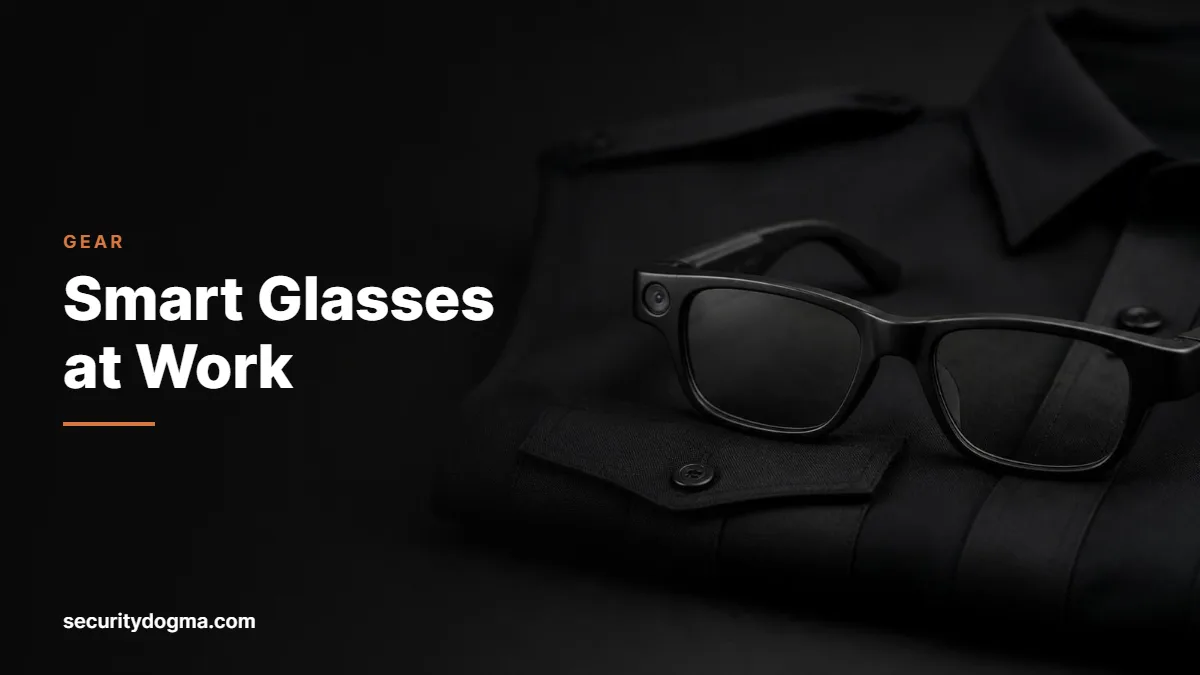
Smart glasses from Meta are showing up on posts, in patrol cars and on surveillance jobs. Ray-Ban Meta and Oakley Meta glasses look like ordinary frames, but they carry a camera, microphones, open-ear speakers and an AI assistant. For a security guard or a private investigator, that raises two questions fast: will they actually help on the job, and are you even allowed to wear them at work?
This guide answers both. It covers what the glasses can and cannot do, where they are already banned, the recording laws that matter, how they compare with a real body camera, and which models make sense if your employer says yes.
Quick answer
- Allowed at work? Only if your employer and the client site say so. Many workplaces, courts and agencies now ban them.
- Best overall: Ray-Ban Meta (Gen 2): 3K video, up to 8 hours of battery, from $379.
- Best for prescription and changing light: Oakley Meta HSTN, with clear, Transitions and prescription lens options.
- Best for outdoor posts: Oakley Meta Vanguard: IP67 water and dust rating, up to 9 hours.
- Not a body camera. Clips are short and footage runs through your phone. If you need proof on duty, wear a real body camera.
- Audio is the legal trap. Several states require everyone’s consent to record a conversation.
Our picks at a glance
| Model | Best for | Video | Battery | Weather rating | Price from | |
|---|---|---|---|---|---|---|
| Ray-Ban Meta (Gen 2) | Everyday wear | 3K, clips up to 3 min | Up to 8 hrs | Not stated | $379 | Check price |
| Oakley Meta HSTN | Prescription, Transitions | 3K | Up to 8 hrs | IPX4 | $399 | Check price |
| Oakley Meta Vanguard | Outdoor posts, rain | 3K, 122° wide view | Up to 9 hrs | IP67 | $499 | Check price |
| BOBLOV M7 (body camera) | Recording on duty | 1080p, continuous | Up to 14 hrs | Not rated | See price | Check price |
What Meta smart glasses actually do
All current Meta glasses share the same core features. A small camera sits in the frame and takes photos and short videos when you press a button or say “Hey Meta.” Video is vertical, like a phone held upright. Open-ear speakers in the arms play calls, music and the assistant’s voice without blocking your hearing. Several microphones pick up your voice for calls and commands.
Meta AI is built in. You can ask questions, send messages, take calls and, depending on your region and settings, get live translation of a conversation. A white capture light on the front turns on whenever the camera is recording.
- Ray-Ban Meta (Gen 2) launched in September 2025 at $379. Meta doubled battery life to about 8 hours and added 3K video, with clips of up to 3 minutes. The case holds about 48 hours of extra charge.
- Oakley Meta HSTN launched in July 2025, from $399. It records 3K video, runs up to 8 hours, carries an IPX4 splash rating and comes with clear, Transitions, polarized and prescription lens options.
- Oakley Meta Vanguard went on sale October 21, 2025, at $499. It is a wraparound sport design with a 12MP ultrawide camera, a 122° field of view, up to 9 hours of use, an IP67 water and dust rating and the loudest speakers in Meta’s line.
- Meta Ray-Ban Display costs $799 and adds a small screen inside the lens, controlled by a wristband. It is heavier and has less battery life, and for most security work it adds cost without solving a real problem.
Two privacy changes matter at work. In July 2026, Meta said the camera now disables itself if the capture light is covered, starting with second-generation glasses, and it later extended this to stop a recording if someone covers the light mid-clip. Meta also says it removes listings and posts that sell ways to disable the light and takes legal action against sellers. Tampering with the light is not a workaround; it is a fast way to lose your job and your credibility.
Can you wear Meta glasses at work?
There is no law that bans smart glasses at work in general. Whether you can wear them on a post comes down to three layers: your employer’s policy, the client’s site rules and your post orders, and the law where you are standing. If any one of them says no, the answer is no.
More places are saying no. Recent examples worth knowing:
- Federal workspace. In August 2026, U.S. Immigration and Customs Enforcement barred all of its employees from wearing Meta smart glasses in the federal workspace. Its memo treats the glasses as body-worn cameras that could “unintentionally capture, record or transmit sensitive information.”
- Courts. On July 20, 2026, New York became the first state to ban smart glasses with a camera, microphone or computer in all of its state, county, town and village courts. Visitors hand them to court officers and wear regular glasses inside. Other courts, including in North Carolina and Hawaii, have their own bans.
- Healthcare. Hospitals and clinics can generally ban recording-capable glasses in patient areas, because recording patients can violate HIPAA.
- Travel and venues. Royal Caribbean bars smart glasses in public restrooms, youth areas, medical areas and the casino. Some gyms and testing centers ban them outright.
- Police and corrections. Law enforcement memos reported in 2026 treat smart glasses as a facility security risk, especially inside police buildings and jails.
If you work a hospital, courthouse, government building, school, casino or corporate campus, assume smart glasses are not allowed on duty until someone with authority tells you otherwise in writing.
The law: recording, consent and privacy

Smart glasses do not change recording law. They make it easier to break, because nobody sees a phone come out.
Audio is where you get in trouble
Federal law, 18 U.S.C. § 2511, lets you record a conversation you are part of with only your own consent. Several states are stricter. According to the Reporters Committee for Freedom of the Press, California, Delaware, Florida, Illinois, Maryland, Massachusetts, Montana, New Hampshire, Pennsylvania and Washington generally require the consent of everyone in the conversation. Michigan, Oregon, Hawaii and Maine have narrower all-party rules. Smart glasses record audio with every video, so in those states a clip of a private conversation can be a crime.
Places you never record
Restrooms, locker rooms, changing areas and anywhere people undress are off limits in every state. Medical areas carry HIPAA risk. Some states also require employers to give advance notice before electronic monitoring, including New York and Connecticut.
Faces and AI
Illinois, Texas and Washington have biometric privacy laws that cover face and voice data, and Illinois lets people sue. Meta has paid large settlements over biometric claims in Illinois and Texas. Meta has not released face recognition on its glasses, but anything you send to Meta AI can be processed on Meta’s servers and, under its terms, reviewed by people. A March 2026 investigation reported that contract workers reviewing glasses footage saw private material. Keep AI features off around client data, IDs, screens and documents.
The benefits for security guards
Where they are allowed, smart glasses do some things well:
- Hands-free photos for reports. Damage, a propped door, a leaking pipe, a parking violation: one tap or a voice command, and both hands stay free for your flashlight and radio.
- Calls without a phone in your hand. Open-ear speakers let you talk to a supervisor while you keep your eyes and ears on the scene.
- Ears stay open. Unlike earbuds, open-ear audio does not block footsteps, voices or alarms.
- Translation. Live translation can help with a basic exchange when you and a visitor do not share a language. Do not rely on it for anything that matters legally. See our guide to translation apps and devices.
- One pair of glasses. Prescription and Transitions lenses on the Oakley Meta HSTN mean you are not swapping frames between indoor and outdoor posts.
The downsides
- They are not a body camera. Clips are short (up to 3 minutes on the Ray-Ban Meta Gen 2), not a continuous shift-long recording. You will miss the part of the incident that matters.
- Battery does not cover a long shift. Up to 8 or 9 hours of typical use, and recording drains it faster. A 12-hour post outlasts them.
- Your footage leaves your control. Media moves to your phone through the Meta AI app, and anything you share with Meta AI can be processed on Meta’s servers. That is a chain-of-custody and client-confidentiality problem.
- People distrust them. The capture light is small. A visitor who notices it may assume you are filming them, which can escalate a calm contact.
- They are a target in a fight. Glasses come off, get grabbed and break. A $400 pair is an expensive thing to lose in a scuffle.
- They can cost you the job. Wearing recording glasses on a site that bans them is a policy violation, and on some sites a reason to remove you from post.
Smart glasses vs. a body camera

If your real goal is evidence that protects you, a body camera is the right tool. It is visible on your uniform, which is itself a deterrent, it records for hours, and the footage stays on the device until you hand it over. Smart glasses are a communication and convenience tool that happens to have a camera.
Use our body cameras for security guards guide if recording on duty is what you need.
Smart glasses for private investigators
Investigators have a different question: can these replace a hidden camera? In most cases, no. The capture light is designed to be seen, and the camera shuts off if you cover it. That makes the glasses a poor covert tool, and modifying them is the kind of thing that ends careers and gets evidence thrown out.
- Where they help: quick photos of a vehicle or address while you walk past, hands-free notes, navigation and calls on mobile surveillance.
- Where they fail: long static surveillance, low light, zoom work and anything that needs a long continuous video. A camcorder or superzoom camera still does that job.
- Audio: in all-party consent states, assume you cannot record conversations. Many investigators record video only and switch audio off.
- Evidence: keep the original file, note the date and time, and work from copies. Never edit the original.
See our private investigator equipment list for the tools that do surveillance work properly.
Before you wear smart glasses on duty

- Get written approval from your employer, and check that the client allows them on site.
- Read your post orders. If they ban personal recording devices, glasses count.
- Know your state’s audio consent rule before you ever record.
- Never record in restrooms, locker rooms, changing areas or medical areas.
- Keep Meta AI and sharing off around client data, IDs, screens and documents.
- Take them off when a site, a court or a client asks. Carry a regular pair.
- If you capture an incident, report it and preserve the original file the way your employer requires.
If you supervise guards: smart glasses on your sites
Every site needs a written rule, both for officers and for visitors. Lawyers who advise employers on this suggest the following:
- Name the category, not the brand. Cover “smart glasses, wearable cameras and recording-capable devices,” not just one product.
- Tie the rule to a real reason. Client confidentiality, privacy areas, patient data, security of the site. Blanket bans on all recording can run into federal labor law, so limit the rule to work time and work areas.
- Say what happens to the device. Removed, powered off or stored during working time.
- Build an approval path for legitimate uses, and a disability accommodation process. Smart glasses can be assistive devices, and a flat refusal creates legal risk.
- Ban uploading workplace recordings to personal accounts, social media, cloud storage or AI services.
How to spot smart glasses
Look for a small camera lens at a front corner of the frame, a pinhole light on the other corner, and thicker-than-normal arms. A white light on the front means the camera is recording.
When a visitor is wearing them
On private property, the owner sets the rules. If your post orders ban recording, tell the person politely what the rule is and ask them to remove the glasses or stop recording. If they refuse, follow your post orders, call your supervisor, and ask them to leave if you have that authority. Do not grab the glasses or demand footage. That turns a policy issue into a use-of-force issue. Our guide to de-escalation for security guards covers how to handle the conversation.
The best smart glasses for work
If your employer approves them, these are the models worth considering. All three record 3K video and run Meta AI.
Ray-Ban Meta (Gen 2)
3K video · clips up to 3 min · up to 8 hrs · from $379
The classic frame looks like ordinary eyewear, which makes it the least conspicuous option on a post where glasses are approved. Gen 2 doubled the battery of the first model and added 3K video. Clear and Transitions lenses are available.
Watch out for: no published water rating, and battery still falls short of a 12-hour shift.
See current price →Oakley Meta HSTN
3K video · up to 8 hrs · IPX4 · from $399
A sportier frame with a splash rating and the widest lens choice: clear, Transitions, polarized and prescription. A good fit if you move between indoor and outdoor posts and need one pair that works for both.
Watch out for: IPX4 means splashes, not downpours.
See current price →Oakley Meta Vanguard
3K video · 122° view · up to 9 hrs · IP67 · $499
Built for athletes, which makes it the toughest Meta frame: IP67 against rain and dust, the longest battery in the line, and the loudest speakers, useful next to traffic or wind. The wide 122° camera captures more of a scene.
Watch out for: the wraparound sport look stands out on a uniformed post, and there are no prescription lenses.
See current price →BOBLOV M7 body camera
1080p · GPS · up to 14 hrs · 128GB built in
If your goal is proof, not convenience, a body camera does the job glasses cannot: hours of continuous recording, GPS stamps and footage that stays on the device. It is our top pick in our body camera guide.
Watch out for: 1080p only, and no published water rating.
See current price →Frequently asked questions
Can I wear Meta glasses at work?
Only if your employer allows it and the site you work on does too. No general law bans them, but many employers, courts, hospitals and agencies do.
Is it legal to record people with smart glasses?
Video of people in public view is usually legal. Audio is different: in all-party consent states, recording a private conversation without everyone’s consent can be a crime. Never record in restrooms, locker rooms or changing areas.
Can security guards use Meta glasses instead of a body camera?
Not as a replacement. Clips are short, the battery does not cover a long shift, and footage moves through a phone app. A body camera records continuously and keeps footage on the device.
Do Meta glasses show when they are recording?
Yes. A white capture light turns on when the camera records. Since July 2026, Meta says the camera disables itself if the light is covered, starting with second-generation glasses.
Can private investigators use smart glasses for surveillance?
For quick photos and hands-free notes, yes, where it is legal. They are a poor covert camera, because the recording light is designed to be seen and covering it shuts the camera off.
Can my employer ban smart glasses?
Generally yes, especially where there is a clear business reason such as client confidentiality, patient privacy or site security. Very broad no-recording rules can conflict with federal labor law, and employees may request smart glasses as a disability accommodation.
Sources
- 9to5Google: Ray-Ban Meta Gen 2 battery and video upgrades
- Android Central: Oakley Meta Vanguard vs. Oakley Meta HSTN
- GSMArena: Oakley Meta Vanguard announced
- PetaPixel: Meta disables the camera if the recording light is covered
- Tom’s Guide: Meta glasses stop recording if the light is covered
- Boston Globe: ICE bars workers from wearing Meta smart glasses
- New York State Bar Association: court system bans smart glasses
- TravelPulse: Royal Caribbean limits smart glasses
- CEDR Solutions: can employers ban Meta glasses in healthcare?
- Dickinson Wright: smart glasses in the workplace and the clinic
- Poyner Spruill: legal implications of AI glasses at work
- Reporters Committee for Freedom of the Press: Reporter’s Recording Guide
- 18 U.S.C. § 2511, Cornell Legal Information Institute
- KIRO 7: contract workers reviewing Meta glasses footage
- Captain Compliance: police memos on smart glasses
Reviewed October 14, 2026. Prices and features change; check the product listing before you buy.
Legal disclaimer: This page is for general information and education only. It is not legal advice, and reading it does not create an attorney-client relationship. Security Dogma is not a law firm. Laws, licensing rules and court decisions vary by state and change often, and what is written here may not match your situation or be current when you read it. Before you act on anything here, check the official rules from your state licensing agency, follow your employer’s and client site’s policies, and talk to a licensed attorney in your state for legal questions. See our Terms and Conditions and how facts are checked in our Editorial Policy.