

Security Dogma is reader-supported. When you buy through links on this page, we may earn a commission at no extra cost to you. As an Amazon Associate I earn from qualifying purchases. Learn more
Your phone runs your patrol app, your translation app and your notes. Your radio keeps you connected. Your body camera and voice recorder capture what happened. All of it is useless when the battery dies at 3 a.m. or the screen cracks on a stairwell landing.
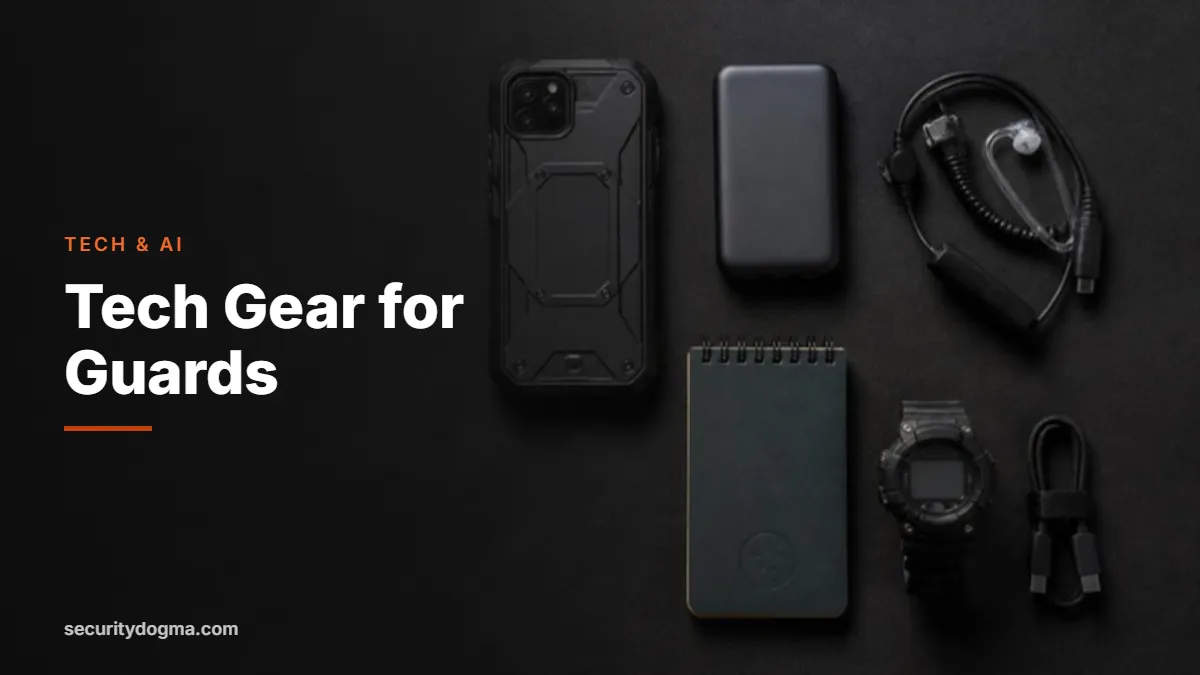
This guide covers the tech gear every security guard should carry: the accessories that keep your devices charged, protected and within reach, plus the digital tools worth buying with your own money. It’s part of our security guard technology and AI guide, and it complements our security guard equipment list, which covers the core duty gear.
Quick answer
- Buy first: a 10,000-20,000mAh power bank and a rugged phone case.
- Next: a secure way to carry your phone (holster or chest mount), and a proper radio earpiece.
- For reports: a voice recorder and an all-weather notebook as backup.
- Nice to have: a rugged smartwatch for alerts and time, a USB-C rechargeable flashlight and a car charger for mobile patrol.
- Before buying: check your employer’s rules on personal devices, recording and what you can wear on duty.
Why your personal tech kit matters
More and more security work runs through a phone: patrol checkpoints, incident reports, photos, translation, maps and communication with supervisors. Many officers use their own phones for this, and many employers allow or even expect it. That makes your phone part of your duty gear, and like any duty gear, it needs to survive weather, drops and 12-hour shifts.
A small investment pays off quickly. A dead phone can mean missed checkpoints that look like skipped patrols, a report you can’t finish or no way to call for help. A cracked screen can mean a week of borrowing someone else’s device. The gear below prevents both.
1. Power: never run out mid-shift
Patrol apps that use GPS, cameras and screens drain batteries fast, especially in cold weather. A power bank is the single most useful accessory for a security officer.
- Capacity: 10,000mAh charges most phones about twice; 20,000mAh covers long shifts and a second device, but is heavier.
- Fast charging: look for USB-C Power Delivery so a short break gives you a real charge.
- Size: it should fit a cargo pocket or a duty bag without bulk.
- Cables: carry a short, durable cable that matches your phone, radio and recorder.
- Vehicle patrol: add a car charger with USB-C so you charge between stops.
2. Protection: cases and screen protectors
Officers kneel, climb, run and work in rain. A thin fashion case won’t survive that. Look for a rugged case with raised edges around the screen and camera, port covers if you work outdoors, and a grip that doesn’t slip from a gloved hand. Add a tempered-glass screen protector. If you tap NFC checkpoints, check that the case doesn’t block NFC; most don’t, but very thick or metal-plate cases can.
3. Carry: keep your phone secure and reachable
A phone in a back pocket gets sat on, dropped and lost. A belt holster, a MOLLE pouch on a vest or a chest mount keeps it secure and quick to reach. Chest mounts also let you record video hands-free where that’s permitted, though a dedicated body camera is the better tool for that job. A lanyard or tether stops falls from heights and stairwells.
4. Communication: earpieces and radios
Radio traffic from a speaker on your shoulder broadcasts every message to everyone around you. An earpiece keeps it private and lets you hear in noisy places. Make sure it matches your radio’s connector. Our two-way radio guide covers radios and compatible earpieces in detail.
5. Notes and documentation
Good reports start with good notes. A voice recorder captures details in seconds, and an all-weather notebook works when screens fail, in rain and in cold. Keep both. The habit of writing things down as they happen will save you more trouble than any gadget.
6. Time and alerts: a rugged watch
A watch keeps exact times for your notes without pulling out your phone, which matters when you’re logging events every few minutes. A rugged smartwatch adds silent vibration alerts for messages and calls, a flashlight function on some models and long battery life. A simple shock-resistant digital watch does the core job for much less. Whatever you choose, make sure the time matches your patrol system’s clock.
7. Light: USB-C rechargeable
Your duty flashlight is core gear, and our flashlight guide covers the best options. For a tech kit, the main upgrade is charging: a light that charges from the same USB-C power bank and cable as your phone means one less charger and one less excuse for a dead light.
Our picks
These are well-known, widely available options in each category. Check the current listing for exact specs, compatibility with your phone and price.
Anker 20,000mAh power bank
Look for: USB-C Power Delivery · 2+ ports · pocket-size
Anker is one of the most widely used power bank brands, and its 20,000mAh models carry enough to recharge a phone several times over a long shift.
Watch out for: Higher capacity means more weight; a 10,000mAh model is lighter if you only charge your phone.
See current price →OtterBox Defender Series
Multi-layer case · port covers · holster-compatible versions
A long-established rugged case line built for drops and dust, with versions that clip to a belt holster. Choose the model that matches your exact phone.
Watch out for: Bulky; check that it fits your holster or pouch.
See current price →Casio G-Shock
Shock resistant · water resistant · long battery
A durable, inexpensive watch for accurate times in your notes without reaching for your phone.
Watch out for: No smart alerts on basic models.
See current price →Rite in the Rain notebook
Write in rain and cold · pocket sizes
The backup that never needs charging. Pair it with an all-weather pen for notes in any conditions.
Watch out for: Paper notes still need to be transferred into your report system.
See current price →Digital tools worth paying for
- A password manager. Officers juggle logins for patrol apps, scheduling, payroll and training sites. A password manager keeps them secure and saves time.
- Cloud backup for your personal files. Back up your licenses, certificates and training records so you can produce them at any interview.
- An AI assistant subscription for studying and writing, if you use it heavily. Follow the privacy rules in our AI report-writing guide and never paste client data into a personal account.
- Translation earbuds or a handheld translator if your post sees many languages. See our translation guide.
Rules to check before you buy
- Personal devices on post. Some posts ban personal phones while on duty, or require company devices.
- Recording. Chest mounts, body cameras and recorders all raise recording-law and policy questions. Read our recorder guide for the consent basics.
- Uniform rules. Watches, holsters and pouches may need to match the uniform standard.
- Data and security. Use a screen lock and keep work apps logged out on shared devices.
Set up your phone for duty in 10 minutes
- Turn on a screen lock with a PIN, and set the screen to lock quickly.
- Set up Medical ID or emergency information and emergency SOS so first responders can use them.
- Add a voice memo shortcut to your lock screen or home screen for one-tap notes.
- Download offline maps of your site area and your main translation languages.
- Turn on NFC if your patrol app uses NFC checkpoints.
- Turn on battery saver at a set level, such as 30%, so you never hit zero unexpectedly.
- Silence non-work notifications during your shift so alerts that matter stand out.
These settings cost nothing and make your phone faster and safer to use on post.
Battery safety
Lithium batteries in power banks, phones and radios are safe when treated well. Buy from reputable brands, don’t leave devices charging on a hot dashboard, replace swollen or damaged batteries immediately and use cables in good condition. In cold weather, keep spare batteries and power banks in an inside pocket; cold drains them quickly. Our cold-weather gear guide has more tips for winter posts.
A sample kit by post type
| Post type | Recommended tech kit |
|---|---|
| Indoor static post | Power bank, phone case, voice recorder, notebook |
| Foot patrol, large site | Power bank, rugged case, holster or chest mount, earpiece, watch, recorder |
| Mobile vehicle patrol | Car charger, power bank, phone mount for the vehicle (used only when parked or as allowed), rugged case, flashlight |
| Outdoor or construction site | Rugged case with port covers, all-weather notebook, power bank, rugged watch, cold-weather gear |
| Events and crowds | Earpiece, power bank, translation app, phone lanyard |
Frequently asked questions
What tech should a security guard carry?
At minimum, a charged phone in a rugged case, a power bank, a radio with an earpiece where issued, and a way to take notes. Many officers add a voice recorder, a rugged watch and a body camera where allowed.
What size power bank do I need for a 12-hour shift?
A 10,000mAh bank usually recharges a phone about twice, which covers most shifts. Choose 20,000mAh if you also charge a radio, recorder or second phone.
Can I use my personal phone at work as a guard?
It depends on your employer and post. Many allow it and some require it for patrol apps; others ban personal phones on duty. Check your post orders.
Should security guards wear smartwatches?
A watch helps you log exact times without reaching for your phone. Smartwatches add silent alerts. Check uniform rules first.
Will a thick case stop NFC checkpoint scans?
Most rugged cases work fine with NFC, but very thick cases or cases with metal plates for magnetic mounts can interfere. Test a checkpoint after fitting a new case.
Sources
- U.S. Bureau of Labor Statistics — Security Guards (duties and technology)
- Trackforce — NFC guard tour systems
Reviewed in October 2026. Product specs and prices change; check the current listing before buying.
Legal disclaimer: This page is for general information and education only. It is not legal advice, and reading it does not create an attorney-client relationship. Security Dogma is not a law firm. Laws, licensing rules and court decisions vary by state and change often, and what is written here may not match your situation or be current when you read it. Before you act on anything here, check the official rules from your state licensing agency, follow your employer’s and client site’s policies, and talk to a licensed attorney in your state for legal questions. See our Terms and Conditions and how facts are checked in our Editorial Policy.