
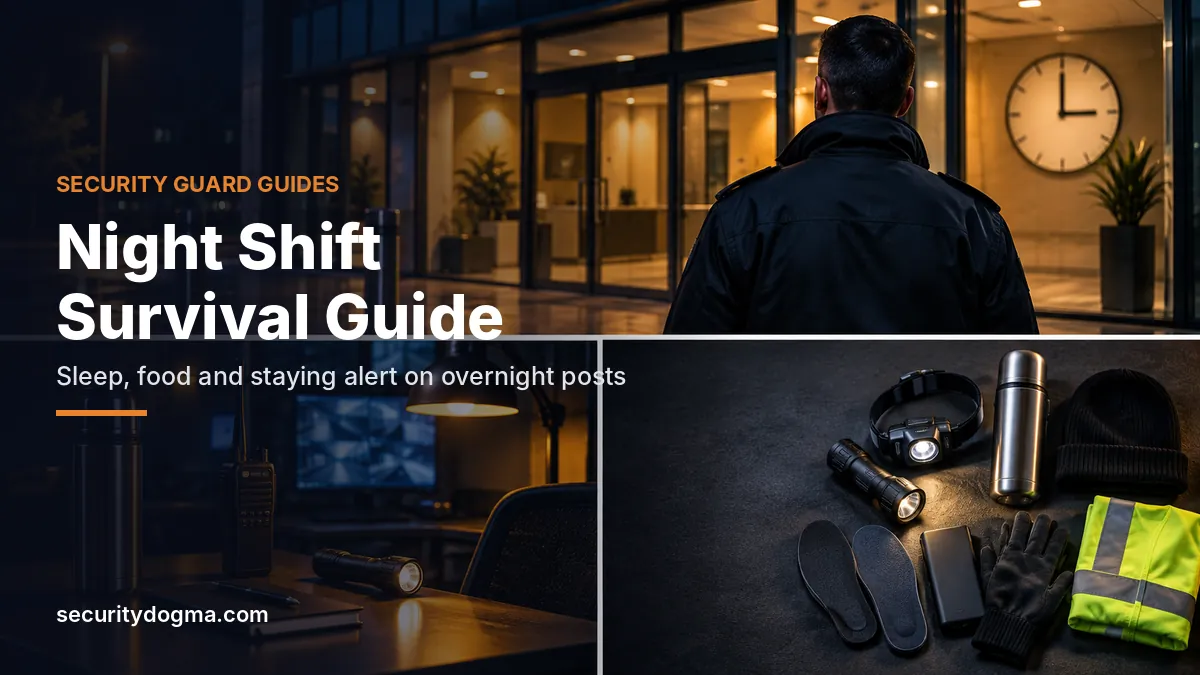

Most night shifts don’t go wrong at 11 p.m. They go wrong somewhere between 3 and 5 a.m., when the post is quiet, the coffee has worn off and your body is doing exactly what it was built to do at that hour: shut down. On a security post, that is the stretch when you are least sharp and most likely to be needed.
I have worked that stretch for years: nightclub doors that ran deep into the night, and hotel night shifts from 10 p.m. to 6 a.m. where I was the only person on site doing security. Honestly, it felt horrible, and at times I had to walk around just to stay awake. This guide is what works, from the sleep you get before the shift to the drive home after it. It is written for security guards, but it applies to anyone who works nights.
Security Dogma is reader-supported. When you buy through links on this page, we may earn a commission at no extra cost to you. As an Amazon Associate I earn from qualifying purchases. Learn more
Not medical advice. This page shares general guidance from public health and safety sources plus my own experience. If you have ongoing sleep problems, or a health condition that caffeine or night work could affect, talk to a doctor.
Quick answer: how do you stay awake on a night shift?
- Sleep first. Go to bed as soon as you get home, in a fully dark, quiet room, and get as much of your sleep as you can before about 2 p.m.
- Use caffeine early, not late. Have it near the start of the shift in moderate amounts, and stop three to four hours before you plan to sleep.
- Eat light during the dead hours. Keep real meals on a normal schedule and avoid sugary, low-fiber food when you need to stay alert.
- Stay in bright light and keep moving in the first half of the shift. Walk the patrol route, stand, change positions.
- Treat the drive home as the riskiest part of the night. If you are drowsy, don’t drive.
Prefer to watch? This video covers the same routine in under five minutes.
This video is hosted by YouTube (Google). Loading it shares your IP address with Google and may set cookies. See our Privacy Policy.
This video was made with AI tools. The charts are illustrations, not real data, and some lines are stronger than the research: alertness drops overnight, but fatigue can be managed with the steps below, and NHTSA reports drowsy-driving crashes happen most often between midnight and 6 a.m. and in the late afternoon.
Why 3 a.m. hits so hard
Your body runs on an internal clock that expects you to be asleep in the early morning hours. Working nights means you are awake when that clock says sleep, and trying to sleep when it says wake up. NIOSH, the federal agency for workplace safety research, notes that night workers tend to get less sleep and poorer-quality sleep than day workers, and that the body’s alerting signal comes back in the early afternoon, which is why daytime sleep keeps getting cut short.
You can’t fully switch that clock off. When I started out, my first year was mostly nights, and no routine ever fully reset my body clock. What a good routine does is move you from dragging through the shift to actually being alert on post. On a security post, alertness is the job.
Sleep before and after the shift
Everything else in this guide works better if you protect your daytime sleep. NIOSH’s guidance for night workers comes down to a few rules:
- Go straight to bed when you get home. Errands and chores in the early morning eat your best sleep window. Aim to get as much sleep as possible before about 2 p.m.
- Make the room truly dark. Blackout shades or curtains, a sealed gap under the door, or an eye mask. Light wakes you and shortens sleep.
- Block noise and the phone. Earplugs or a white noise machine, and a phone that can’t wake you. Tell the people you live with when you are sleeping.
- If you are hungry at bedtime, a small snack with some protein and carbohydrate is better than a full meal.
- Nap before the shift if you can. A pre-shift nap adds sleep and helps you stay alert later.
Days off: use an anchor
Flipping fully back to a day schedule every weekend makes the first night back brutal. NIOSH suggests a compromise: on days off, stay up until around 3 or 4 a.m. and sleep until about noon or 1 p.m., so some of your sleep hours stay the same every day. It also warns against staying awake all day before your first night shift or after your last one. Both raise your accident risk.
What I did on days off was try to stay awake to break the cycle, the way you push through jet lag. If you do the same, know that this is the long-awake stretch NIOSH warns about: don’t drive or take on anything risky that day. An anchor schedule is the gentler option.
Caffeine: when to drink it and when to stop
Caffeine works, but timing matters more than the amount. The Sleep Foundation suggests a cup of coffee or other caffeinated drink near the start of the shift (it usually kicks in within 15 to 20 minutes), moderate amounts spread out rather than one big dose, and no caffeine for three to four hours before you plan to sleep.
Do the math for a typical 10 p.m. to 6 a.m. post. If you are in bed by about 7 a.m., your last caffeine should be around 3 to 4 a.m., which is right when the wall hits. That is why the caffeine has to do its work in the first half of the shift, and why the second half has to run on light, movement and tasks instead.
On the total amount, the FDA cites 400 milligrams a day, about two to three 12-ounce cups of coffee, as an amount not generally associated with negative effects in healthy adults. People vary a lot in how sensitive they are, and the FDA says people with certain medical conditions, people on certain medications and anyone pregnant or breastfeeding should check with a health care provider. Energy drinks count toward the same total.
I like coffee, a lot of it, so the cutoff is the part I had to watch. I never liked energy drinks: they left me too wired afterward, though I knew plenty of guards who loved them. Whatever you drink, it is the timing and the daily total that matter.
What to eat on a night shift
The fastest way to make 4 a.m. worse is a big, sugary meal at 2 a.m. NIOSH’s diet suggestions for night workers are simple:
- Keep meals on a normal day-night pattern as much as you can, with three meals in each 24 hours.
- Eat less, or nothing heavy, between midnight and 6 a.m. Small, frequent snacks are better than one big meal when you need energy.
- Good choices during the shift: vegetables, salads and vegetable soups, fruit, whole-grain sandwiches, yogurt, cheese, eggs and nuts.
- Avoid sugary foods and low-fiber carbs when you feel drowsy or need to stay sharp. They can make sleepiness worse.
- Drink water through the shift and pack your own food, because there is rarely anything decent open at 3 a.m. near a post.
On my nights it was simple food: snacks, sandwiches, and soup when it was really cold. Instant soups were great on a cold post. Eating something was also one of my ways to shake off sleepiness when I felt it coming.
Staying alert on a quiet post
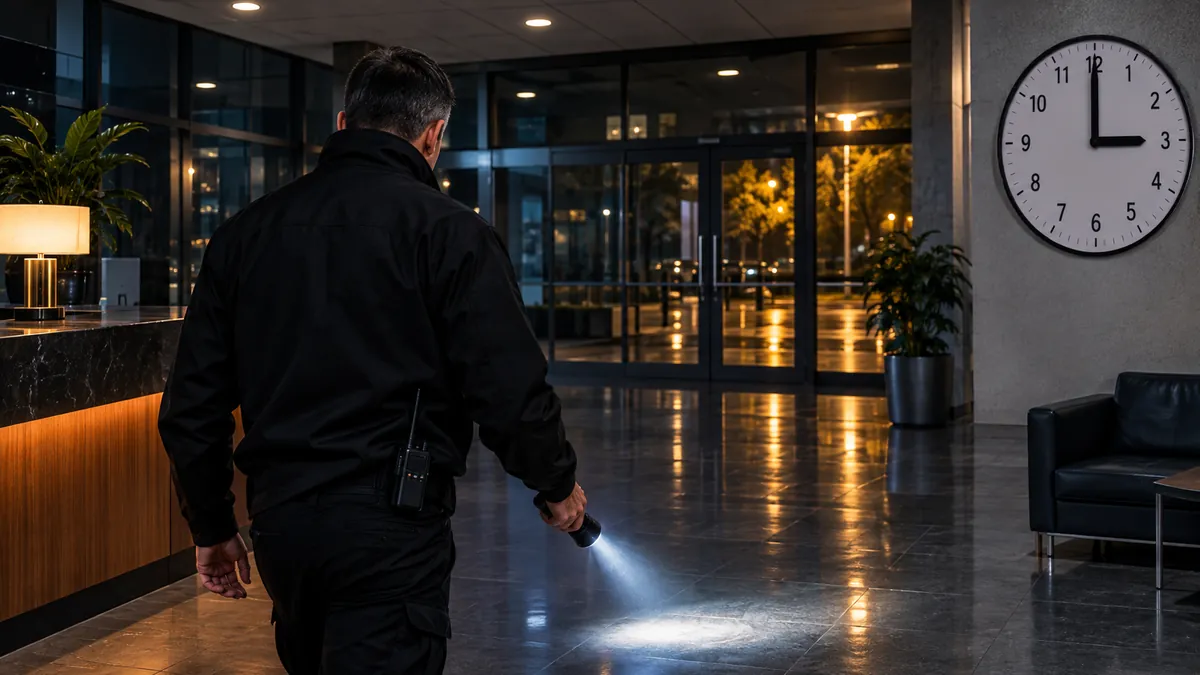
The dangerous nights are the quiet ones. Compared with nightclub work, my hotel nights were relatively boring and much more service-oriented: rounds of the floors, checking false fire alarms, finding water leaks and electrical problems and calling management. Most of the job was being there and catching small problems early. That kind of night is exactly where fatigue wins if you let it.
- Use light on purpose. NIOSH suggests spending as much of the first half of the shift as you can in brightly lit areas, then cutting back on bright light in the second half so you can sleep later. If you are very sleepy near the end of the shift, bright light can still help you stay awake.
- Give the night a rhythm. Break the shift into rounds, checks and log entries at set times. Walking the patrol route is the best alertness tool you have, and it is part of the job anyway.
- Stand up and change position. Sitting still in a warm, dim booth is the setup for nodding off.
- Save tasks for the dead hours. Report writing, log reviews and equipment checks give your brain something to do at 4 a.m.
- Keep your ears on the post. If you are thinking about music or podcasts to stay awake, read whether security guards can wear headphones on shift first.
What worked for me was simple: get up and walk, eat something, find something to do. What didn’t work was music. It made me sleepier, not more alert.
Fatigue on post is a safety problem
A tired guard is not just a slow guard. Severe sleepiness can bring on micro-sleeps, brief lapses of a few seconds that you may not notice. On a post, that means a missed alarm, a missed camera event or a door you never saw open. NHTSA, the federal road safety agency, warns that seriously sleep-deprived people can have micro-sleeps of four to five seconds even after caffeine.
Learn your own warning signs: heavy eyelids, rereading the same line in the log, not remembering the last few minutes of a round. When you notice them, move: walk a round, step into brighter light, splash water on your face. If it keeps happening, tell your supervisor before it turns into an incident. Some posts allow a short rest on a scheduled break; check your post orders and never rest on post unless they explicitly allow it.
My own rule was about the nodding phase, that in-between state where you are not sure if you are awake or dreaming. The moment I felt it, I got up: walked around, ate something, anything to break it. Don’t wait to see if it passes.
The drive home is the most dangerous part of the night
You finish the shift, the adrenaline drops and you get behind the wheel during one of the worst hours for drowsy driving. NHTSA estimates that in 2017, drowsy drivers were involved in 91,000 police-reported crashes, about 50,000 injuries and nearly 800 deaths, and says the real numbers are likely higher. Its data shows these crashes happen most often between midnight and 6 a.m. or in the late afternoon, often with a single driver drifting off the road without braking.
- Know the signs. Drifting over lane lines or hitting a rumble strip is a clear warning. So is missing your exit or not remembering the last few miles.
- Don’t count on coffee alone. NHTSA notes caffeine gives only short-term alertness.
- Nap before you drive if you need to. NHTSA suggests one to two cups of coffee and a 20-minute nap in a safe place if you feel sleepy while driving. It helps, but only for a short time.
- Get a ride when you are wrecked. Public transportation, a ride share or a coworker is always better than a crash.
- Sunglasses only if someone else is driving. NIOSH notes that sunglasses block light’s alerting effect, so wearing them for the drive after a night shift can make drowsiness worse.
My drive home after nights was about an hour on average. I never had a close call, partly because when I was really tired, I didn’t drive. I rented a room instead.
Night work and your long-term health
Years of night work can take a toll. NIOSH research links shift work and long hours to chronic sleep loss, weaker thinking and reaction time, lower immune function, more depression and occupational injuries, and long-term conditions including heart disease, digestive problems and mood disturbances. It can also strain family life, because you are asleep when everyone else is awake.
None of this means you can’t work nights. It means you should take your sleep seriously and pay attention to warning signs. If you regularly can’t sleep when you try to, or you are excessively sleepy on shift even after a full day’s sleep, talk to a doctor. The Sleep Foundation describes this pattern as shift work disorder, and it is a medical question, not something to fix with more caffeine.
What’s in my night bag
This is what I keep in my bag for overnight posts, and why each item earns its place.
- A real flashlight, plus a headlamp. Rounds in dark stairwells, parking areas and plant rooms need more than a phone light. See our security guard flashlight guide and my Maglite vs Streamlight comparison.
- Broken-in boots and good insoles. Eight to twelve hours on your feet add up by the end of the night. Start with our security guard boots guide.
- Warm layers, a beanie and gloves. The early morning hours are usually the coldest and the quietest. See our cold and wet weather gear guide.
- A spare radio battery or charger. A dead radio at 4 a.m. leaves you alone on the post. Our two-way radio guide covers what to look for.
- An insulated bottle for water or coffee. Hot drinks early in the shift, water later.
- Your own food. The light meals and snacks from the section above, packed before you leave home.
- A power bank and a notebook and pen. For your phone, and for notes that end up in the report.
- A high-visibility vest for outdoor rounds, parking lots and any post near traffic.
For gear I have personally used in the field, see my field-tested gear picks.
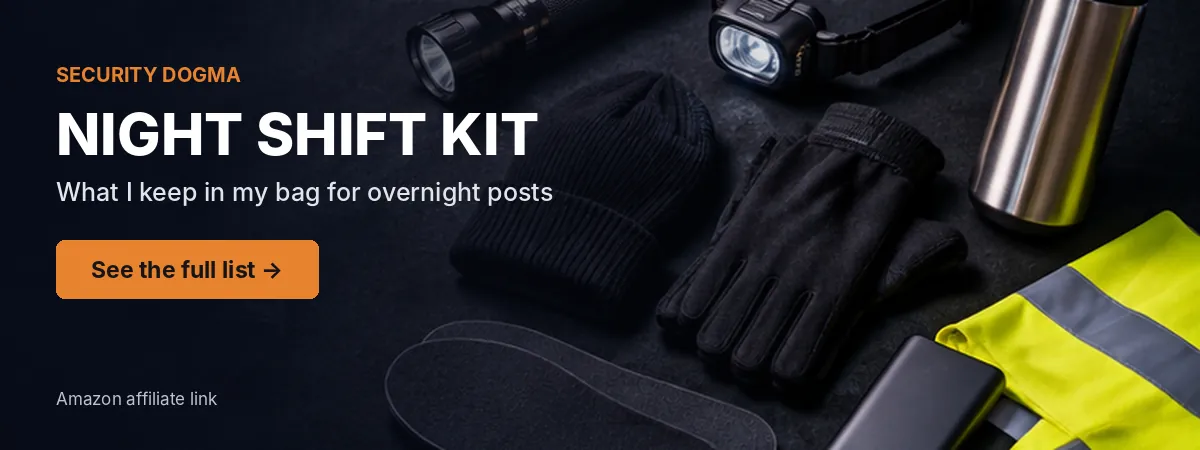
Working cold nights outdoors? I keep my cold-weather gear list on Amazon (affiliate link).
Frequently asked questions
How do you stay awake on a night shift?
Protect your daytime sleep first, use caffeine in the first half of the shift and stop three to four hours before bed, eat light during the early morning hours, stay in bright light early in the shift and keep moving. Breaking the night into rounds and tasks helps more than sitting and waiting.
What should I eat on a night shift?
Light, steady food: vegetables, soups, fruit, whole-grain sandwiches, yogurt, eggs, cheese and nuts. NIOSH suggests eating less between midnight and 6 a.m. and avoiding sugary and low-fiber foods when you need to stay alert.
What should I eat after a night shift?
If you are hungry before bed, have a small snack with some protein and carbohydrate rather than a big meal, then go straight to sleep. Keep your main meals on a normal day-night pattern as much as you can.
How do you get through a night shift with no sleep?
Try not to. NIOSH warns against staying awake all day before a night shift because it raises accident risk. If it happens anyway, nap before the shift if you can, use caffeine early, stay active, tell your supervisor if you are struggling and don’t drive home drowsy.
How much caffeine is too much on a night shift?
The FDA cites 400 milligrams a day, about two to three 12-ounce cups of coffee, as an amount not generally associated with negative effects for healthy adults. Sensitivity varies, and some people should check with a health care provider first. Timing matters as much as the total.
Can security guards nap on a night shift?
Only if your post orders and supervisor allow it, and only on a scheduled break away from the post. Never rest on post unless the post orders explicitly allow it. A nap before the shift, or before the drive home, is the safer way to add sleep.
Sources
- NIOSH (CDC), Training for Nurses on Shift Work and Long Work Hours, Module 9: Coping with night and evening shifts (sleep, light and diet pages)
- NIOSH (CDC), Sleep and Work, NIOSH Science Blog, 2012
- U.S. Food and Drug Administration, Spilling the Beans: How Much Caffeine is Too Much?
- NHTSA, Drowsy Driving
- Sleep Foundation, Tips for Shift Workers and workplace tips
Last verified November 10, 2026.