

Security Dogma is reader-supported. When you buy through links on this page, we may earn a commission at no extra cost to you. As an Amazon Associate I earn from qualifying purchases. Learn more
Quick answer
- A security guard resume has one job: get you to the interview. Hiring managers look first for experience and whether you’re licensed.
- Put your guard card or state license near the top, using the exact name the job ad uses.
- Many applications pass through software first. Answer the screening questions accurately, and use a plain one-column Word or PDF file the system can read.
- Write it well. A thin resume that’s clean and clear can still get a call. A badly written one usually doesn’t.
Over my career I’ve interviewed hundreds of people, many of them security guards. Before I met any of them, I read their resume. Resumes reached me through HR, through job listings I posted at local college campuses, and through referrals. This guide is what I looked for, plus what you need to know about the software that now reads many applications before a person does.
It covers U.S. guard jobs. License names and rules differ by state; check yours in our security guard license requirements by state.
Prefer to watch? This video walks through the same steps in about six minutes.
This video is hosted by YouTube (Google). Loading it shares your IP address with Google and may set cookies. See our Privacy Policy.
This video was made with AI tools and summarizes this guide. Scenes are illustrations, not real events.
What do hiring managers look for on a security guard resume?
When I picked up a guard resume, I checked two things first: experience, and whether the person was licensed. Then I looked at how it was written. A badly written resume went to the side quickly. A thin resume that was well written and well organized could still get a call.
Keep the resume’s purpose in mind. It doesn’t get you the job; it gets you the interview. I hired people whose resumes were weak because they interviewed well. But they had to get to the interview first.
| What the reader checks | What to give them |
|---|---|
| Are you licensed? | Your guard card or state license, near the top, named the way the job ad names it |
| Relevant experience | Security posts, or jobs dealing with the public: retail, hospitality, call centers, the military |
| Can you communicate? | Clean, correct writing and a clear layout |
| Will you show up? | Steady work history and your availability, including nights, weekends and holidays |
| Judgment | De-escalation, reporting and following post orders, not force |
Will a person read your resume? How ATS works for guard jobs
Often a person reads it only after software does. Many guard jobs are posted on job boards and through company hiring systems, called applicant tracking systems (ATS). Two things happen there before a recruiter looks at you.
1. Screening questions sort you first
Employers can add questions to the application. On Indeed, for example, an employer can ask about experience, certifications, availability or work authorization, and the ready-made questions include shift availability. If the employer marks a question as required and your answer doesn’t meet it, Indeed moves your application to the employer’s Rejected list. The employer can still open it and move it back, but don’t count on it.
For guard jobs, expect questions like these:
- Do you have a current state guard card or security license?
- Do you have an armed license or firearm permit? (armed posts)
- Can you work nights, weekends and holidays?
- Do you have reliable transportation, or can you commute to this site?
- How many years of security or customer service experience do you have?
Read each question slowly and answer it accurately. A careless “no” can remove you before anyone sees your resume. A “yes” you can’t back up is worse: licenses can be checked, and in many states the license search is public.
2. The system reads your file
When you upload a resume, the system tries to pull your name, contact details, jobs and dates into its own fields. If it can’t read the file, your application can arrive with blanks. I never hired guards through one of these systems. In my current work in IT management I have, and a good candidate can be missed because of how the resume was built.
Greenhouse, an ATS company, lists what makes resumes fail to parse in its system. Build your file around that list:
| Do | Avoid |
|---|---|
| Upload a .docx or PDF document | A photo or scan of your resume |
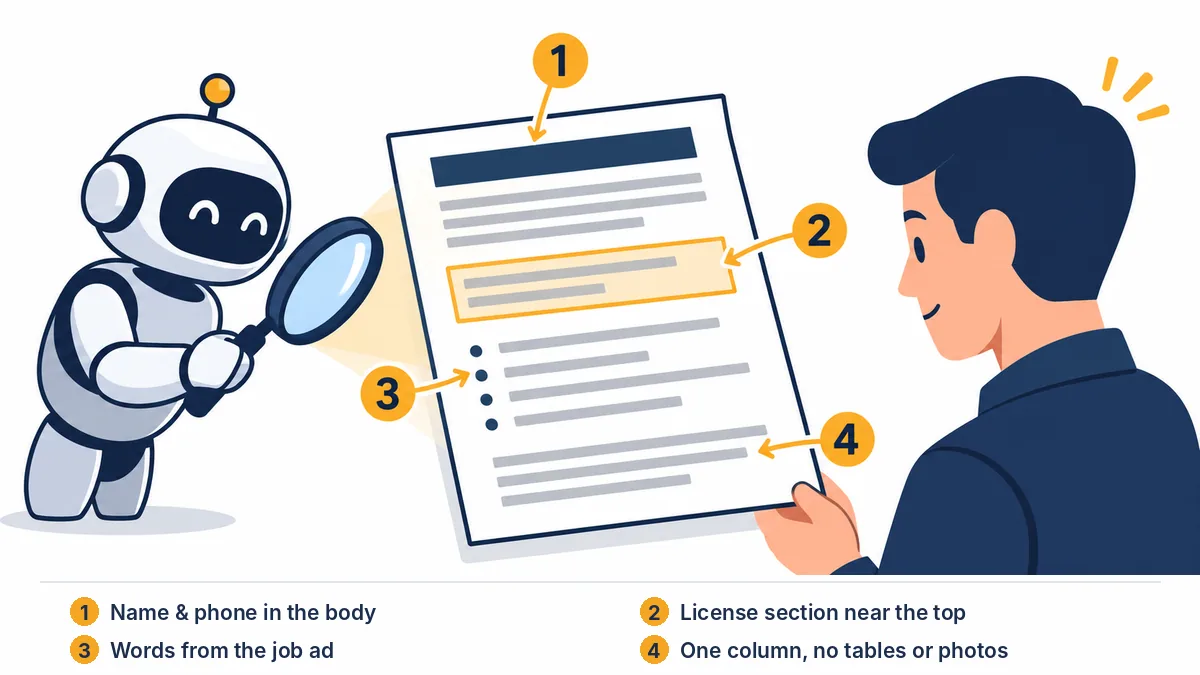
| One column, top to bottom | Columns, tables and text boxes |
| Name and phone in the body of the page | Contact details in the header or footer |
| Clear section headings: Summary, Licenses, Experience, Skills, Education | Graphics, icons, photos or word art |
| Full job titles and company names | Abbreviations and letters spaced out for style |
| A small file | Large images (Greenhouse can’t parse files over 2.5 MB) |
Then match the job ad’s words where they’re true for you. If the ad says “guard card,” “patrol,” “access control” and “daily activity reports,” and you’ve done those things, use those words. Employers sort applications by the criteria they set, so the words matter.
How do you list a guard card on a resume?
Give it its own section, right under your summary, and use the official name. When I hired, what mattered on the resume was that the license was there. The details can be checked afterwards, and they will be.
| State | What the license is called | Example resume line |
|---|---|---|
| California | Guard Card (Security Guard Registration, BSIS) | California Guard Card (BSIS), active, expires 06/2028 |
| Florida | Class D Security Officer License; Class G for armed | Florida Class D Security Officer License, active |
| Texas | Non-commissioned or commissioned security officer license (DPS) | Texas Non-Commissioned Security Officer License (DPS), active |
| New York | Security Guard Registration Card (Department of State) | New York Security Guard Registration Card, active |
| Illinois | PERC; Firearm Control Card (FCC) for armed | Illinois PERC (IDFPR), active |
- Expiration date: worth adding. It shows the license is current.
- License number: optional on the resume. Give it on the application form or when asked.
- Still in progress? Say exactly where you are: “California Guard Card: training complete, application submitted March 2027.”
- Several states? List each one on its own line.
Not licensed yet? Start with how to become a security guard and your state’s guide, such as the California guard card guide or the Florida Class D guide.
How do you write a security guard resume summary?
Two or three sentences: your license, your most relevant experience, and why you want this job. That last part matters more than people think. For candidates with no security experience, a clear summary, or a cover letter explaining why they wanted the job, is often what got them a call from me.
Examples below are templates, not real people.
- No security experience: “Licensed California guard with four years in hotel guest services, handling upset guests on evening shifts and working with managers to resolve problems. Looking for a steady overnight security post where calm customer service matters. Available nights, weekends and holidays.”
- Experienced unarmed: “Security officer with five years on commercial and residential posts: access control, patrols, alarm response and daily activity reports. Known for de-escalating disputes and clear, on-time reporting. Florida Class D, CPR/First Aid/AED certified.”
- Armed: “Armed security officer with six years on bank and corporate posts. Current Texas commissioned security officer license. Trained in de-escalation and in when and if force is justified; every incident documented and reported to the client.”
How do you describe security guard duties on a resume?
Use the tasks guard jobs are built around. The U.S. Department of Labor’s O*NET profile for security guards lists them, and job ads use the same language: locking and securing entrances, patrolling premises, monitoring and authorizing who enters and leaves, answering alarms, responding to medical emergencies with first aid, writing reports of daily activities and irregularities, and calling police or fire in an emergency.
Turn the ones you’ve done into bullets: an action word, what you did, and where or how often. Example bullets (patterns, not a real work history):
- Controlled access to a 20-floor office building, checking visitor and contractor IDs at the front desk.
- Patrolled a parking structure and grounds on hourly rounds overnight; reported lighting and door faults.
- Answered alarms and wrote daily activity and incident reports for the client.
- Calmed disputes between patrons by listening and offering options; called a supervisor or police when needed.
- Gave first aid until paramedics arrived; documented the incident the same shift.
Use your real numbers and posts. The examples are patterns, not facts to copy. For the job titles, use the one you actually held. O*NET lists the common ones, from “security officer” and “security guard” to “loss prevention officer” and “campus security officer,” and job ads mix them, so a resume that says “Security Officer” still fits a “security guard” ad.
Several sites under one employer
List the employer once, with your full dates, and put the posts under it as bullets. Describe a site by type if the client is confidential: “Class A office tower, 2 years” or “hospital emergency department, 8 months.” Floating between many sites for one company isn’t job-hopping, so don’t let it look like it.
Same site, new company
If the client changed security companies and you stayed on the post, list both employers with their dates and add a short note: “Same site; security contract changed companies.” Otherwise two short jobs can look like two quits.
Some job changes didn’t bother me if I liked the resume, unless there were a lot of them, and I’d still let the person explain in the interview. That was my approach. Not every reader will give you that chance, so explain contract changes on the page.
What words hurt a security guard resume?
Anything that makes force the headline. It was a red flag for me when use-of-force experience really stuck out on a resume. Writing about de-escalation training, and about when and if to use force, was fine. That’s the same point I make in our security guard interview questions guide: words before force.
| Sends the wrong message | Says it better |
|---|---|
| “Enforcer” or “tactical” as your title | Your real title: Security Officer, Patrol Officer |
| “Took down and removed troublemakers” | “De-escalated disputes; involved management or police when needed” |
| A long list of restraint and takedown experience | “Trained in de-escalation and in when and if force is justified” |
| “Zero tolerance” | “Enforced site rules consistently and reported violations” |
See de-escalation for security guards for the vocabulary.
What skills and certifications should you list?
Only the ones you have. The state license comes first, because most states require guards to be licensed or registered. After that:
- CPR, First Aid and AED. Not required for every post, but when I saw them they made a candidate stand out.
- De-escalation or conflict-resolution training.
- Report writing: daily activity reports and incident reports.
- Systems you’ve used: CCTV, access control, visitor management or guard tour systems.
- A driver’s license for mobile patrol posts.
- Languages you speak well enough to use on post.
Your state’s training hours belong under Licenses or Training, not as a skill.
How do you write a security guard resume with no experience?
Lead with the license, then show the two things guard work runs on: dealing with the public and showing up. Retail, restaurants, hotels, call centers, warehouses and the military all count. Put your strongest example of calming an upset customer into a bullet, and show reliability with dates: two years at one job says more than a list of short ones.
Then write it well. Most of the no-experience candidates I called had a well-written, well-structured resume and a summary or cover letter that explained why they wanted this job.
What goes on a security supervisor resume?
Supervising experience first: how many guards, which posts, what you were responsible for. If you haven’t supervised yet, I looked at the length and steadiness of a candidate’s employment. Show the people side too: training new guards, covering open shifts, and helping someone improve before it became a discipline problem. That’s what I looked for in supervisor interviews, too.
Do you need a LinkedIn profile for security jobs?
For an entry-level guard post, it’s optional; most of those hires run through job boards and company applications. For supervisor, corporate security, executive protection and loss prevention roles, it’s worth having, because an employer may look you up before or after the interview. In my IT hiring today, I do look at candidates’ LinkedIn profiles.
- Match your resume: the same job titles, employers and dates.
- Add your license in the Licenses & certifications section, with the official name.
- Use a plain headline: “Licensed Security Officer | Access Control | Patrol | CPR/First Aid.”
- Same rules as the resume: no force-first wording, and no client names or site details you aren’t allowed to share.
Do you need a cover letter for a security job?
Send one if you can. I read them. Keep it to three short paragraphs: the job you’re applying for and your license; one example that shows calm or reliability; and your availability and why you want this post.
Template, not a real letter: “I’m applying for the overnight security officer position at your downtown site. I hold a current California Guard Card and have four years of evening guest service at a busy hotel, where I handled upset guests calmly and brought in a manager when needed. I can work nights, weekends and holidays, and I live 15 minutes from the site. I’m looking for steady work where calm customer service matters, and I’d welcome the chance to interview.”
Checklist before you hit Apply
- License section near the top, with the official name and expiration date.
- One page, one column, no tables, graphics or photo; name and phone in the body.
- Saved as .docx or PDF, not a photo of a printout.
- Words from the job ad used where they’re true for you.
- No typos. Read it aloud once.
- Contract changes and multi-site work explained.
- Availability stated if the ad mentions nights, weekends or holidays.
- Screening questions read slowly and answered accurately.
Free download: ATS-friendly security guard resume template
Get a one-column Word template built around this guide, with the license section, example bullets and a cover letter you can edit. It’s free: enter your email and we’ll send you the download link, along with occasional Security Dogma guides. You can unsubscribe at any time.
What you need to finish your application
Once you’ve downloaded the template, these four things take you from a draft to an application you can hand over: software to edit it, good paper for printed copies, a folder to carry everything, and the certificate that makes a guard resume stand out.
Some links in this section are affiliate links. If you buy through them, Security Dogma may earn a commission at no extra cost to you. As an Amazon Associate I earn from qualifying purchases. Learn more. These are research picks: I haven’t tested these exact products.
Microsoft 365 Personal (12 months)
Word, Excel, PowerPoint, Outlook · 1 TB cloud storage · Windows, Mac and mobile · digital download
The free template is a Word file. Editing it in Word keeps the one-column layout, fonts and spacing the way they were built, so what you upload is what the hiring system reads.
Watch out for: it’s a yearly subscription that auto-renews unless you cancel. Google Docs can also open the template for free.
See current price →Paid link · opens Amazon.com
AHA Heartsaver First Aid CPR AED Student Workbook (2025)
American Heart Association · 2025 edition · course workbook
When I hired, CPR and First Aid certificates made a candidate stand out. This is the student workbook for the American Heart Association’s Heartsaver First Aid CPR AED course, to study before class and keep as a reference after.
Watch out for: the book doesn’t certify you. The card comes from completing the course, and some course providers include the workbook, so ask before you buy.
See current price →Paid link · opens Amazon.com
Southworth 25% Cotton Business Paper
8.5″ x 11″ · 24 lb · linen finish · white · 100 sheets
When I hired, how a resume looked mattered. Heavier cotton paper makes the printed copy you hand across the desk feel finished, and it works in laser and inkjet printers.
Watch out for: paper doesn’t fix a weak resume. Get the writing right first.
See current price →Paid link · opens Amazon.com
Samsill Professional Padfolio
Faux leather · letter-size writing pad · document pocket · pen loop
One folder for your resume copies, guard card copy, ID and references, so nothing arrives creased and you’re not digging through a bag at the front desk.
Watch out for: it’s faux leather. Fine for interviews, not built for daily use on post.
See current price →Paid link · opens Amazon.com
Getting ready for the interview
Once the resume works, the interview decides. Bring printed copies in a folder, with your guard card and ID. Then prepare with our security guard interview questions guide, and check what the job should pay in security guard salary by state.

FAQ
How long should a security guard resume be?
One page is enough for most guard jobs. A reader should find your license, your most relevant posts and your availability in a few seconds. Supervisors and managers with many years of experience can go to two pages if every line earns its place.
Should I put a photo on my security guard resume?
No. A photo didn’t matter to me when I hired, and photos are one of the things that can stop hiring software from reading a resume. Spend the space on your license and experience instead.
Should I list my criminal record on my resume?
A resume isn’t the place for it. Answer any background questions on the application honestly. Under federal rules, an employer that uses a background-check company needs your written permission first. If it may reject you because of that report, it must first give you a copy and a notice of your rights, so you can fix mistakes. Your state or city may add rules, and the state licensing agency runs its own background check for the guard card. See security guard jobs with a criminal record.
Is a security guard CV the same as a resume?
For guard jobs in the U.S., people use the two words for the same thing: a short document about your license, experience and skills. Send whatever the job ad asks for, built the way this guide describes.
What should an armed security guard resume include?
Everything above, plus your armed license or firearm permit, its expiration date, and the state-required firearms training you’ve completed. Requirements differ by state; see armed vs. unarmed security guards. Keep the tone the same as any guard resume: training in de-escalation and judgment first, the weapon qualification as a credential, not the headline.
What if my license is pending when I apply?
Say so plainly on the resume, with what’s done and what’s left. On screening questions, answer what’s asked: if the question is whether you hold a current license today, a pending application usually means “no.” If a license in progress is acceptable, the ad or a screening question will usually say so.
Sources
- Indeed, How to Use Screener Questions on Indeed (last updated September 29, 2026; checked November 14, 2026).
- Greenhouse, Unsuccessful resume parse (last updated March 2, 2026; checked November 14, 2026).
- U.S. Department of Labor, O*NET OnLine, 33-9032.00 Security Guards (checked November 14, 2026).
- U.S. Bureau of Labor Statistics, Occupational Outlook Handbook: Security Guards and Gambling Surveillance Officers (checked November 14, 2026).
- U.S. Equal Employment Opportunity Commission and Federal Trade Commission, Background Checks: What Job Applicants and Employees Should Know (issued March 11, 2014; checked November 12, 2026).
- State license names: Security Dogma state licensing guides, sourced to each state’s regulator.
- Author experience: Yair Arad, hiring as a security manager and security company owner.
Last verified November 14, 2026.
Firearms and weapons disclaimer: This page discusses firearms or other weapons for general information only. It is not legal advice, not firearms training, and not a recommendation to buy, carry or use any weapon. Laws on owning, carrying, transporting and using firearms, stun guns, pepper spray, batons and knives vary by state, county and city. They change often, can be different for security work, and breaking them can lead to criminal charges. Before you carry or use any weapon, confirm the current law where you are, get any required permit or license, train with a certified instructor, and follow your employer’s, client’s and property owner’s rules. You alone are responsible for how you buy, carry, store and use any weapon. Security Dogma and its authors accept no liability for any injury, loss, damage or legal consequence that results from acting on this information. A product link does not mean the item is legal where you live, so check local restrictions before you buy.
Legal disclaimer: This page is for general information and education only. It is not legal advice, and reading it does not create an attorney-client relationship. Security Dogma is not a law firm. Laws, licensing rules and court decisions vary by state and change often, and what is written here may not match your situation or be current when you read it. Before you act on anything here, check the official rules from your state licensing agency, follow your employer’s and client site’s policies, and talk to a licensed attorney in your state for legal questions. See our Terms and Conditions and how facts are checked in our Editorial Policy.