

Security Dogma is reader-supported. When you buy through links on this page, we may earn a commission at no extra cost to you. As an Amazon Associate I earn from qualifying purchases. Learn more
How these picks were chosen: products on this page are selected from manufacturer specifications, published standards and reviews, and the practical needs described in this guide. They have not been hands-on tested for this article.
Last verified November 9, 2026
This guide is for the buyer: a business owner, property manager or facility manager choosing a security guard company in the United States. It covers how to check a company’s license and insurance, how to compare bids fairly, what to put in writing and what to do when a guard doesn’t work out. For prices, see how much a security guard costs.
Prefer to watch? This 4-minute video covers the three checks most businesses skip (the license, the insurance certificate and references), how to compare bids on the same scope, and what has to be in writing before the first shift.
Notes on the video: it was made with AI tools from this guide, and its scenes are illustrations; the license number shown is fictional. When it says skipping these checks shifts “all the legal and financial liability” back to you, read that as a warning, not a legal rule: who is liable depends on your state and your contract.
How do you hire a security guard?
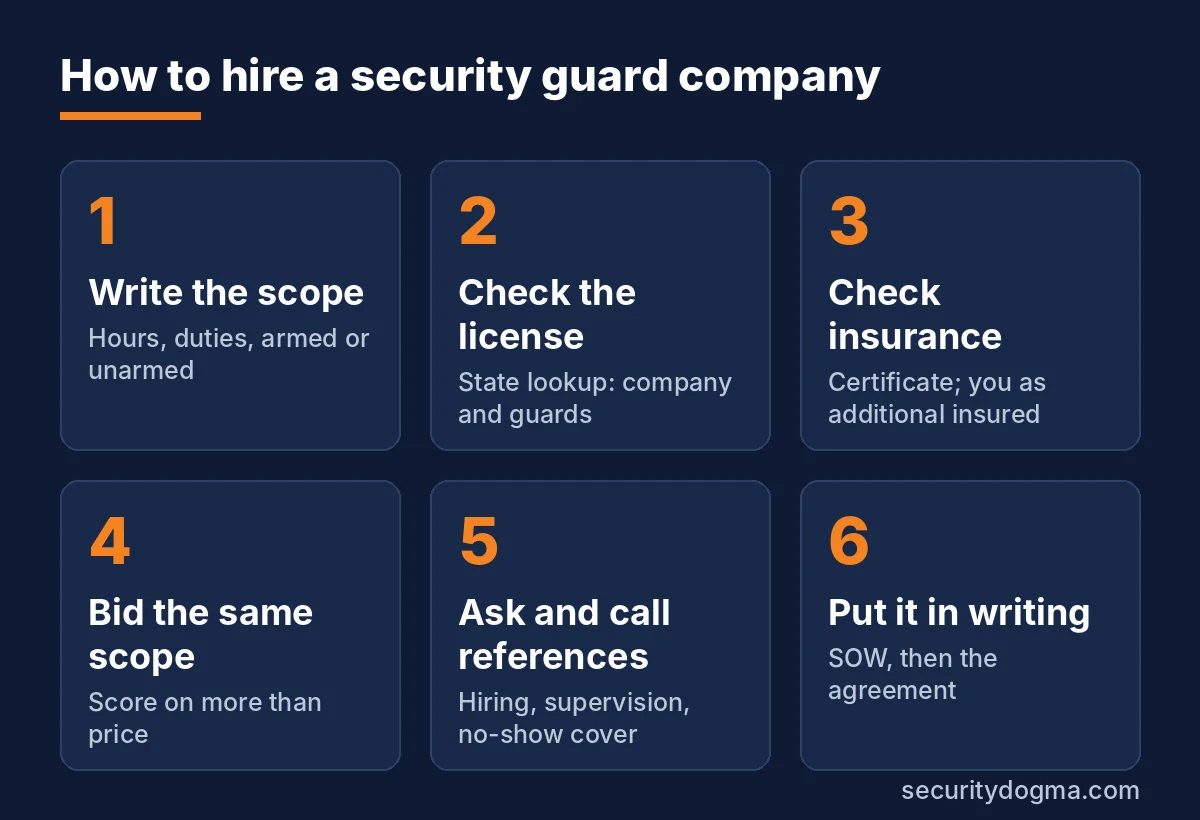
To hire a security guard, write down exactly what the post needs, then check each company’s state license and insurance, get bids on that same written scope, call references and sign a written agreement before the first shift. In order:
- Write the scope. Hours, duties, armed or unarmed, reporting, and who the guard answers to on site.
- Shortlist licensed companies. Check each one on your state’s official lookup.
- Check insurance. Ask for a certificate of insurance before you compare prices.
- Get bids on the same scope. Every company prices the same written statement of work.
- Ask questions and call references.
- Put it in writing, then supervise the first weeks closely.
In my years managing security on the contractor side for telecom clients, this is how the client’s director of security ran it: the company had to be licensed and insured, every guard on the post had to be licensed and trained, and the work went out to bid. Companies submitted proposals and the best bid won. “Best” is the word that matters, and I come back to it below.
Should you hire a security company or a guard directly?
Most businesses should hire a licensed security company, because the company handles the guard’s licensing, training, payroll, insurance and replacement when someone calls out. Hiring your own guard as an employee is possible, but in some states it brings registration duties of its own; for example, California regulates businesses that employ their own uniformed guards, and Texas requires notice to the state before a business employs certain in-house officers. Our cost guide covers that option. The rest of this guide assumes you are hiring a company.
How do you check a security company’s license?
Look the company up on your state regulator’s free license search, and check the individual guards too, because a licensed company can still put an unlicensed person on your post. Ask for the company’s license number in writing, then search it yourself rather than relying on a copy they send you.
| State | Company license (regulator) | Guard credential | Official lookup |
|---|---|---|---|
| California | Private Patrol Operator (Bureau of Security and Investigative Services) | Security guard registration (“guard card”); armed guards also need a firearm permit | DCA License Search |
| Texas | Security company license (DPS Private Security Program) | Non-commissioned (Level II) or commissioned/armed (Level III) officer | TOPS public search |
| Florida | Class “B” security agency (Dept. of Agriculture and Consumer Services) | Class “D” security officer; armed guards also need a Class “G” license | FDACS licensee search |
| New York | Watch, guard or patrol agency (Dept. of State) | Security guard registration; special armed guard registration for armed posts | DOS license search (agencies by business name or ID) |
For California, see our guard card guide; for Texas and Florida, our Texas and Florida license guides. If the company can’t give you a license number on the spot, stop there.
What insurance should a security company carry?
A security company should carry at least the general liability insurance its state requires to hold a license, and you should ask for a certificate of insurance that names your business as an additional insured. The state minimums are floors, not recommendations:
| State | Minimum general liability to hold a company license |
|---|---|
| California | $1,000,000 per occurrence; “claims made” coverage is not permitted |
| Texas | $100,000 per occurrence (bodily injury and property damage), $50,000 per occurrence (personal injury), $200,000 aggregate |
| Florida | $300,000 combined single limit |
| New York | $100,000 per occurrence / $300,000 aggregate if the agency employs guards, plus a $10,000 surety bond |
Public buyers usually go further. The City of Albany, Oregon’s 2024 request for proposals for unarmed guard services, for example, required the city to be named as an additional insured by endorsement on the contractor’s general liability policy, on a primary and non-contributory basis. Ask your own insurance agent what limits and wording fit your site; that is a question for them, not for the security company.
What should you ask a security company before you hire it?
Start with four questions: are you licensed, are you insured, what experience do you have with sites like mine, and who can I call as a reference. When I managed a security company in California around 2000–2002, those were the questions the clients worth having asked first, and clients of my private investigation firm asked the same four. Then ask about the people who will actually stand on your post:
- Hiring: How do you recruit and screen guards? What background checks do you run beyond what the state requires?
- Training: What training does a guard get before working my site, and who gives the site-specific orientation?
- Supervision: Who is my account contact? How often does a supervisor visit or check the post?
- Coverage: What happens when a guard calls out or doesn’t show up, and how fast is the post covered?
- Reporting: What reports will I get, how often and in what format? Ask to see a real (redacted) daily activity report.
- References: Two or three current clients with sites like yours, and call them.

What are the red flags when hiring a security company?
The biggest red flag is a company that hires anyone off the street. I called those guards “seat warmers”: someone in a uniform filling a chair, with no real screening or training behind them. Other warning signs:
- No license number when you ask, or a license that doesn’t show on the state lookup.
- No certificate of insurance, or one that arrives weeks later.
- A bid far below the others. The difference usually comes out of guard pay, supervision or training; our cost guide shows where the money goes.
- Vague answers on who supervises the post and who covers no-shows.
- Reluctance to put duties, rates and reporting in writing.
How should you compare security company bids?
Compare bids only after every company has priced the same written statement of work, and score them on more than price. On the contracts I worked, the scope of work came first, before any decision, so every company bid on the same post. Otherwise one company prices two guards and another prices one, and the cheaper number means nothing.
“Best bid” should not mean “lowest bid.” In the City of Albany’s 2024 guard RFP, price was worth 25 of 125 points. Experience and qualifications were worth 40, the company’s understanding of the work and its service approach 35, references 15, and management and financial strength 10. You don’t need a points system for one site, but the balance is a good model: price matters, and it is not most of the decision.
Watch: why the low bid costs more. This 6-minute video shows where a cheaper quote usually finds its savings, and the checklist to run before you sign.
Notes on the video: it was made with AI tools from our cost guide, and its charts are illustrative. The 42 classroom hours it mentions for California are not required yet; see California guard training changes. Security Dogma does not have the 24/7 calculator it mentions; the cost guide has the 24/7 math.
What should the scope of work and contract cover?
The scope of work should describe the post in enough detail that two companies would price the same job, and the master agreement should cover everything else: rates, insurance, reporting, replacement and how either side can end it. The sequence I saw work was simple: a statement of work (SOW) before the decision, then a master service agreement (MSA) covering everything once a company was chosen. The checklist below is a summary, not contract language:

- Post details: location, hours, number of guards, armed or unarmed, uniform.
- Duties: written post orders, patrol routes, access control, what the guard may and may not do.
- People: licensing and training requirements, supervision, how replacements are handled.
- Coverage: how fast a no-show is covered and who you call.
- Reporting: daily activity reports, incident reports and deadlines.
- Money: hourly rates, overtime, holiday and short-notice rates, invoicing.
- Insurance: certificate on file, your business as additional insured, renewal notices.
- Term and exit: start date, renewal, notice period and how the contract ends.
Two records worth keeping at the post
Whichever company you hire, keep a few records on site that belong to you, not the vendor: who had which key, and what each shift handed over to the next. These picks come from research, not hands-on testing. They are paid links: Security Dogma earns a commission on purchases made through them.
BookFactory Key Control Logbook
120 pages · 8.5 × 11 in · Wire-O · made in USA
Columns for key number, who has it, time out and in, and initials, plus space for keys that are lost or retired. Kept at the post, it gives you, not the guard company, the record of who had which key, which matters when the contract ends and keys have to come back.
Watch out for: a paper log only works if every key movement gets written down. Put that requirement in the post orders.
See current price →Paid link · opens Amazon.com
BookFactory Security Pass Down Log Book
100 pages · 8.5 × 11 in · hardbound, section-sewn · made in USA
Fields for post or shift, time of change, date and notes. On posts with more than one shift a day, a written handover shows whether the outgoing guard briefed the incoming one, which is where small problems turn into missed ones.
Watch out for: a newer listing with little review history. Ask the guard company first; its reporting app may already record handovers.
See current price →Paid link · opens Amazon.com
In California, the price itself has a legal angle. Labor Code §2810 says a business must not enter a contract with a security guard contractor if it knows or should know the contract doesn’t include enough money for the contractor to comply with labor laws. A detailed written contract containing the items the law lists creates a presumption that the buyer complied. Ask your lawyer how it applies to you.
Want the full checklist? Our Security Guard Contract & Scope of Work Checklist turns this guide into four pages you can tick off: what to decide before you ask for bids, how to vet each company, what the scope of work must cover, a bid scoring table, the agreement topics and a 90-day review. It’s a checklist, not a contract template, and Security Dogma sells it.
Security Guard Contract & Scope of Work Checklist: $14.99
Instant download. Word + PDF. One-time payment.
Secure checkout by Lemon Squeezy. Taxes calculated at checkout. See what’s inside.
What if a guard or the security company underperforms?
If a guard isn’t suited to your site, ask the company to replace that guard; that is the normal first step, and a good company will do it without argument. On the contracts I saw, financial penalties could be written in, but they were used only in extreme cases. Most problems were solved by replacing the person on the post.
Keep a record either way. Daily activity reports and incident reports show what happened on each shift, and they are what you point to when you raise a problem. If the same issues continue after replacements, use the notice and exit terms in your agreement, which is why they belong in writing from day one.
Frequently asked questions
Can a regular person or small business hire a security guard?
Yes. Many security companies take work from individuals and small businesses, for a single event or on an ongoing basis. The same checks apply: license, insurance and a written scope, even for a short job.
How much does 24-hour security cost?
A 24/7 post means staffing 168 hours a week, which is more than four full-time schedules. Our cost guide works through the annual math with published 2026 rates.
Should I hire armed or unarmed guards?
Most sites use unarmed guards; armed posts cost more and need extra state credentials. Our guide to armed vs. unarmed security guards explains the difference.
Do I need a formal bid for one guard?
No, but get at least a few quotes on the same written scope, so you are comparing the same job. A one-page SOW is enough for a small site.
Sources
All sources were checked on November 9, 2026.
- California Bureau of Security and Investigative Services: Verify a License and Private Patrol Operator insurance requirements; Proprietary Private Security Employer fact sheet (rev. January 2025).
- California Labor Code §2810 (amended by Stats. 2024, ch. 739, effective January 1, 2025).
- Texas Department of Public Safety: Private Security licensing and registration and internal security registration; Texas Occupations Code §1702.124.
- Florida Department of Agriculture and Consumer Services: Search for a Licensee and security licensing brochure P-01714; Florida Statutes §493.6110 (2026).
- New York Department of State: Watch, guard or patrol agency license and licensee search.
- City of Albany, Oregon: RFP #240311, Unarmed Security Guard Services (issued March 18, 2024, revised April 10, 2024).
Legal disclaimer: This page is for general information and education only. It is not legal advice, and reading it does not create an attorney-client relationship. Security Dogma is not a law firm. Laws, licensing rules and court decisions vary by state and change often, and what is written here may not match your situation or be current when you read it. Before you act on anything here, check the official rules from your state licensing agency, follow your employer’s and client site’s policies, and talk to a licensed attorney in your state for legal questions. See our Terms and Conditions and how facts are checked in our Editorial Policy.