

Security Dogma is reader-supported. When you buy through links on this page, we may earn a commission at no extra cost to you. As an Amazon Associate I earn from qualifying purchases. Learn more
Hospital security officers control who goes where, patrol the building and grounds, respond to alarms and to aggressive patients or visitors, and document everything. In the 2026 postings we reviewed, in-house hospital officers in California were posted at $24 to $32 an hour and a contractor-run healthcare post in Texas and Colorado at $22.50. Most asked for a high school diploma plus six months in healthcare security, policing or the military, or a year as a security officer.
I have never worked a hospital post, and this page does not pretend I have. My background is nightclub, event, loss prevention and executive protection work, five years as a private investigator, and security management for large telecom companies. The part of hospital security that carries over from those jobs is handling people in conflict and writing reports, and I say so where it applies. Everything else here comes from job postings, state statutes, accreditation standards and federal wage data, with sources listed at the bottom.
Quick answer
- What the job is: patrols, access control, escorts, alarm and emergency response, camera monitoring and incident reports in a building that never closes.
- What you need: usually a high school diploma or GED, a background check and CPR certification, plus your state guard license where the state requires one. Many postings prefer healthcare security training.
- Pay: in-house hospital postings we reviewed paid more than contractor postings. See the pay section for the posting snapshot and the federal anchor.
- Who hires: health systems directly, and contract security companies with healthcare divisions.
- The trade-off: steady work and a certification ladder, but you deal with people at their worst: scared, in pain, intoxicated or in a mental health crisis.
What hospital security officers actually do
The postings we reviewed describe these duties:
- Patrols of buildings, grounds and parking, on foot or by vehicle.
- Guarding access points and monitoring surveillance cameras.
- Responding to security emergencies and dispatching other officers by radio, using the hospital’s emergency and radio codes.
- Escorting staff, controlling visitor access and assisting with patient transfers (contractor posting).
- Protecting staff, patients and visitors against acts of violence if they happen.
- Logging activity in a daily log and writing incident reports.
- Reporting privacy breaches the officer sees (one health-system posting listed this).
- Completing Incident Command System courses (ICS 100, 200 and 700) within 90 days of hire (one health-system posting).
What the job is not. Hospital security officers are not clinicians, and they are not police. What an officer may do with a patient, including holding, restraining or removing someone, is set by state law, hospital policy and training. Follow your hospital’s policy and your supervisor’s direction, and ask in training before the situation arises.
What I would tell a new hospital officer
I have not worked a hospital post, but conflict is conflict, and a few things I learned elsewhere apply here.
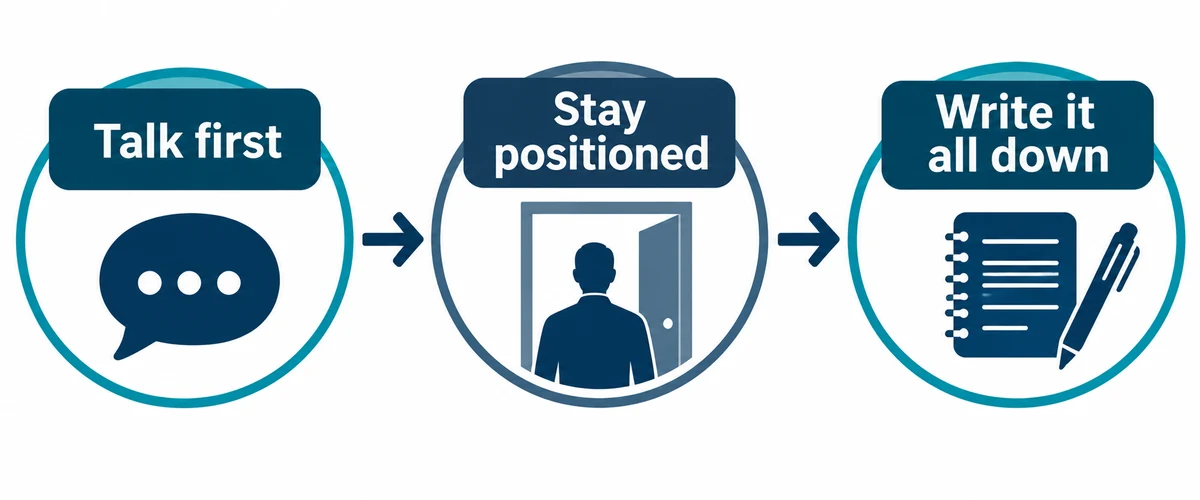
- Try to de-escalate first, and stay ready for it to go bad fast. It is a balancing act. You talk first and you stay positioned for the moment talking stops working.
- Follow your policies and procedures exactly. In a hospital there is a written procedure for most of what you will face, and your protection comes from having followed it.
- Rely on your training. Under stress you fall back on what you practiced, so practice it.
- Write the most detailed report of your career after a serious incident. The report is what protects you, your employer and the people involved when the incident is reviewed later.
- The mistake I see most: officers who go in aggressive and never try to de-escalate first.
For more on the first two points, see de-escalation for security guards. For the report, see the incident report template.
Gear worth having for hospital shifts
J.L. Darling Rite in the Rain pocket notebook, 3.5″ x 5″ (No. 754)
After an incident you write from notes, and notes taken in a stairwell, parking structure or ambulance bay should survive spills and wet weather. This ties to the advice above about writing the most detailed report of your career.
Watch out for: Check your hospital’s policy on carrying a notebook and what may be written in it, since patient information is sensitive.
See current price →Verbal Judo: The Gentle Art of Persuasion, Updated Edition
A communication book by a former police officer about calming people down and getting cooperation without force. It matches the advice to try de-escalation first.
Watch out for: Most examples are policing scenarios. It is not hospital-specific training and does not replace your employer’s de-escalation course.
See current price →CHARMKING compression socks, 15-20 mmHg, 3 pairs
Hospital posts mean long stretches on hard corridor floors and stairs, and a multi-pair pack is a cheap first purchase.
Watch out for: Compression socks are not a medical treatment. Ask a doctor first if you have circulation or heart conditions, and check the size chart.
See current price →What hospital security pays
Federal anchor. BLS counts hospital officers inside the “security guards” occupation, and general medical and surgical hospitals are one of its largest employers of guards. In the May 2023 BLS tables (the latest year we could open in full), those hospitals employed 44,460 guards at a mean of $21.61 an hour, against a $19.44 mean for all guards. The May 2022 tables showed the same gap, $19.83 against $17.64. Hospitals paid above the all-industry guard average in both years we checked. Last verified November 9, 2026; this figure is refreshed when BLS publishes new data each spring.
Posting snapshot (reviewed November 9, 2026; some postings have since closed, so treat them as examples, not current offers):
| Employer type and place | Pay | Experience asked for |
|---|---|---|
| In-house, Community Hospital San Bernardino, CA (Dignity Health) | $27.16–$31.83/hr | 6 months healthcare, law enforcement or military, or 1 year as a security officer; CA guard license; CPR within 90 days |
| In-house, Glendale Memorial, CA, night shift (Dignity Health) | $24.00–$30.26/hr | 1 year as a security officer; CA guard license; CPR within 90 days; Basic Health Care Security Officer preferred |
| In-house, St Bernardine Medical Center, CA, evening shift | $26.12–$30.60/hr | Not shown in the excerpt we saw |
| Contractor, PalAmerican Security, Texas and Colorado healthcare posts | $22.50/hr | High school diploma; prior law enforcement, military police or security experience; able to lift and drag 50 lb |
| National average, healthcare security (ZipRecruiter, June 2026) | $18.48/hr (most between $16.35 and $19.23) | n/a |
Two things drive the spread. In-house hospital jobs in California pay California wages. In the postings we reviewed they also paid more than the contractor post, but that is a small sample from different states. One California hospital posting said the position is represented by a union under a collective bargaining agreement; we found no national source on how many hospital officers are unionized, so do not assume it.
Requirements and training
- State license. California hospital postings required the state security guard license. Rules for in-house hospital officers vary by state, so check your state page: see security guard license requirements by state.
- Experience. Entry bars in the postings were low: a diploma plus six months to a year in security, healthcare, policing or the military.
- CPR. Basic Life Support within 90 days of hire was a common requirement.
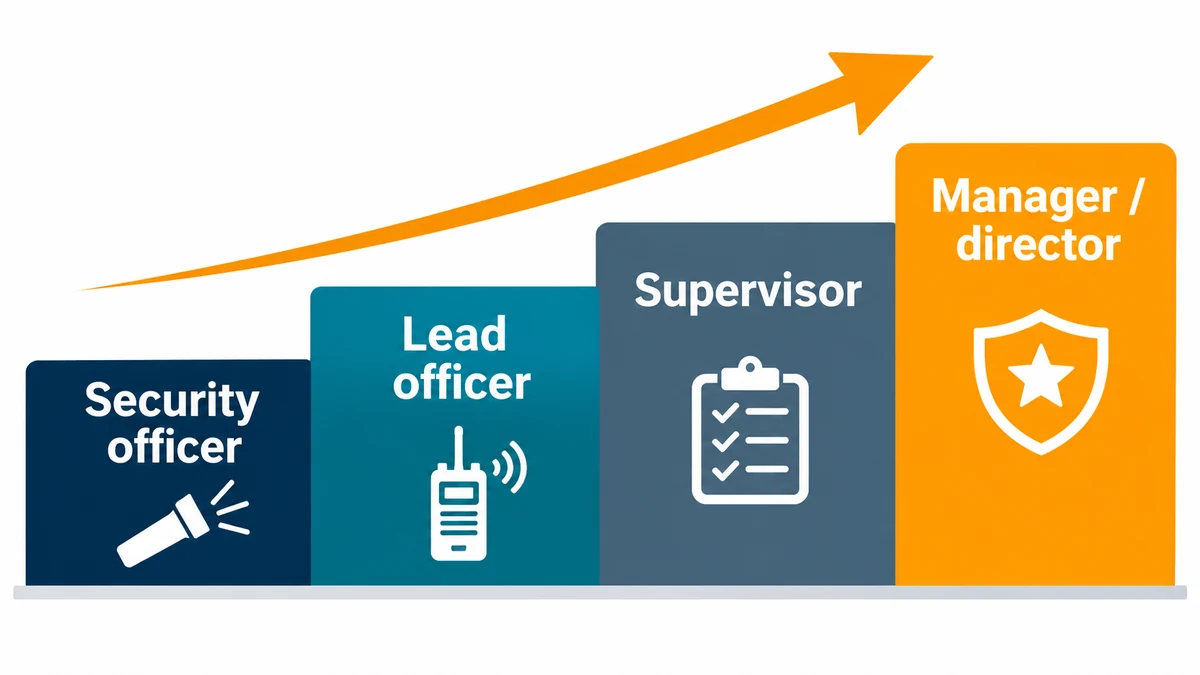
- Healthcare security certification. The International Association for Healthcare Security and Safety (IAHSS) runs a ladder: Basic (Certified Healthcare Security Officer), Advanced, Supervisor, then the Certified Healthcare Protection Administrator (CHPA) for management. IAHSS lists the Basic course and exam at $130 for members and $360 for non-members, and the CHPA exam at $450 and $525 (checked November 9, 2026; prices change). Several hospital postings listed Basic certification as preferred.
- Armed or unarmed. Policies differ by hospital and state, and I have no stance on it. IAHSS publishes a guideline on firearms in healthcare security. Check the posting and your state’s armed license rules.
Why hospital security hiring is changing: state rules to know
Hospitals are under growing legal pressure to staff and train security. This table is general information, not legal advice. Last verified November 9, 2026.
| Jurisdiction | What it requires | Dates |
|---|---|---|
| Federal accreditation (Joint Commission) | Accredited hospitals and critical access hospitals must run a workplace violence prevention program led by a designated person, with worksite analysis, reporting, post-incident strategies and training. | In effect since Jan 1, 2022 |
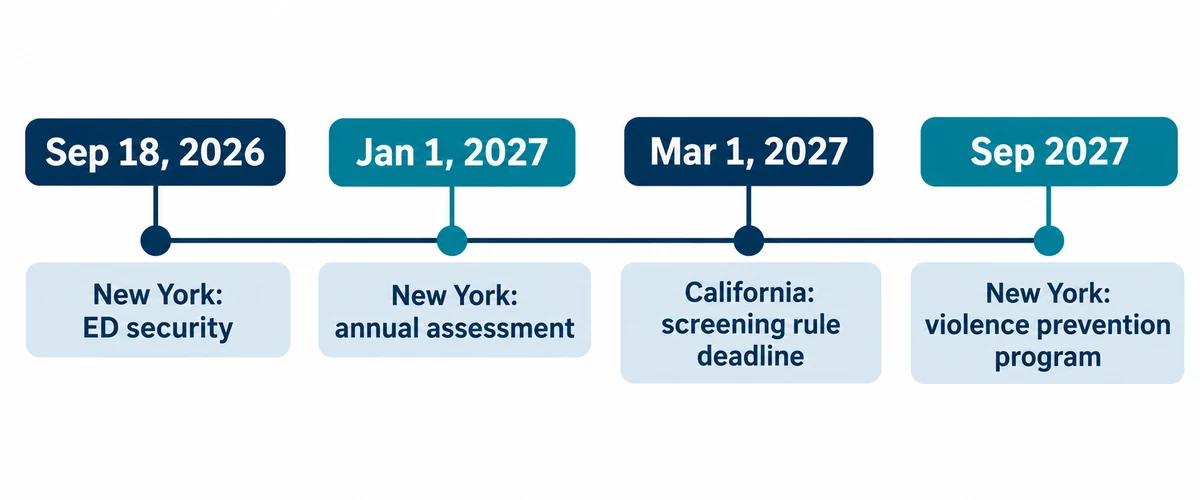
| New York (Public Health Law §§2832, 2832-a) | General hospitals in a city or county of 1 million or more need at least one off-duty law enforcement officer or trained security person in the emergency department at all times. Elsewhere, at least one on premises at all times, prioritizing the ED. Critical access, sole community and rural emergency hospitals are generally exempt unless ED violence rises. | ED security: Sept 18, 2026. Annual safety and security assessment and plan: Jan 1, 2027. Full violence prevention program: phased in over the following year, with the final deadline in September 2027 (check the statute text for the exact date) |
| California (Health & Safety Code §1257.7; Labor Code §6401.8; 8 CCR §3342) | Hospitals must run annual security assessments and keep sufficient security personnel to carry out their security plan. A 2024 law requires automated weapons screening at the main, emergency and (if separate) labor and delivery entrances, run by trained non-clinical personnel with at least 8 hours of training. | The Standards Board must adopt the screening rule by March 1, 2027; hospitals then get up to 90 days to comply |
| Ohio (H.B. 452; Ohio Rev. Code §§3727.18, 3727.181) | Each hospital and hospital system must have a security plan to prevent workplace violence, based on a security risk assessment, with training requirements for security personnel, an annual review and an annual attestation to the Ohio Department of Health, plus a workplace violence incident reporting system. | In effect Apr 9, 2025; existing hospitals had until July 9, 2025 to set up plans and reporting |
| North Carolina (G.S. §131E-88) | Requires law enforcement officers in hospital emergency departments. | Since Oct 1, 2024 |
If you are applying in one of these states, expect the hiring side of these rules to show up as more ED posts, more trained-screener posts and more training requirements in postings.
How to get a hospital security job
- Meet the entry basics: age, diploma or GED, clean background check and your state license if required.
- Get CPR/BLS certified before you apply. Many postings give 90 days after hire, but having it helps.
- Build six months to a year of security experience, or healthcare, police or military experience. Healthcare experience is what several postings asked for first.
- Take the IAHSS Basic course if you can afford it. It is listed as preferred in postings and starts your ladder.
- Apply to health systems directly and to contract firms with healthcare divisions. Search “Security Officer,” “Healthcare Security Officer” and “Public Safety Officer” on hospital career sites.
- Prepare for scenario questions about de-escalating an agitated person, following procedure and writing reports.
Hospital security career ladder
| Level | What changes | Certification |
|---|---|---|
| Security officer | Patrols, access control, response, reports | IAHSS Basic |
| Advanced / lead officer | Experienced officer, trains others | IAHSS Advanced |
| Supervisor | Runs a shift | IAHSS Supervisor |
| Manager / director | Runs the program, budget and risk assessment | CHPA |
We have no sourced hospital-specific pay figures for supervisors and directors, so this page does not give any. Hospital experience carries into hotel security, casino security, loss prevention and corporate security. See our hotel security jobs guide and casino security jobs guide.
Frequently asked questions
Do you need a license to work hospital security?
Often your state’s security guard license, yes. California hospital postings required it. Rules for in-house staff vary by state, so check yours.
Are hospital security officers armed?
It depends on the hospital and state. Many are unarmed. Check each posting.
What does a hospital security officer do all day?
Patrols, access control, escorts, response calls, camera monitoring and reports.
How much do hospital security guards make?
BLS data show hospital guards paid above the all-industry guard average (a $21.61 mean hourly wage in May 2023). In 2026 postings, California in-house hospitals paid $24 to $32 an hour and a contractor post paid $22.50.
Is hospital security a good first security job?
The entry bar is low, there is a certification ladder, and the work gives you de-escalation and reporting experience. The cost is dealing with distressed and sometimes violent people.
Can hospital security restrain a patient?
That depends on state law, hospital policy and your training. Do not act outside them. Ask in training. For the general rules on holding people, see can security guards detain people.
Sources
- BLS OEWS May 2023: Security Guards (33-9032)
- BLS OEWS May 2022: Security Guards (33-9032)
- New York Public Health Law §2832-a
- California Health and Safety Code §1257.7
- California AB 2975 (chaptered text)
- California Labor Code §6401.8
- Ohio Revised Code 3727.18
- IAHSS: Certified Healthcare Security Officer course and exam
- IAHSS: CHPA certification exam
- ZipRecruiter: healthcare security jobs (June 2026 average; PalAmerican Security posting)
- Joint Commission workplace violence prevention standards (effective January 1, 2022)
- North Carolina G.S. §131E-88 (via Epstein Becker Green summary)
- Dignity Health / CommonSpirit Health job postings, requisitions 2026-483024, 2026-455540, 2026-463907 and 2026-465685 (reviewed November 9, 2026)
Reviewed November 9, 2026. Pay, rules and fees vary by employer and state; check each listing and your state regulator.
Next steps
- → Hotel security jobs: pay, duties and how to get hired
- → Casino security jobs: pay, licensing and getting hired
- → De-escalation for security guards
- → Security guard incident report template
- → Security guard license requirements by state
- → How to become a security guard
- → Security guard salary guide
Legal disclaimer: This page is for general information and education only. It is not legal advice, and reading it does not create an attorney-client relationship. Security Dogma is not a law firm. Laws, licensing rules and court decisions vary by state and change often, and what is written here may not match your situation or be current when you read it. Before you act on anything here, check the official rules from your state licensing agency, follow your employer’s and client site’s policies, and talk to a licensed attorney in your state for legal questions. See our Terms and Conditions and how facts are checked in our Editorial Policy.