

Security Dogma is reader-supported. When you buy through links on this page, we may earn a commission at no extra cost to you. As an Amazon Associate I earn from qualifying purchases. Learn more
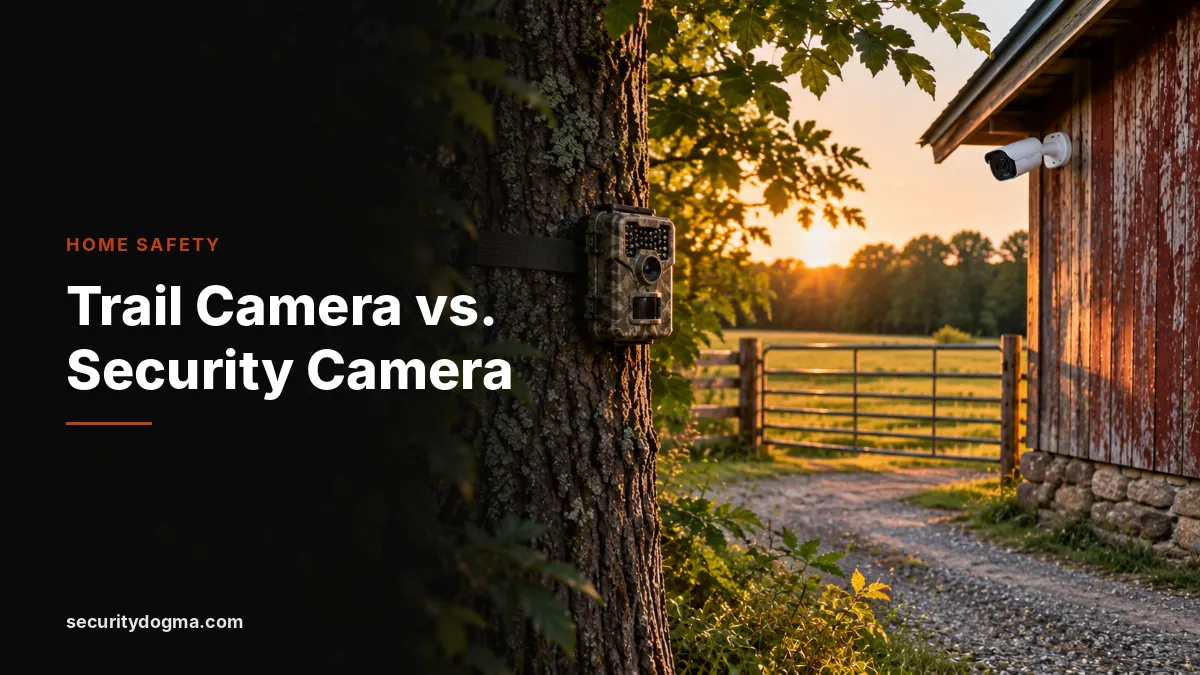
Trail cameras were built to photograph deer. Security cameras were built to watch doors. Both can protect a property, but they do different jobs, and picking the wrong one is how people end up with a clear photo of their trailer leaving and no way to stop it.
This guide compares them the way a security professional would: by what happens between someone arriving and you finding out.
Quick answer
- Choose a trail camera for remote, unpowered spots where you mainly need a record of who came and went: a back gate, a field track, a shed at the edge of the property.
- Choose a security camera where you need fast alerts, live view or visible deterrence: the main gate, the cabin, the equipment yard.
- Many remote properties need both: visible security cameras where you want to turn people away, and hidden trail cameras where you want evidence.
How we chose the examples in this guide: research only. We have not tested these cameras. Specs come from each manufacturer’s website, checked October 30, 2026.
Trail camera vs. security camera at a glance
| Trail camera | Security camera | |
|---|---|---|
| Built for | Recording wildlife quietly | Watching an area and alerting you |
| Power | Usually batteries, sometimes solar | Outlet, battery, solar or PoE cable |
| Connection | None, or cellular on cellular models | Wi-Fi, cellular, or cable to a recorder |
| Recording | Photos or short clips when motion is detected | Motion clips; wired models can often record continuously |
| Live view | Rare, often limited or a paid add-on | Common |
| Alerts | Cellular models send images after capture; others only when you check the card | Push alerts, often with person or vehicle detection |
| Look | Camouflaged, easy to hide | Visible, often meant to be seen |
| Ongoing cost | Data plan for cellular models | Data plan for cellular models; optional cloud plans |
| Best at | Evidence in places with no power | Deterrence and fast response |
These are typical traits. Individual models vary, so check the specs of the one you are considering.
What happens between motion and your alert
The biggest practical difference is time. On a remote property, the minutes between someone arriving and you knowing about it decide whether you can do anything.
With a cellular trail camera, the chain usually runs like this:
- Trigger: a motion sensor detects heat and movement.
- Capture: the camera takes a photo or short clip.
- Save: the file is written to internal memory or the SD card.
- Upload: the camera connects to the mobile network and sends it, often at a lower resolution to save data.
- Alert: the app notifies your phone.
- Response: you look, decide, and call someone.
Delays can creep in at every step, especially upload. Weak signal, a busy network or settings that batch uploads can all add time. Non-cellular trail cameras stop at step 3: you see nothing until you collect the card.
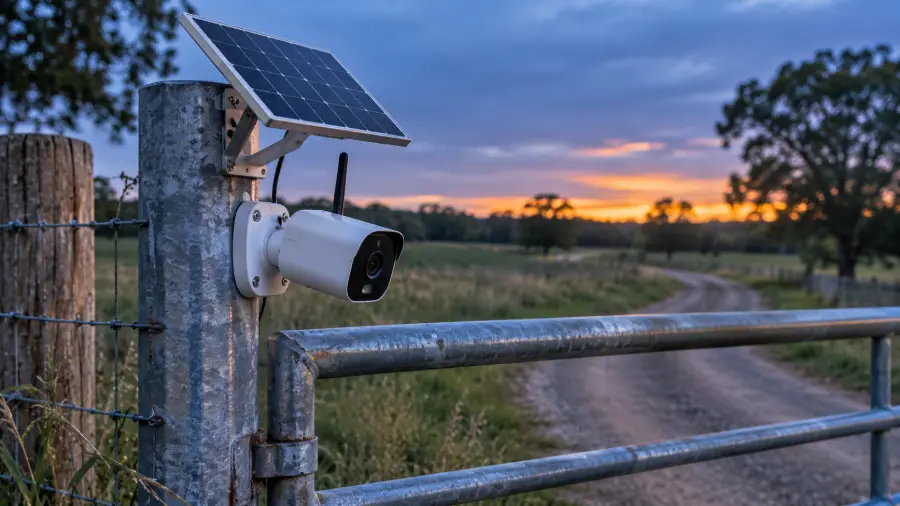
A security camera with good signal usually shortens that chain and adds live view, so you can check what is happening before you call anyone. That is why security cameras suit the spots where you would actually respond.
Which fits where
| Location | Better fit | Why |
|---|---|---|
| Main gate or driveway | Security camera | You want deterrence, vehicle detail and a fast alert |
| Back gate or field track | Cellular trail camera | Quiet coverage of a secondary route, often without power |
| Shed or barn at the edge of the property | Either | Trail camera for evidence; security camera if equipment inside is valuable and you can respond |
| Equipment yard | Security camera | Visible coverage turns people away from expensive, towable items |
| Vacant land | Cellular trail camera | Cheap, low-power coverage of dumping, trespass and access routes |
| Cabin or second home | Security camera at doors, trail camera on approaches | Visible protection where it counts, hidden coverage of how people arrive |
Hidden or visible?
This is the real choice, and it is not about the camera type. It is about what you want the camera to do.
- Visible cameras deter. Someone who sees a camera may leave before doing anything. That is the outcome you want at the main entrance.
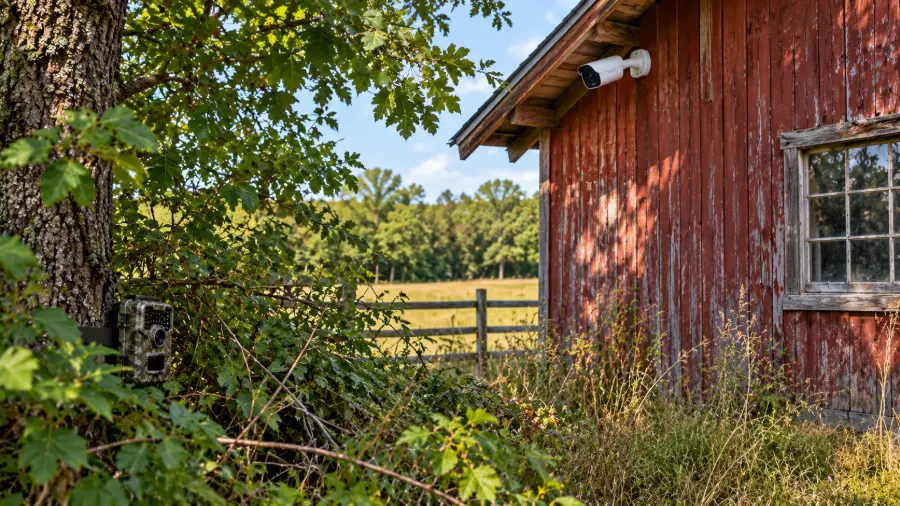
- Hidden cameras gather evidence. In my private investigation work, I used concealed pinhole cameras precisely because a visible camera changes behavior. On a property, a hidden camera records what someone does when they think nobody is watching, including the vehicle they arrived in.
Most remote properties benefit from both: visible cameras at the obvious approaches, and hidden ones covering the routes people use when they want to avoid those cameras.
Keep hidden cameras on your own property, and avoid places where people expect privacy. Recording audio in secret raises legal issues in many states (see the legal notes below).
When a trail camera is the wrong choice
A trail camera is the wrong tool when:
- You need to respond in real time. If you or a neighbor would act on an alert, upload delays and limited live view work against you.
- You need continuous recording, such as a gate where you must see every vehicle, not just those that trigger the sensor.
- Detail at distance matters. Trail cameras are tuned for animals at close to medium range. Reading a plate on a moving vehicle is a job for a properly placed security camera.
- You need deterrence. A camouflaged camera, by design, deters nobody.
- The area records conversations. Some trail cameras capture sound with video. Near a cabin porch or work area, that can raise audio-recording issues.
How to choose a trail camera for security
If a trail camera fits the spot, these are the features that matter for security rather than hunting:
- Cellular or not: for security, cellular is almost always worth it. A card you collect weekly tells you about a theft days later.
- Network support: some cameras connect to several carriers and pick the strongest signal. Check what signal you get at the exact mounting spot.
- Trigger speed: a faster trigger catches a vehicle or person crossing the frame instead of an empty track.
- Night flash: low-glow infrared shows a faint red glow; no-glow is harder to spot but often gives darker night images.
- Video length and storage: short clips save data; internal memory means no card to steal or corrupt.
- Plan rules: most cellular trail cameras need a data plan to send images. Check what the cheapest tier includes and whether live view or full-resolution downloads cost extra.
- Power: batteries, rechargeable packs, external power or solar. In cold weather, batteries drain faster.
- Theft protection: check whether the maker sells a security box, or whether the camera takes a cable lock.
For placement, night vision and keeping any camera secure, see our home security camera guide.
Examples worth a look (research-based, not tested)
These are current cellular trail cameras from established brands, chosen because their specs and plan terms are clearly published. We have not tested them. Figures are the manufacturers’ own.
Tactacam Reveal X 3.0
4K photos · 1080p video · low-glow IR · 8GB + SD · 12 AA or 12V
According to Tactacam, it picks the strongest available network through an integrated SIM, with a data plan separate from your phone plan. The low-glow flash has a listed 96-foot range, and GPS is built in.
Watch out for: A data plan is required to receive images; Live View and HD requests cost extra.
See current price →Moultrie EDGE 3
40MP photos · 1080p video · 0.5 s trigger · 50° view · 100 ft flash
Moultrie says it connects to all four major US networks and stores to built-in memory, so there is no card to steal or corrupt. It has GPS, a USB-C power input, and works with Moultrie’s solar pack.
Watch out for: Moultrie states that all its cellular cameras require a paid subscription.
See current price →SPYPOINT FLEX-M2
32MP photos · 1080p video · 0.4 s trigger · 90 ft range · dual SIM
An entry-level cellular camera with two SIMs. SPYPOINT lists low-glow LEDs and 90-foot flash and detection ranges.
Watch out for: The free plan is limited to 100 photos a month per camera.
See current price →If you need live view and faster alerts instead, look at cellular security cameras.
Permission, privacy and rules
This is general information, not legal advice.
- Get permission before placing cameras on land you lease or share.
- Stay on your side of the line. Don’t aim cameras at neighbors’ homes or private areas.
- Audio: some states require consent from everyone in a conversation. If unsure, turn audio off. See our overview of recording laws.
- Public land and hunting areas: some states regulate trail cameras, including cellular models, on public land or during hunting seasons. Check your state wildlife agency before mounting one off your own property.
FAQ
Can a thief spot a trail camera?
Sometimes. Low-glow infrared flashes give off a faint red glow when they fire at night, and a camera strapped at eye height to the most obvious tree on a track is the first place anyone looks. Mount it higher and angle it down, use branches or brush as cover without blocking the lens or motion sensor, and pick a spot that watches the approach rather than the item itself. That way, even if someone finds the camera, it has likely already recorded them on the way in. If the maker sells a lockable security box, use it.
Can a trail camera connect to home Wi-Fi?
Some models offer Wi-Fi, but usually with short range, meant for setup or downloading files while you stand nearby rather than sending alerts across a property. A remote cabin or field rarely has Wi-Fi that reaches the camera anyway. On a remote property, a cellular model that sends images over the mobile network is more practical. If the site has strong Wi-Fi and power, a regular security camera is usually the better tool.
Can I watch a trail camera live on my phone?
Only some cellular models offer live view, and it is often limited to a set number of sessions or sold as a paid add-on to the data plan. If you expect to check the property live, for example right after an alert, a security camera with live view built in is the better fit. Treat a trail camera as an evidence tool first and a live-monitoring tool second.
Do I need a data plan?
For a cellular trail camera, yes in almost every case. Some makers offer a small free tier, often with a monthly photo limit; others require a paid subscription for any images. Without an active plan, many cameras still record to their own memory or card, but nothing reaches your phone until you collect the files in person. Before buying, check what the cheapest plan includes and whether video, full-resolution downloads or live view cost extra.
For the bigger picture, see our guide to rural and remote property security.
Legal disclaimer: This page is for general information and education only. It is not legal advice, and reading it does not create an attorney-client relationship. Security Dogma is not a law firm. Laws, licensing rules and court decisions vary by state and change often, and what is written here may not match your situation or be current when you read it. Before you act on anything here, check the official rules from your state licensing agency, follow your employer’s and client site’s policies, and talk to a licensed attorney in your state for legal questions. See our Terms and Conditions and how facts are checked in our Editorial Policy.