

Security Dogma is reader-supported. When you buy through links on this page, we may earn a commission at no extra cost to you. As an Amazon Associate I earn from qualifying purchases. Learn more
A boat is a high-value asset that sits unattended most of the time, often behind a gate nobody checks. That is exactly what a thief looks for. This guide applies the same principles security professionals use on buildings and people (threat assessment, layered protection, access control) to a boat at the dock, at anchor and underway. If you cruise rather than own a boat, see our cruise ship safety tips instead.
Quick answer
Most boat theft is opportunistic. Thieves go for small, trailered, unlocked boats and for electronics, outboards and tenders they can remove fast. Protect a boat in layers: deter with visible locks and no keys aboard, delay with outboard and trailer locks, detect with a GPS tracker or monitoring alerts, and respond with serial numbers and the hull ID already recorded.
How this guide was made: research only. We have not tested the products listed. Facts come from NICB theft data, BoatUS insurance claim analyses, police and news reports, manufacturer spec pages and maritime-industry sources, listed at the end. Checked November 3, 2026.
Watch: yacht security at the dock and at anchor
Prefer to watch? This six-minute video walks through this guide: the five threats that actually hit boats, the four layers of deter, delay, detect and respond, and how to secure a boat at the dock, at anchor and for the off-season.
The presenter in this video is an AI-generated likeness of Yair Arad using his own voice and field notes. Scenes marked “Dramatized” are AI-generated illustrations, not real footage.
What actually threatens yachts and boats
Start where any security assessment starts: what gets stolen, from where, and how. The data points to five threats.
Theft of the whole boat
The National Insurance Crime Bureau (NICB) counted 58,957 motorcycles, ATVs, snowmobiles and watercraft stolen in the US in 2025, and about 63% were never recovered. That release does not break out watercraft on their own. NICB’s most recent watercraft-only figures cover 2022: 4,461 watercraft were stolen, and Florida led with 891.
Insurance data shows who gets targeted. A BoatUS review of five years of its own theft claims found that 75% of stolen boats were under 26 feet, 73% were taken while sitting on their trailers, and only about 15% of owners had any kind of lock installed.
Theft of electronics, outboards and tenders
Thieves often strip a boat rather than take it. In November 2025, two thieves went boat to boat at a marina in Aventura, Florida, taking GPS units worth $1,300 to $6,000 each. A month later on Longboat Key, eight GPS units worth about $40,100 were taken from five boats in one night. Outboards are a target too. There are no national figures for engine theft, but CNBC reported organized thieves targeting high-value Yamaha outboards at dealerships, and Yamaha-made watercraft topped NICB’s theft list by manufacturer in 2017 to 2019 (mostly WaveRunner personal watercraft).
Break-ins at marinas and moorings
Marina break-ins usually come through the weakest access point. In a May 2025 case at Black Point Marina in Florida, a boat owner blamed a dock gate that stayed open most of the time after thieves gutted his console. He put the replacement cost at $16,000.
Opportunistic boarding at anchor
In cruising grounds the classic loss is the dinghy and its outboard. The Caribbean Safety and Security Net reports that this theft is still mostly opportunistic, and that too many dinghies are secured with nothing more than a light padlock and cable.
Crew, contractors, guests and reconnaissance
Access control covers the people you let aboard, not just strangers. BoatUS reported that in a series of dealership thefts, a suspect posed as a shopper the day before. Anyone unusually curious about your keys, codes or routine is a reason to tighten up.
From the field — Yair Arad
In loss prevention, the stores that got hit hardest were busy ones with few staff and no cameras, especially when the registers near the exit were understaffed or left empty. Thieves who meant business came prepared. I once stopped a man stealing over-the-counter medicine to make illegal drugs. He brought a bag for it and knew exactly where the products were on the shelves. I learned to watch for things that didn’t fit: I always look at shoes, and I remember a well-dressed man whose shoes were old and worn out. People carrying empty bags were another sign. Deterrence works, too. At one location I watched on CCTV as a suspicious man looked around a lot, saw the signs and cameras, and left. A boat is no different: busy, unwatched and unlocked is what thieves look for.
The pattern is opportunity. Most thieves pick the easiest target in front of them, so the goal is to make your boat the harder one.
A note on recovery numbers: NICB reported a 42% recovery rate for 2021, and that count includes boats found stripped of engines and electronics. Either way, prevention beats recovery.
Think in layers: how a security professional protects a boat
A protection detail never relies on one barrier, and a boat shouldn’t either. Use four layers, each doing a different job.
| Layer | Goal | On a boat |
|---|---|---|
| Deter | Make the thief choose another target | Visible locks, warning stickers, no keys aboard, nothing valuable on show |
| Delay | Make the job slow and noisy | Outboard and trailer locks, locked hatches, an engine immobilizer |
| Detect | Know within minutes, not the next morning | GPS tracker with movement alerts, entry or motion sensors, a 4G camera |
| Respond | Act fast and recover | Recorded hull ID and serial numbers, a call plan, a police report within hours |
The deterrence goal is simple: make your boat look like a harder target than the next one. It’s the same thinking we use in our guide to securing your home.
Securing your boat at the dock or marina
- Lock everything a thief tests first: companionway, cabin door, hatches and lockers. BoatUS recommends a solid instrument cover and tamper-resistant fasteners for helm electronics.
- Never leave keys aboard. Hiding places don’t work: finding keys is what thieves do for a living.
- Remove what you can. Take portable electronics, paperwork and valuables home. Small outboards come off the transom and go somewhere locked.
- Know who holds keys and codes. Crew, cleaners, mechanics and brokers all get access at some point. Collect keys back and change codes when the job or the relationship ends.
- Light it up. Motion lighting on the dock or the boat removes the dark that thieves work in.
Judge the marina like a security site. Look for gates onto the pontoons themselves, CCTV, 24-hour patrols and floodlighting. Before you sign a slip agreement, ask:
- Does the dock gate actually latch every time, and who reports it when it doesn’t?
- Who reviews the camera footage, and how long is it kept?
- Is anyone on site at night?
- Are there liveaboard neighbours? Their eyes are part of your detection layer.
Securing your boat at anchor or on a mooring
At anchor the threat changes: fewer barriers, more water access, and the tender becomes the prize.
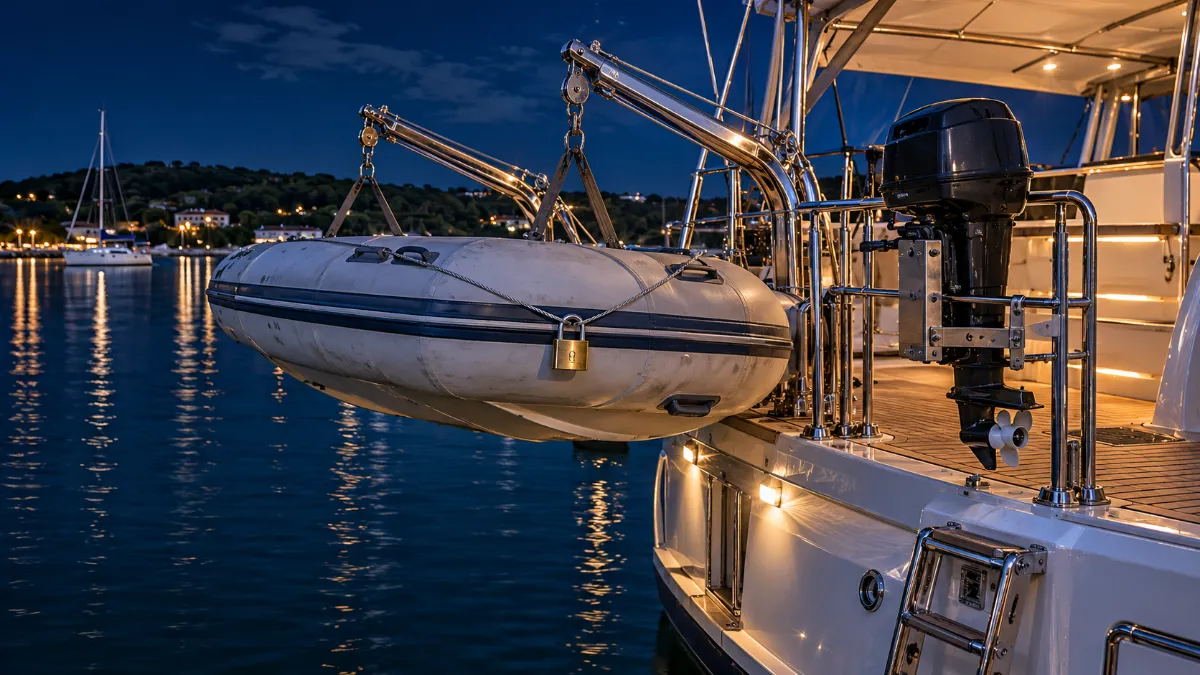
- Lift and lock the tender every night. The CSSN says even lifted dinghies are within reach of a determined thief, so lifting and locking is best practice. BoatUS advises that small outboards should be removed and stored somewhere secure, so take the outboard off the tender overnight.
- Use your anchor alarm as a watch tool. Anchor-alarm apps sound when the boat leaves a set radius, and some can alert a second phone ashore. A boat moving when it shouldn’t is a safety problem and a security one.
- Set a night routine: close hatches, raise the swim or boarding ladder, switch on deck or motion lighting, and keep a phone and torch at the berth. Agree in advance who checks a noise and how.
- Watch the approaches. Note boats circling or loitering at dusk. When you arrive somewhere new, the CSSN suggests asking on VHF about recent incidents.
- Keep everyone in contact. On larger boats, give whoever is on watch a way to reach the rest of the crew quietly. See our guide to two-way radios.
From the field — Yair Arad
In the Israeli Navy I served on small patrol boats, fast boats and Zodiac inflatables, patrolling close to shore. On regular patrol we rotated three eight-hour watches; during certain operations, everyone was on. The hardest part of a night watch is staying sharp. What worked for me was keeping my mind busy, talking to a teammate and drinking a lot of coffee. Everyone aboard, not only the guard on duty, stayed aware of what was around us. When a vessel approached, we followed set protocol, and most of the time a call over the loudspeaker was enough. I also learned that sound carries differently over water at night, so we kept communication to the radio and hand signals.
Boat security systems worth installing
Technology covers the detect layer, but only if someone acts on the alert. In the Black Point case, the owner got a phone alert that someone was aboard and still lost his electronics. Decide before you buy who gets the alert and what they do next.
- GPS trackers tell you the boat has moved and where it is. Hide them: one Florida theft ring searched for and disabled GPS trackers on stolen vehicles.
- 4G and solar cameras work where there is no Wi-Fi. Check cellular coverage where the boat sits, and budget for the data plan. For more on these, see our off-grid security cameras guide and home security camera guide.
- Motion, hatch and bilge alarms warn you about an intruder and about water coming in.
- Remote monitoring apps pull it together on your phone. Most require a subscription for as long as you own the boat.
Examples worth a look (research-based, not tested)
These come from established brands that publish clear specs and plan terms. We have not tested them, and the figures below are the manufacturers’ own. Subscription prices change, so check the current plan before you buy.
LandAirSea 54
4G LTE · magnetic · waterproof · geofence and movement alerts
A small battery tracker you can hide on a boat, tender or trailer. LandAirSea lists 1 to 3 weeks of battery on frequent updates and up to 6 months in low-power mode, and its app can alert you the moment the boat is moved.
Watch out for: A subscription is required to see location data; LandAirSea lists plans from $19.95 a month. It’s a battery device, so you have to remember to charge it.
See current price →Siren 3 Pro (Siren Marine / Yamaha)
GPS geofence · cellular · wireless entry, motion and bilge sensors · NMEA 2000
A wired monitoring hub that sends geofence, entry and motion alerts plus bilge, battery and shore-power warnings to your phone. It works with any brand of outboard.
Watch out for: It costs far more than a tracker, sensors are sold separately, and a cellular plan is required (listed from $18.75 a month in 2024). Amazon stock was limited when we checked.
See current price →Reolink Go PT Ultra
4K · 355° pan / 140° tilt · battery or solar · microSD up to 128GB · IP64
A cellular camera for a dock, boathouse or trailer spot with no Wi-Fi. Reolink says it needs a nano SIM and a cellular data plan; its smart detection is free, and cloud storage is a paid extra.
Watch out for: IP64 means splash-resistant, not built for salt spray or immersion. Mount it on a fixed structure, not out on an exposed deck.
See current price →Locking down tenders, outboards and deck gear
- Lock the outboard to the transom. A locking nut replaces one mounting nut, so the engine can’t be unbolted. Pair it with an immobilizer where you can: Yamaha’s Y-COP system disables the ignition with a key fob and is fitted by a Yamaha dealer.
- Cable the tender and loose gear to a fixed point, and lift the tender at night.
- Mark your gear. BoatUS suggests engraving electronics and the outboard and posting a warning.
- Record the hull ID (HIN). Every boat built in or imported to the US since 1972 carries a 12-character HIN. Police can enter a stolen boat into the national NCIC database by HIN, registration number, Coast Guard number or an owner-applied number, so have them ready.
- Keep a serial-number list. NICB’s marine vessel checklist covers engine, radio, depth sounder, compass and trailer serials. Photograph everything and store it off the boat.
Trimax TBL610 outboard motor lock
Heavy-gauge steel · covers the mounting clamps · foam padding · quick release · 2 keys
A two-piece lock that fits around the outboard’s mounting clamps so the clamp handles can’t be loosened. It suits the small clamp-on outboards that thieves can lift off a transom or tender in seconds.
Watch out for: It only fits clamp-on (tiller) outboards, not larger engines bolted through the transom. For those, ask your dealer about locking mounting nuts and an engine immobilizer.
See current price →Master Lock Python adjustable cable, 2-pack
6 ft · 3/8 in braided steel · vinyl coated · keyed alike
An adjustable steel cable that locks tight at any length. Keyed-alike pairs let one key cover the tender and the outboard.
Watch out for: Any cable can be cut with the right tools. Treat it as a delay layer and combine it with lifting the tender at night.
See current price →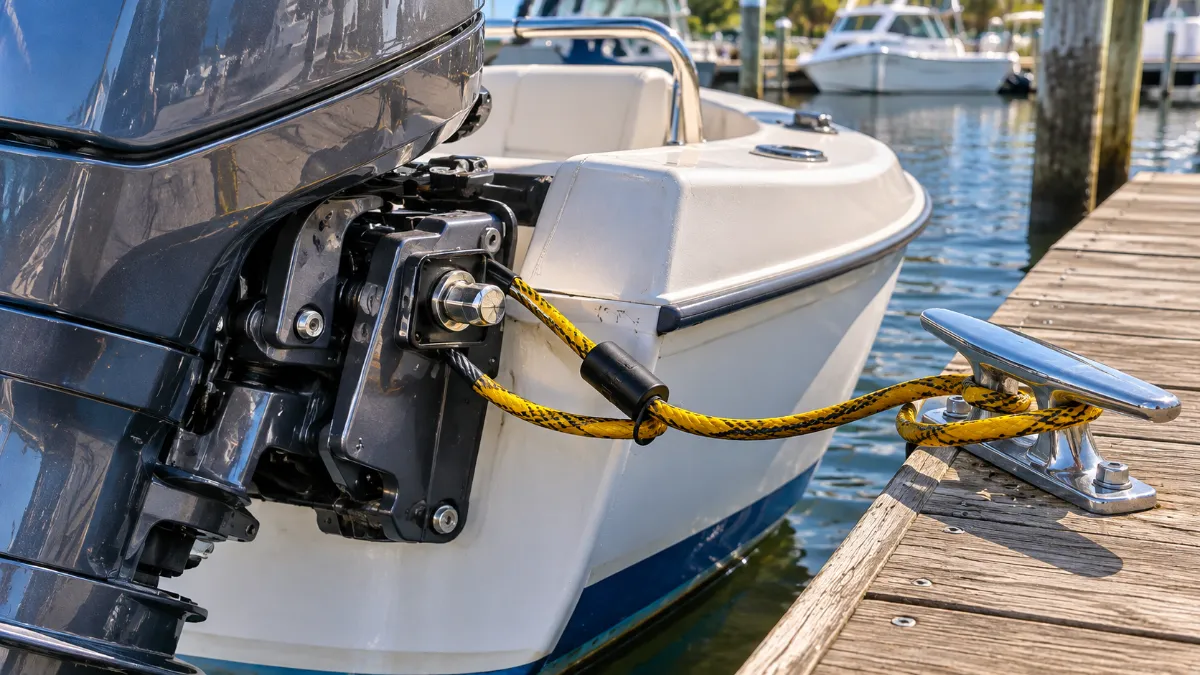
Leaving your boat for weeks or the off-season
- Someone you trust checks the boat on a set schedule, and you know who it is.
- Electronics, keys and paperwork are off the boat. BoatUS lists electronics among the most common theft claim during winter storage.
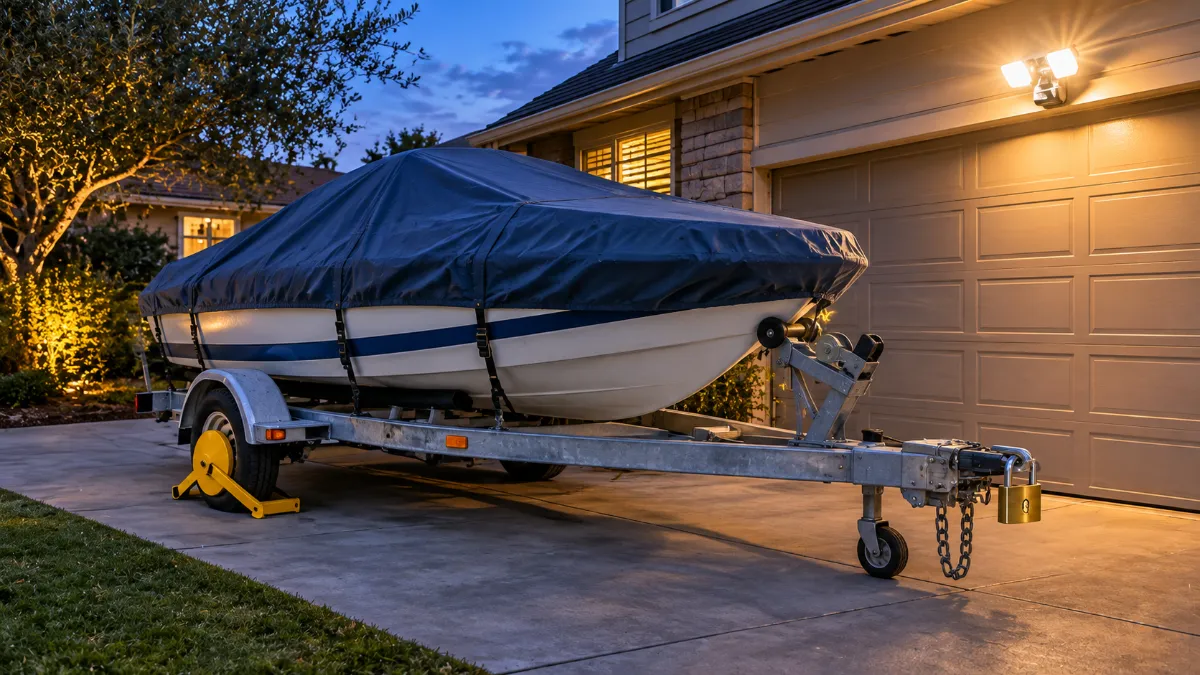
- Trailer secured: hitch facing away from the street, a wheel removed or wheel-locked, and the coupler locked.
- Tracker charged, geofence armed, monitoring subscription active.
- Dated photos and your serial-number list stored at home for insurance.
- No “for sale” sign, and a full cover over eye-catching graphics.
Leaving the house at the same time? Use our vacation home security checklist too.
Superyachts: what a yacht security officer does (and how people get into the job)
For owners
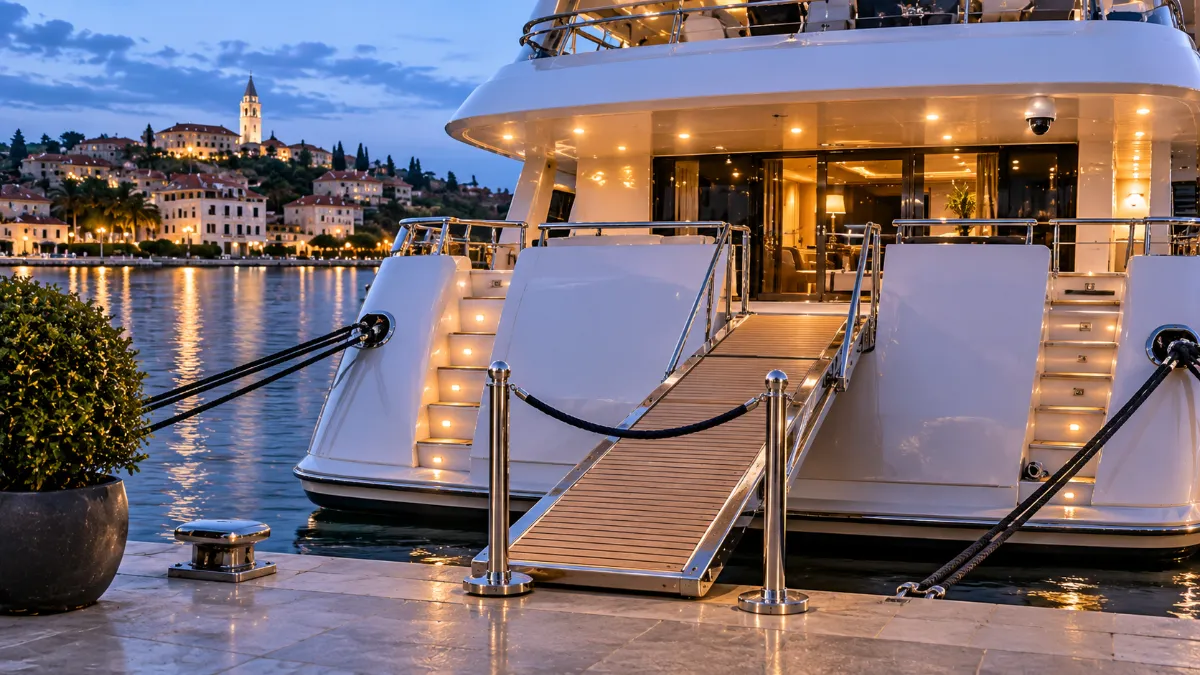
Security on a large yacht is a staffed function, not just a set of locks. The captain carries ultimate responsibility for security. On larger, commercially operated yachts, a designated Ship Security Officer runs it day to day, and that is often the first officer rather than a separate hire. Some privately owned yachts also carry a dedicated security officer as specialist crew. Formal certification is covered in our ship security officer course guide.
In practice the job looks familiar to anyone from close protection: monitoring access points and CCTV, running embarkation and disembarkation in port, and escorting owners and guests on shore excursions. A yacht management firm’s security manager notes that technology works best combined with protocols and crew training.
How it differs from close protection ashore. Ashore, a detail controls a route, a venue and a vehicle. Aboard, everyone shares a confined space for weeks, and the captain commands the vessel. One provider says land-based close-protection teams work under the Ship Security Officer once aboard, and that onboard procedures differ from shoreside ones. (This is one security firm’s description of common practice, not a rule set by any regulator.) The highest-risk moments are usually port arrivals and shore trips, which is where advance work and route planning from close protection carry straight over.
From the field — Yair Arad
I spent about three years in executive protection, for clients in the entertainment industry and for corporate executives and businesspeople. Every movement started with a thorough advance: checking all floors, planning different routes out, knowing which hospitals were open and who was on shift. If we weren’t sure someone should be there, they didn’t get near the client. We stopped them verbally and positioned ourselves so they couldn’t get close. With a two-person team, one is ready to take the client away while the other deals with the threat. Arrivals were the riskiest moments, and if at the last minute I felt an arrival point wasn’t safe, we went in a different way. The closest I came to this work afloat was escorting clients through an airport to their private jet; I have never worked aboard a boat. My advice to an owner hiring security: make sure the physical measures are in place and actually working.
When to consider one: guests with a public profile, frequent calls at busy marinas, shore excursions in unfamiliar places, or any route your captain rates as elevated risk.
What to ask when hiring:
- Which maritime security and crew certificates do you hold?
- How will you work under the captain’s command?
- What is your plan for access control, drills and incident reporting in port?
- Can you cover shore excursions, or will that need separate close-protection staff?
For readers who want the job
Security providers describe their yacht teams as coming mostly from police and military backgrounds, and a recruiter notes that executive protection or military experience is a significant advantage. Because you live and work as crew, the basic crew tickets matter too: STCW Basic Safety Training and an ENG1 medical are required for commercial yacht crew. One crew agency lists a guide salary of €3,000 to €5,000 a month for yacht security officers. (Note: this is the only published figure we found for this specific role. The major crew salary guides don’t list it, so treat it as a rough guide, not a market rate.)
For the detail, use these guides rather than starting from scratch:
- How to become a maritime security contractor: the full training and entry path.
- Ship security officer course: the certification side of the role.
- How to become a bodyguard: the close-protection foundation for shore work.
- Maritime security contractor salary: how pay compares across maritime roles.
- Cruise ship security careers: another onboard security role to compare.
- Maritime security careers hub: every guide in the series.
When a passage goes through high-risk waters
Current guidance for yachts is blunt: avoid recognized piracy high-risk areas, and if you must go, register with the military reporting centres at least two weeks before entering. For where piracy happens today, read are there still pirates? and our maritime security hub.
FAQ
How do you stop someone from stealing a boat?
Layer it. Use visible trailer and outboard locks, keep keys off the boat, immobilize the engine, and add a hidden tracker with movement alerts. Most stolen boats are small, trailered and unlocked, so basic locks remove much of the risk.
What is the best GPS tracker for a boat?
It depends on the boat. A hidden, battery-powered LTE tracker suits small boats, tenders and trailers. A wired monitoring system with geofence and sensor alerts suits larger boats. Both need a subscription, so check cellular coverage where the boat is kept.
Do superyachts have armed security?
Usually not, day to day. Maritime lawyers note that armed guards on a yacht need flag-state permission and must comply with the firearms laws of every port and coastal state on the route. Security firms say armed teams typically join only for transits through high-threat waters. Commercial shipping is a different subject: see do cargo ships have armed guards?
Is it safe to leave a yacht at anchor overnight?
In most anchorages the realistic risk is theft of the tender or outboard, not violence. Lift and lock the dinghy, take the outboard off, lock up, and check recent local incident reports before you anchor.
What does a yacht security officer do?
They control who boards, watch access points and CCTV, run security drills, and often escort the owner and guests ashore, all under the captain’s command.
How do you become a yacht security officer?
Most come from police, military or close-protection backgrounds and add maritime security certificates and basic crew training. Our maritime security contractor guide and ship security officer course guide cover the path.
Does boat insurance cover theft?
Most boat policies cover theft, but the details vary. Agreed-value policies pay a set amount, while actual-cash-value policies deduct depreciation. Some policies exclude “mysterious disappearance“, so read your policy and ask your insurer about limits on electronics and tenders.
About the author
I’m Yair Arad. I served in the Israeli Navy from 1994 to 1996 and have spent more than 15 years in security, executive protection, loss prevention and private investigation. I have never owned a yacht or worked as a yacht security officer. This guide applies protection principles I’ve used professionally to boats, backed by the research listed below.
Next steps
- Owners: secure your home · vacation security checklist · off-grid security cameras · cruise ship safety tips
- Careers: maritime security hub · become a maritime security contractor · become a bodyguard · cruise ship security
Sources
- NICB: Recreational vehicle thefts declined in 2025
- NICB: 2022 watercraft theft report
- NICB: 2021 watercraft thefts
- NICB: Marine vessel checklist
- BoatUS: Analyzing boat thefts
- BoatUS: Preventing off-season boat theft
- BoatUS: From locks to lockdown
- Trade Only Today: BoatUS theft-prevention tips
- The Fisherman: BoatUS winter storage theft tips
- Local10: Thieves hit nearly a dozen boats at Aventura marina (Nov 2025)
- Your Observer: Cannons Marina burglary (Dec 2025)
- WSVN: Black Point Marina theft (May 2025)
- Florida Attorney General: Six charged in organized cargo theft ring (2026)
- Noonsite: CSSN annual report on crime against yachts
- Noonsite: Caribbean security for cruisers
- Yamaha: Y-COP
- LandAirSea: Boat GPS tracker
- LandAirSea 54
- Panbo: Yamaha and Siren Marine app and pricing
- Reolink Go PT Ultra
- Trimax TBL610 outboard motor lock specs
- CNBC: Organized thieves target expensive boat engines (2017)
- NICB: 2019 watercraft theft report
- Chambers: Maritime security onboard yachts, a legal perspective
- Master Lock Python adjustable locking cable
- Hull Identification Numbers explained
- NCIC Boat File (Utah BCI)
- Yotspot: Who is responsible for yacht security on board?
- Ocean Independence: Yacht crew explained
- Praxis: Superyacht security insights
- Ascalon Protection Group: Superyacht security
- The Estate Agency: Private yacht security jobs
- Yachting Pages: Superyacht crew training
- YaCrew: Yacht crew positions and salaries
- MSCIO: Updated guidance on piracy risks for yachts (Nov 2025)
- BoatUS / GEICO: Boat insurance coverage options
- Rivkin Radler: “Mysterious disappearance” exclusion ruling
Checked against these sources on November 3, 2026. Prices, plans and guidance change; confirm with the manufacturer, your insurer or the relevant authority before acting.
Legal disclaimer: This page is for general information and education only. It is not legal advice, and reading it does not create an attorney-client relationship. Security Dogma is not a law firm. Laws, licensing rules and court decisions vary by state and change often, and what is written here may not match your situation or be current when you read it. Before you act on anything here, check the official rules from your state licensing agency, follow your employer’s and client site’s policies, and talk to a licensed attorney in your state for legal questions. See our Terms and Conditions and how facts are checked in our Editorial Policy.
Firearms and weapons disclaimer: This page discusses firearms or other weapons for general information only. It is not legal advice, not firearms training, and not a recommendation to buy, carry or use any weapon. Laws on owning, carrying, transporting and using firearms, stun guns, pepper spray, batons and knives vary by state, county and city. They change often, can be different for security work, and breaking them can lead to criminal charges. Before you carry or use any weapon, confirm the current law where you are, get any required permit or license, train with a certified instructor, and follow your employer’s, client’s and property owner’s rules. You alone are responsible for how you buy, carry, store and use any weapon. Security Dogma and its authors accept no liability for any injury, loss, damage or legal consequence that results from acting on this information. A product link does not mean the item is legal where you live, so check local restrictions before you buy.