

Security Dogma is reader-supported. When you buy through links on this page, we may earn a commission at no extra cost to you. As an Amazon Associate I earn from qualifying purchases. Learn more
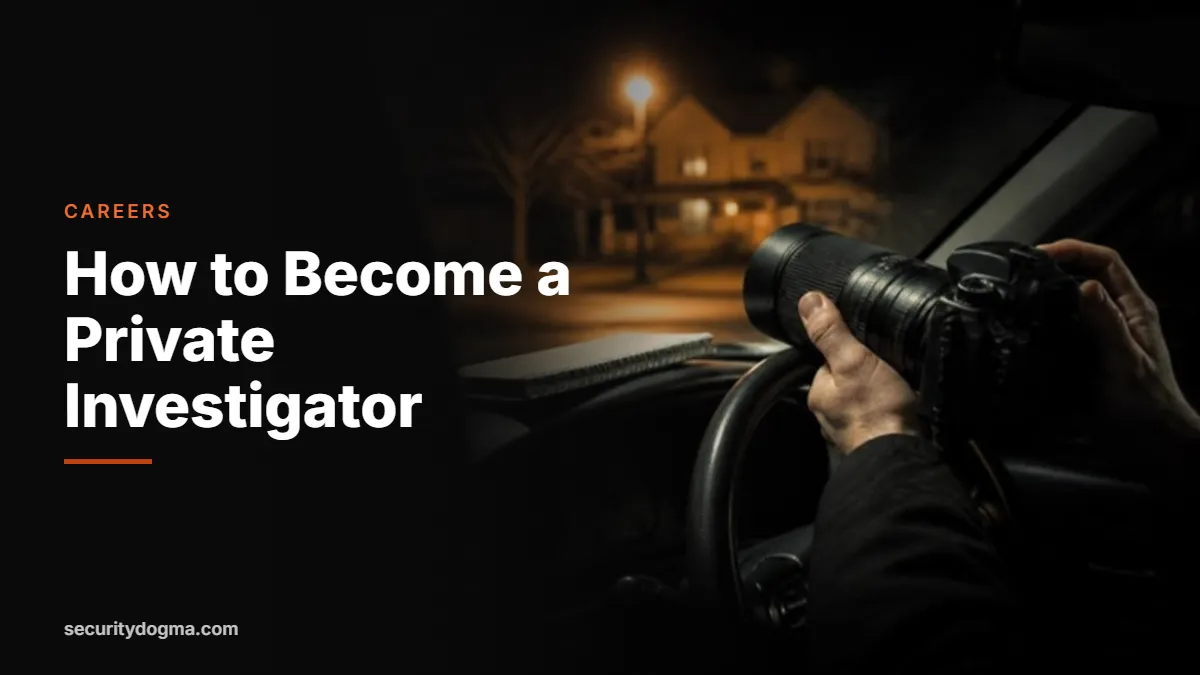
Private investigators find facts that other people can’t, or won’t, find themselves. They follow insurance claimants to see whether an injury is real, locate witnesses for attorneys, check out job applicants, search public records, document infidelity, trace assets and serve as the eyes and ears of businesses and families. The work can be fascinating. It’s also tightly regulated, often lonely, and far more about patience and paperwork than the movies suggest.
Part of our Private Investigators hub. When you are ready to buy gear, start with our PI equipment list: 20 essentials.
This guide explains how to become a private investigator in the United States: what the job involves, what it pays, the licensing rules most states use, the skills and gear you’ll need and the legal lines you can’t cross. For the exact rules where you live, see our private investigator license requirements by state. It’s part of our security careers guide.
From the field — Yair Arad
I owned and ran a private investigation firm, and before that I worked surveillance investigations on insurance workers’ compensation and infidelity cases, wearing hidden cameras.
One lesson from running the firm: always do the background check. I almost hired an investigator, but my check showed he had lied about a DUI. The funny thing is, if he hadn’t lied, I might have hired him. It was the lie, not the DUI, that cost him the job.
Another lesson from the field: write everything down. On one surveillance, the person I was investigating stopped at a house and I didn’t note the house number. At the end of the case I had to drive 45 minutes back just to get it so my report would be complete.
Quick answer
- Licensing: most states require a PI license. Common requirements are age 18 to 25, a clean background, fingerprints, documented investigative experience or an exam, and a bond or insurance.
- Experience: many states require one to three years of investigative experience, often reduced with a related degree. California requires 6,000 hours; New York requires three years.
- Pay: BLS median pay for private detectives and investigators was $51,220 in May 2025.
- Outlook: about 39,500 jobs, growing 5% from 2025 to 2035, faster than average.
- Best first step: get a job that builds qualifying experience, such as insurance investigations, loss prevention or work for a licensed agency.
What private investigators actually do
- Surveillance: watching and documenting a person’s activities, usually for insurance, legal or domestic cases.
- Background checks: verifying identity, employment, education, criminal and civil records.
- Locating people (skip tracing): finding witnesses, heirs, debtors and missing persons.
- Legal support: interviewing witnesses and gathering evidence for attorneys in civil and criminal cases.
- Corporate investigations: employee misconduct, fraud, theft and due diligence.
- Asset searches: finding property and business interests for judgments or divorces.
- Online research: open-source intelligence (OSINT), social media and public records.
According to the U.S. Bureau of Labor Statistics (BLS), the biggest employers of private detectives and investigators are retail trade (34%), administrative and support services (18%), finance and insurance (11%), and government (8%). Many investigators are also self-employed, which the BLS wage figures don’t include.
Private investigator pay and job outlook
The BLS reports about 39,500 private detective and investigator jobs in 2025 and a median pay of $51,220 a year ($24.62 an hour) in May 2025. It projects 5% growth from 2025 to 2035, faster than average, with about 3,200 openings a year. Pay depends heavily on specialty and whether you work for an agency or for yourself: experienced investigators with an established client base, particularly in legal, insurance and corporate work, often charge hourly rates well above employee wages, but they also carry the costs of running a business.
For a full breakdown by state, industry and experience level, see our private investigator salary guide.
How PI licensing works
Each state sets its own rules, and they differ more than security guard rules do. A 2024 comparison prepared for the Nebraska Legislature lists Idaho, Mississippi and South Dakota as having no statewide license requirement, and notes that in Alaska and Wyoming licensing happens at the city level. Everywhere else, you need a state license before you can investigate for hire. Most states use some combination of these requirements:
- Minimum age: usually 18 or 21; New York requires 25.
- Background check: fingerprints and a criminal history review. Some convictions disqualify you; see our criminal record guide.
- Experience: documented investigative work, often for a licensed agency, law enforcement, insurance company or attorney.
- Exam: many states test knowledge of the PI law, privacy rules and investigative practice.
- Bond or insurance: often required for agency owners.
- Training: some states require pre-license or continuing education.
Examples from the biggest states
| State | Key requirements (summary) |
|---|---|
| California | Age 18+; 6,000 hours (three years) of compensated investigative experience, reduced to 4,000 or 5,000 hours with certain degrees; two-hour multiple-choice exam; DOJ and FBI background check. |
| New York | Age 25+; three years of experience (or 20 years as a police officer or fire marshal); exam ($15); $10,000 surety bond; $400 individual license fee. |
| Texas | Investigations company license requires three consecutive years of investigative experience as an employee or owner of an investigations company, or other requirements set by the commission. |
| Florida | Class C license requires two years of full-time investigative or related experience (which can include time as a Class CC intern) and an exam on Chapter 493; Class CC interns need 40 hours of approved training. |
Every detail above is summarized from state sources linked below, and each state has more rules than fit in a table. Use our PI license requirements by state for a full guide to your state.
How to become a private investigator: step by step
- Check your state’s rules. Find out whether you need a license, the minimum age, experience, exam and fees.
- Check your record. Get a copy of your own criminal history and driving record. Be completely honest on every application.
- Build qualifying experience. Common routes are working for a licensed PI agency, insurance claims or special investigations, loss prevention, law enforcement or military police. Some states offer an intern or apprentice license.
- Get education or training. A criminal justice degree can reduce experience requirements in some states, and pre-license courses prepare you for the exam.
- Pass the exam where required, covering your state’s PI law, privacy rules and investigative practice.
- Apply and get fingerprinted. Submit the application, fees and documents to your state regulator.
- Arrange bond or insurance if you’ll run your own agency.
- Choose a niche. Insurance surveillance, legal support, background screening, corporate, domestic or OSINT research.
- Keep learning and renew on time. Many states require renewal every one to three years, some with continuing education.
Skills that make a good investigator
- Patience: surveillance can mean hours of waiting for a few minutes of activity.
- Attention to detail: times, addresses, plate numbers and descriptions make or break a case.
- Report writing: your report is the product the client pays for. Our DAR guide and AI report-writing guide help.
- Research: public records, court files, social media and databases.
- Interviewing: getting people to talk, and listening carefully.
- Discretion and ethics: clients trust you with sensitive matters.
- Camera and technology skills: clear, time-stamped video is often the key evidence.
Legal lines a private investigator cannot cross
A PI license doesn’t give you police powers. In general, private investigators cannot:
- Impersonate police or other government officials.
- Trespass on private property to get evidence.
- Obtain someone’s bank or phone records by lying (pretexting). Federal law, including the Gramm-Leach-Bliley Act and the Telephone Records and Privacy Protection Act of 2006, prohibits this.
- Record conversations they’re not part of, or record without consent where state law requires it.
- Put a GPS tracker on someone else’s vehicle where state law forbids it; California, for example, restricts electronic tracking devices without consent.
- Hack accounts, access email or install spyware.
Rules vary by state, and violations can cost you your license and expose you to criminal charges. When in doubt, ask the attorney you’re working for, or don’t do it.
Gear and books for new investigators
You don’t need a van full of equipment to start. A few quality tools cover most surveillance and research work. Each button shows the current price.
Nikon Coolpix P1000
Superzoom bridge camera · very long optical zoom · video
A long zoom lets you document activity from a lawful distance, which is the core of surveillance work. A favorite category for insurance and domestic surveillance.
Watch out for: Large and heavy; practice holding it steady, and use a monopod for long shots.
See current price →Vortex Diamondback HD 10×42
10x magnification · 42 mm lenses · waterproof
Lets you confirm a subject, read a plate or check activity before you start recording.
Watch out for: Binoculars do not record; pair them with a camera.
See current price →Sony ICD-UX570 voice recorder
One-button recording · time-stamped files
Capture times, addresses and plate numbers in seconds without taking your eyes off the subject. Record your own notes, not other people’s conversations, unless the law allows it.
Watch out for: No transcription built in.
See current price →The Complete Idiot’s Guide to Private Investigating by Steven Kerry Brown
Surveillance · records · running a PI business
An approachable overview of how investigations work, written by a working investigator.
Watch out for: A general U.S. guide; check your state’s law.
See current price →OSINT Techniques by Michael Bazzell
Online research · people searches · open sources
A detailed, regularly updated guide to finding information online, now a core skill for investigators.
Watch out for: Technical, and tools change often; buy the newest edition.
See current price →For long surveillance days, add a power bank, a car charger and a notebook; see our tech gear guide. For recording laws and devices, read our voice recorder guide.
Working for an agency vs. starting your own
Most new investigators start at an established agency. You get steady cases, supervision and, in many states, the documented experience you need for your own license. Starting your own agency means more freedom and higher rates, but also bonding and insurance, marketing, accounting, and the pressure of finding clients. Many investigators work for others for years first, build a specialty and a reputation with a few attorneys or insurers, and then go independent.
If you hire investigators yourself one day, check every applicant carefully. As the story above shows, a background check tells you not only what’s in someone’s past but whether they’re honest about it.
Frequently asked questions
How long does it take to become a private investigator?
It depends on your state. Where experience is required, it often takes one to three years of qualifying work. In states with exam-only or intern routes, you can start sooner, sometimes under a licensed agency.
Do you need a degree to be a PI?
Usually not. Most states accept experience, though a criminal justice or related degree can reduce the experience requirement in some states.
Can a private investigator carry a gun?
Only with the state’s armed permit or license where available, plus any local carry permit. Many investigators work unarmed.
Can a PI track someone’s phone or car?
Not without legal authority or consent in most situations. Many states restrict GPS tracking devices, and accessing phone data without permission can be a crime.
Can I be a PI with a criminal record?
It depends on the offense, how long ago it was and your state’s rules. Felonies and crimes of dishonesty often disqualify applicants. Be honest on your application.
Which states don’t require a PI license?
A 2024 comparison for the Nebraska Legislature lists Idaho, Mississippi and South Dakota as having no statewide requirement, with Alaska and Wyoming licensing at the city level. Check local rules before working.
Sources
- U.S. Bureau of Labor Statistics — Private Detectives and Investigators
- California BSIS — Private Investigator fact sheet
- New York Department of State — Become a private investigator
- Texas Occupations Code § 1702.114
- Florida Association of Licensed Investigators — Class C and CC requirements
- Nebraska Legislature — State comparison of PI licensing (2024)
Verified against the sources above in October 2026. Licensing laws change; confirm with your state regulator before applying.
Legal disclaimer: This page is for general information and education only. It is not legal advice, and reading it does not create an attorney-client relationship. Security Dogma is not a law firm. Laws, licensing rules and court decisions vary by state and change often, and what is written here may not match your situation or be current when you read it. Before you act on anything here, check the official rules from your state licensing agency, follow your employer’s and client site’s policies, and talk to a licensed attorney in your state for legal questions. See our Terms and Conditions and how facts are checked in our Editorial Policy.