
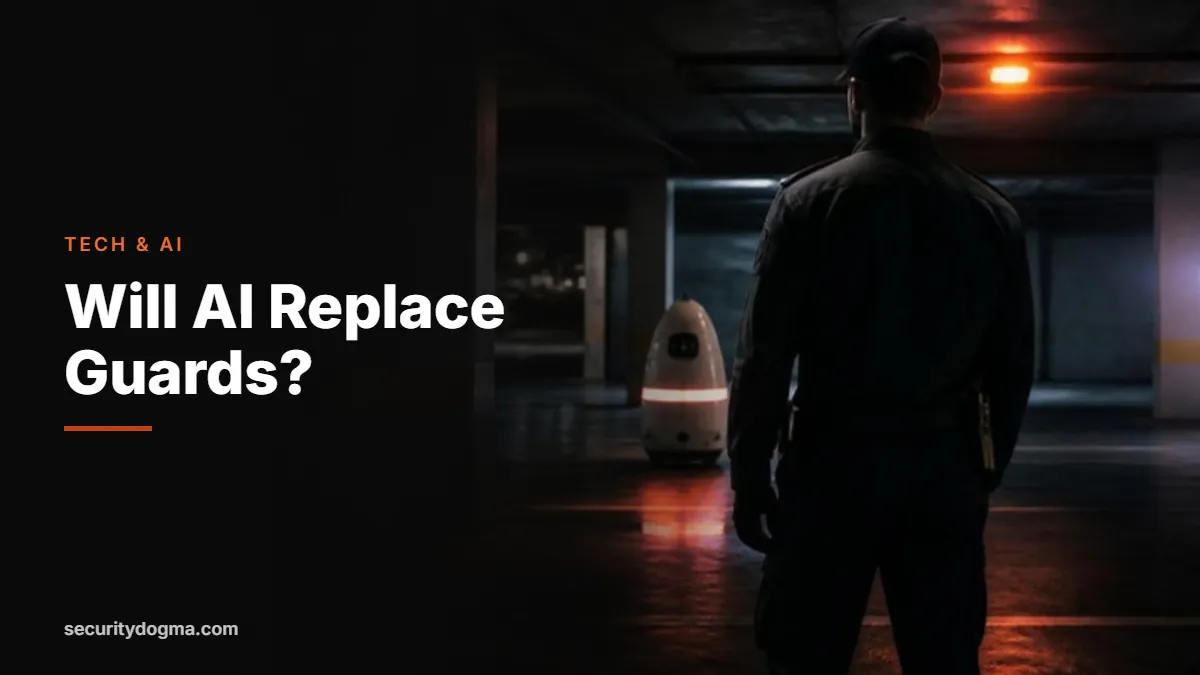

Robots patrolling parking lots. AI cameras that spot intruders before a human does. Monitoring centers watching dozens of sites at once. If you work in security, or you’re thinking about it, it’s fair to ask: will AI and robots replace security guards?
For the career side of this shift, read From Uniforms to Algorithms, and for managers modernizing camera systems, see hybrid corporate security.
The honest answer is no, not in the way the headlines suggest, but the job is changing, and some kinds of security work are shrinking while others grow. This article looks at what the labor data actually says, what machines can and can’t do, which roles are most and least exposed, and how to position yourself on the right side of the change. It’s part of our security guard technology and AI guide.
Quick answer
- Short answer: AI and robots are changing security work, not ending it.
- The data: the BLS projects about 1% growth for security guards from 2025 to 2035, but still about 157,200 openings a year.
- Most exposed: routine watching, such as monitoring screens or walking predictable routes with nothing to do but look.
- Least exposed: judgment, response, customer service, de-escalation and anything that needs a person on scene.
- Best move: learn the systems. Officers who can run cameras, analytics, patrol software and drones are the ones getting promoted.
What the labor data actually says
The U.S. Bureau of Labor Statistics (BLS) is the most reliable source on this question. In its current Occupational Outlook Handbook, it reports about 1.3 million jobs for security guards and gambling surveillance officers in 2025, with a median annual wage of $38,050.
Its projection for 2025 to 2035 is growth of about 1%, slower than average. The BLS gives a reason directly: “an increase in the use of surveillance technologies is expected to somewhat limit demand.” For gambling surveillance officers in particular, it says online gambling and advances in remote monitoring, including AI-integrated cameras, are expected to reduce demand.
But the same profile projects about 157,200 openings every year on average, mostly to replace people who change occupations or leave the workforce. That’s not a dying field. It’s a large, steady field where technology is slowing growth while turnover keeps hiring going.
What AI and robots can do today
- Watch tirelessly. AI video analytics can monitor many cameras at once and flag specific events, such as a person in a closed area or a vehicle in a fire lane, while filtering out many false alarms.
- Cover ground repeatedly. Security robots such as Knightscope’s K5 patrol a route with 360-degree cameras and let staff speak through them.
- Check large areas fast. Drones can inspect a fence line, a roof or a large lot in minutes.
- Record and search. Systems can log every vehicle, badge swipe and door event, and let investigators search hours of video quickly.
- Draft paperwork. AI tools can turn notes or audio into a draft report, with a human checking it.
What they can’t do
The limits matter just as much. A 2022 report on Knightscope’s K5 described a robot of about 400 pounds that tops out at 3 mph. Robots and cameras can detect and record, but they struggle with everything that makes security a people job:
- Judgment. Telling a lost visitor from a thief, a medical emergency from a drunk, or a joke from a threat.
- Physical response. Opening a door, giving first aid, helping in an evacuation or stopping a fight.
- De-escalation. Calming an angry person takes empathy, tone and presence. See our de-escalation guide.
- Customer service. Most of what officers do in lobbies, hospitals and malls is helping people.
- Accountability. Clients, courts and police still want a person who saw what happened and can testify about it.
- Legal authority. Detentions and use of force are decisions the law places on people. See when security guards can detain people.
Which security jobs are most and least exposed?
| Role | Exposure to automation | Why |
|---|---|---|
| Static post watching an empty site overnight | High | Cameras with analytics and remote monitoring can cover this for less |
| Camera operator watching screens with no analytics | High | AI analytics and centralized monitoring reduce the number of operators needed |
| Gambling surveillance | High (per BLS) | Remote monitoring and AI-integrated cameras are expected to reduce demand |
| Lobby, concierge and front-desk security | Low | Customer service, access decisions and visitor management need people |
| Hospital, school and event security | Low | Constant human interaction, de-escalation and emergency response |
| Mobile patrol and alarm response | Low to growing | Remote monitoring creates more verified alarms that need a person to respond |
| Executive protection | Very low | Judgment, relationships and physical presence are the job |
| Loss prevention | Medium | Analytics help find theft, but stops, interviews and cases need people |
| Security supervisors, systems technicians and monitoring-center operators | Growing | Someone has to run, maintain and respond to the technology |
Notice the pattern. The jobs most exposed are the ones where an officer mostly watches. The safest jobs involve people, decisions and response. And new roles appear wherever technology needs someone to run it.
The real shift: from guard to operator
Remote guarding shows where the industry is heading. AI analytics watch the cameras, a monitoring-center operator reviews alerts, talks to people on site through speakers where the system allows it, and sends a mobile officer or police when needed. One site that used to have a static guard now has an analytics system, a share of a remote operator’s time and a patrol officer who responds to verified events.
That doesn’t eliminate people. It changes what they do and what they need to know. The operator needs to read video quickly, use a video management system and communicate clearly. The patrol officer needs to respond safely, document well and work with the monitoring center. The supervisor needs to understand the whole system and explain it to clients.
Security Dogma’s founder, Yair Arad, moved from security work into technology and now works as an IT manager. As he puts it, everything is changing, it’s a kind of digital revolution, and just as he has to keep adapting in his IT role, security officers have to adapt too.
Myths and reality
| Myth | Reality |
|---|---|
| “Robots will patrol every building soon.” | Robots are expensive to operate, slow, limited by stairs, doors and weather, and still need people to respond to what they see. |
| “AI cameras catch everything.” | Analytics reduce false alarms and highlight events, but they miss things, misread scenes and need tuning. A human still verifies. |
| “Remote monitoring means no guards.” | Remote monitoring creates verified alarms that need a mobile officer or police to respond on site. |
| “Technology lowers pay.” | Technology shifts pay toward officers with technical and supervisory skills; routine posts are the ones under price pressure. |
| “Older officers can’t adapt.” | Experience in reading people and situations is exactly what technology lacks. Learning the software is the easier half. |
The pattern in all of these is the same: technology handles the repetitive watching, and people handle meaning, decisions and action. The officers who struggle are the ones who refuse to learn the tools, not the ones the tools replace.
What clients are actually buying
Property managers and corporate security directors increasingly buy a package rather than hours: cameras with analytics, remote monitoring, a patrol schedule, response times and reports. Where a client once bought 168 hours a week of a static guard, it may now buy fewer on-site hours plus technology. The officers kept on those contracts are the ones who make the package work: they respond quickly, write clear reports, keep the patrol system clean and explain what happened when the client calls.
How to future-proof your security career
- Get good at the tech you already use. Master your site’s patrol app, camera system and access control. Volunteer to train new officers on them.
- Write excellent reports. AI can draft, but clear, accurate reports from the person who was there remain valuable. Start with our incident report template and AI report-writing guide.
- Build people skills. De-escalation, customer service and communication are the hardest skills to automate.
- Add a tech credential. An FAA Part 107 drone certificate, a video surveillance or access-control course, or a security certification such as the ASIS PSP. See our tech skills and certifications guide.
- Aim for response, supervision or specialist roles. Mobile patrol, monitoring-center operator, site supervisor, executive protection and loss prevention all use technology without being replaced by it.
- Keep your license current and upgrade it. Armed and specialty licenses open higher-paid posts. Check your state in our license requirements by state guide.
What this means if you’re just starting out
If you’re considering a security career, technology isn’t a reason to stay away. Entry-level jobs remain plentiful because of high turnover, and the path upward is clearer than ever for people who are comfortable with technology. Start with our guide on how to become a security guard, choose posts where you deal with people and systems, and treat every new tool as a skill for your résumé rather than a threat.
Frequently asked questions
Will robots replace security guards?
Not broadly. Robots can patrol and record, but they can’t make judgment calls, help people, de-escalate or respond physically. They’re used as extra sensors that people respond to.
Is security a good career with AI coming?
It can be. The BLS still projects about 157,200 openings a year. The best opportunities go to officers who combine people skills with technical skills.
Which security jobs are disappearing?
Jobs that consist mainly of watching, such as overnight static posts at empty sites and basic camera monitoring, are the most exposed to analytics and remote monitoring.
What tech skills should security guards learn?
Video management systems, access control, patrol and reporting software, report writing with AI assistance and, for some roles, drone operation under FAA Part 107.
Does AI make security guards safer?
It can. Better cameras, faster alerts and reliable communication give officers more information before they respond. The officer still decides how to act.
Sources
- U.S. Bureau of Labor Statistics — Security Guards and Gambling Surveillance Officers
- GovTech — Will crime-fighting robots become part of public safety?
- Security Sales & Integration — AI and analytics in remote guarding
Verified against the sources above in October 2026. Labor projections are updated periodically; check the BLS for the latest figures.
Legal disclaimer: This page is for general information and education only. It is not legal advice, and reading it does not create an attorney-client relationship. Security Dogma is not a law firm. Laws, licensing rules and court decisions vary by state and change often, and what is written here may not match your situation or be current when you read it. Before you act on anything here, check the official rules from your state licensing agency, follow your employer’s and client site’s policies, and talk to a licensed attorney in your state for legal questions. See our Terms and Conditions and how facts are checked in our Editorial Policy.