
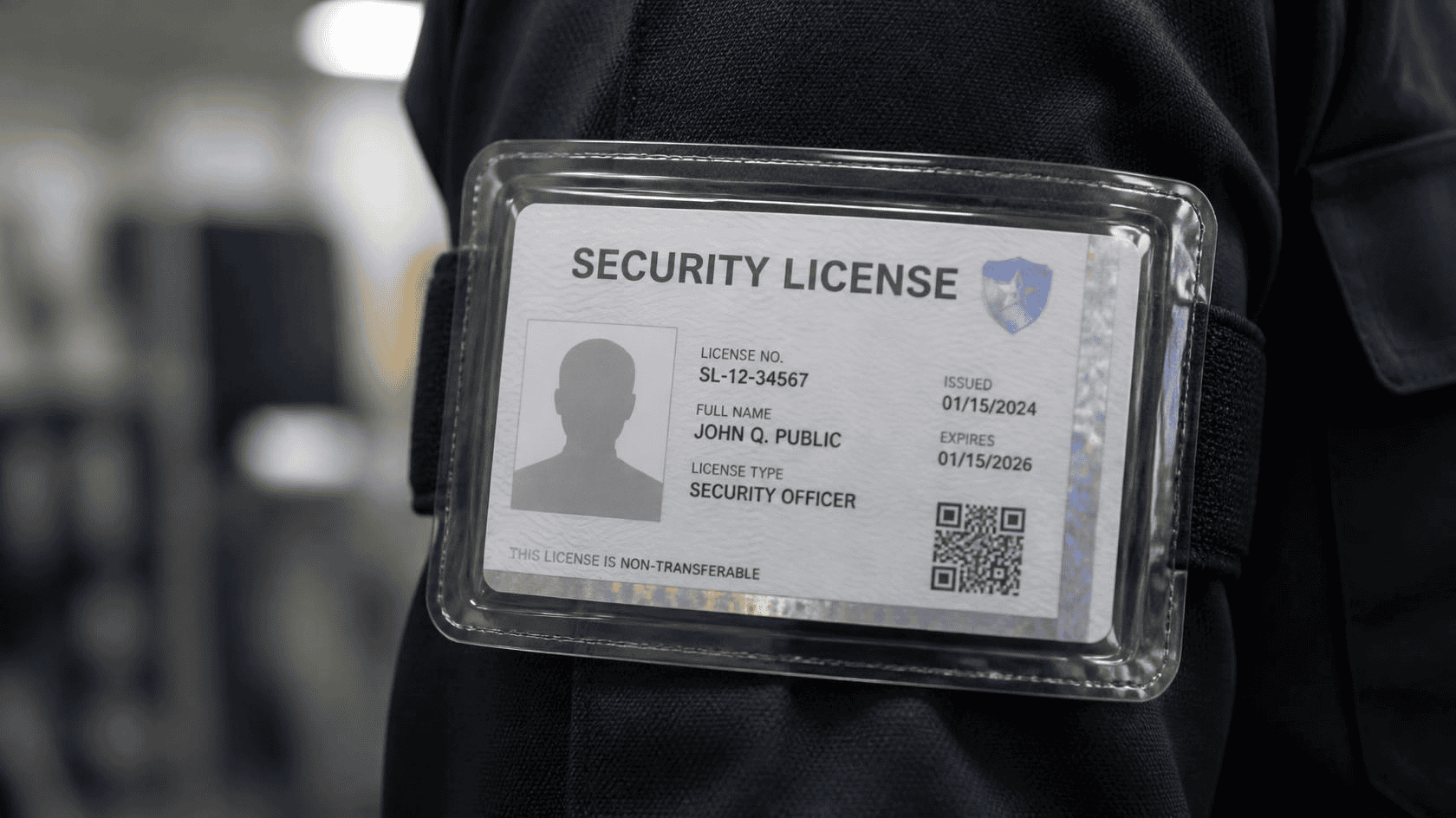

The sight of a security guard is often meant to project immediate order. Whether standing post at a corporate lobby, managing the crowd at a high-end venue, or patrolling an enterprise tech campus, a security professional is expected to signal safety, stability, and control.
At the center of that visual identity is a time-tested symbol: the badge.
For the general public, a metal badge on a uniform instantly signifies authority, accountability, and a point of contact in an emergency. But behind the Hollywood cliché of a shiny 5-point star pinned to a uniform chest lies a complex, highly regulated, and frequently misunderstood operational reality.
Do security guards wear badges? The short answer is: It depends entirely on local jurisdiction, the nature of the industry, and the tactical realities of the specific role.
More importantly, in modern professional security, wearing a badge is not always an advantage. From the legal liabilities of looking like a law enforcement “cop-clone” to the physical dangers of snag hazards in nightlife environments, top-tier security operations are moving away from traditional metal badges altogether.
The “Cop-Clone” Liability: Why Fake Police Badges are Dangerous
One of the most pressing issues in the private security industry is the dangerous line between authorized private protection and public law enforcement impersonation.
In many low-tier security companies, management makes the critical mistake of outfitting guards in gear that deliberately mimics municipal police officers. This includes dark navy tactical utilities, utility belts bristling with unnecessary gear, and heavy metal star-shaped or eagle-topped badges.
This practice creates the “Cop-Clone” liability.
The Legal and Operational Dangers
-
Impersonation Statutes: In many legal jurisdictions, outfitting a private citizen or security guard with insignia, badges, or uniforms that closely resemble active law enforcement is a direct violation of penal codes regarding the impersonation of a police officer.
-
Escalation of Conflict: When the public interacts with a guard who looks indistinguishable from a cop, public expectations change. Civilians expect police-level authority, rights, and temperament. When a security guard attempts to enforce private property rules while looking like a law enforcement officer, interactions rapidly escalate into hostility, accusations of rights violations, and physical resistance.
-
Regulatory Crackdown: Regulatory bodies—such as the Bureau of Security and Investigative Services (BSIS) in California or the Department of Public Safety in Texas—maintain strict uniform and insignia guidelines. They actively penalize security contractors whose badges or patches cross the line into police mimicry.
Professional security organizations do not rely on faux-police aesthetics. They rely on clear, distinct company branding, high-visibility security identification cards, and professional conduct that explicitly establishes their status as private agents protecting specific assets, not municipal enforcers.
When Badges are a Tactical Disadvantage
While statutory regulations in certain states mandate that licensed security personnel wear visible identification, there are specialized sectors where a traditional metal badge is a severe tactical liability.
1. Nightclub Security and Venue Bouncers
Walk into a high-end nightclub or bustling hospitality venue, and you will rarely see professional security personnel wearing heavy metal badges pinned to their chests or dangling from neck lanyards.
There is a straightforward operational reason for this: Physics and safety.
-
The Snag Hazard: In a physical intervention, ejection, or brawl, a metal badge or a neck lanyard functions as a literal handle or a dangerous snag hazard. An aggressive patron can grab a lanyard to choke a guard or use a pinned metal badge to inflict puncture injuries during close-quarters grappling.
-
The Escalation Factor: Nightclub security relies heavily on verbal de-escalation and situational awareness. Flashing heavy, pseudo-police hardware sets an antagonistic, aggressive tone before a conversation even begins.
-
The Uniform Standard: Modern venue security utilizes clean, reinforced plainclothes (such as dark fitted polos or tactical pants) or specialized low-profile outer carrier vests with clear, non-metal, hook-and-loop identifiers that cannot be weaponized against the operator.
2. Executive Protection (EP) and the “Gray Man” Concept
In the world of Close Protection and Executive Protection (EP), the traditional security badge is entirely non-existent.
The core philosophy of executive protection is risk mitigation through discretion—often referred to as operating on the principles of the “Gray Man.” An EP team protecting a high-net-worth individual, a corporate executive, or a visiting dignitary wants to blend into the environment, not advertise their presence to hostile surveillance.
-
Avoiding the Target: If an EP agent wears a prominent badge or tactical identifier, they instantly become the primary target for an adversary looking to neutralize security first.
-
Alternative Identifiers: Instead of a chest badge, EP teams utilize dynamic, highly secure identification methods:
-
The “Pin of the Day”: Small, unassuming lapel pins rotated daily or hourly, recognized only by venue management, local law enforcement liaisons, and advance teams.
-
Encrypted Comms: Continuous radio contact utilizing earpieces and secure digital channels to verify identity and coordinate movements before the principal arrives.
-
Advance Operations: The advance team clears venues and establishes credentials with venue staff long before the principal steps foot inside, eliminating the need for reactive “badge-flashing” at the door.
-
State Mandates and Regulatory Frameworks
Despite tactical preferences, legal realities dictate that many static guard positions must display credentials. Geographic location heavily influences how these rules are applied.
United States
In the U.S., licensing is state-driven, and requirements vary wildly:
-
Texas: Regulated by the Texas Department of Public Safety (DPS), security officers performing duties in uniform are generally required to wear specific company patches and a clear identifier displaying their licensed status.
-
California: Under BSIS guidelines, proprietary and contract security guards must wear a uniform bearing a patch or badge that clearly identifies the employing agency, keeping them distinct from public safety officers.
International Variations
-
Canada: Varies by province. Ontario has stringent provincial standards regarding security guard licensing, uniforms, and visible identification mandates.
-
Germany & Europe: European security standards often emphasize clean, corporate uniforms. In Germany (Securitas and similar private security structures), personnel rely heavily on standardized company identity cards rather than old-west style metal shields.
-
Japan: Regulated strictly under the Security Business Act. Uniforms are standardized, but metal badges are largely absent, replaced by official employer-issued identification cards verified through national compliance frameworks.
The Corporate Evolution: Smart Cards and Access Control
As physical security merges with enterprise IT compliance, the definition of a “security badge” has completely transformed.
In corporate headquarters, data centers, and industrial facilities, the metal shield has been replaced by the Smart Card and RFID Credential. These digital credentials serve a dual purpose:
-
Visual Identification: High-resolution photo ID cards displaying employee or contractor status, clear role designations, and expiration dates.
-
Logical & Physical Access Control: Integrated NFC/RFID chips that grant or deny access to sensitive server rooms, executive floors, and restricted perimeters based on strict access management protocols.
In these environments, wearing an ID lanyard is strictly enforced not just for immediate visual recognition, but to prevent tailgating—the unauthorized following of an authorized person into a secure zone.
Conclusion
Do security guards wear badges? The answer spans a wide spectrum from strict legal mandates in state-regulated static guarding to deliberate tactical avoidance in executive protection and nightlife security.
Understanding whether to display a badge—and what kind of badge to display—separates amateur operations from professional security management. It requires balancing legal compliance, public perception, de-escalation psychology, and absolute operational safety.
Legal disclaimer: This page is for general information and education only. It is not legal advice, and reading it does not create an attorney-client relationship. Security Dogma is not a law firm. Laws, licensing rules and court decisions vary by state and change often, and what is written here may not match your situation or be current when you read it. Before you act on anything here, check the official rules from your state licensing agency, follow your employer’s and client site’s policies, and talk to a licensed attorney in your state for legal questions. See our Terms and Conditions.